⏱ 19 min read
Stop relying on brokerage leads and build your own pipeline
Relying on brokerage leads feels like a massive relief during your first year in real estate. Having a steady stream of prospects handed to you takes the pressure off when you are just starting out. However, you eventually close a few deals and realize a harsh truth. Giving up half of your hard-earned commission check means you are working tirelessly to build an asset that belongs entirely to someone else.
- Agents giving up 50% splits on brokerage leads pay thousands of dollars for contacts they do not own.
- Moving to a new brokerage usually requires leaving your active pipeline and database behind if you rely on company leads.
- 63% of sellers find their agent through a referral or past relationship, making your own sphere more profitable than purchased internet leads.
- Transitioning from house leads to an independent pipeline takes roughly 90 days when you implement consistent follow-up systems.
Why do brokerage leads feel like a trap after your first year?
The deals close, but the bank account does not reflect the hours worked. Brokerage leads trap you by capping your income through high commission splits and shared lead pools. Spending your days working contacts that belong to the company limits your independence and keeps you dependent on the broker to feed your pipeline.
“Agents don’t have a lead problem, they have a follow-up problem,” says Rohan Attravanam, founder of nurtureBEAST. “Your database is a goldmine, yet many agents hire someone else to extract the value.”
Accepting a company lead trades a large portion of your income for convenience. Agents in your own office become your competition for the best opportunities, jumping to claim new prospects as soon as they arrive. An independent agent works the exact same hours, drives the same miles, and hosts the same showings while taking home double the pay. Despite handling the same liability and late-night phone calls, the only difference is the amount of money hitting your checking account on closing day.
What are you actually paying for when a broker hands you a lead?
Looking at your settlement statement reveals thousands of dollars missing. That money pays for the initial connection when a broker hands you a lead. Since they covered the upfront marketing cost to acquire that contact, they get paid back with half of your gross commission when the deal closes.
While the broker sat in a comfortable office, you managed the entire transaction process from the first showing to navigating complex inspection repairs and lender delays.
Let’s break down the math on a $400,000 house with a 3% commission. The total commission is $12,000. On a 50/50 split, you give the broker $6,000 for handing you a name and phone number months ago.
Spending a fraction of that $6,000 on tools to manage your own database costs far less than giving up half your check. A reliable CRM and a solid marketing plan cost a few hundred dollars a month. Generating the lead yourself allows you to keep the entire $12,000.
| Setup | Who pays upfront | Split on a $12k commission | Who owns the database |
|---|---|---|---|
| Brokerage Leads | The Broker | You keep $6,000 | The Broker |
| Your Own Pipeline | You (System costs) | You keep $12,000 | You |
The numbers prove you overpay for that initial introduction. You can learn the true cost when you stop renting real estate leads. Every deal closed from a company lead funds the broker’s marketing budget instead of your own business.
Why does relying on company leads make it hard to switch brokerages?
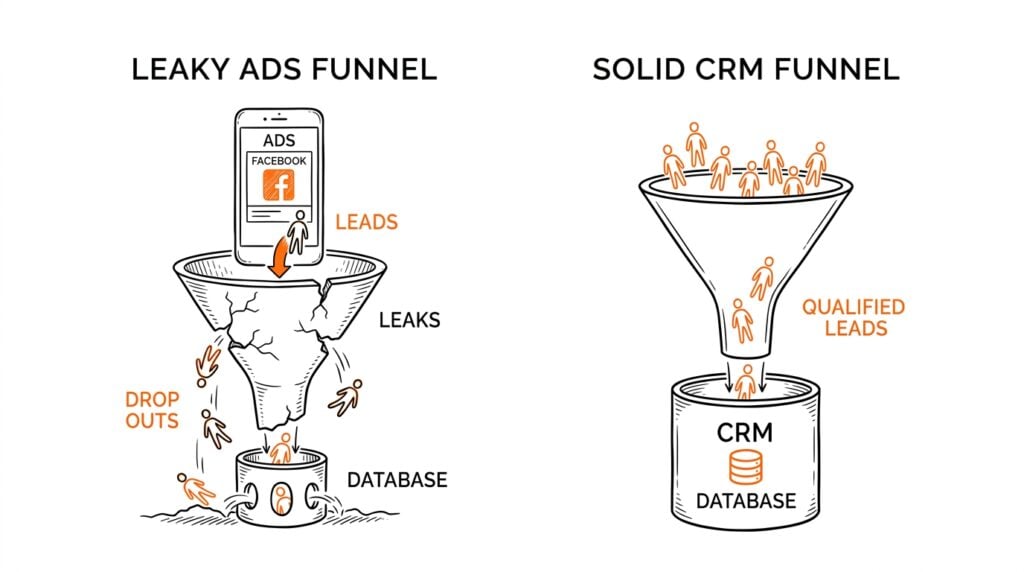
Many agents stay at a brokerage they dislike because they fear losing their pipeline. Relying on company leads makes it hard to switch brokerages because leaving means walking away from your entire database. The broker owns both the CRM and the leads, leaving you empty-handed on your way out the door.
Wanting to leave a bad situation often clashes with the golden handcuffs keeping agents locked to a desk. Because the broker buys the leads and controls the data, the office manager will disable your login to the company CRM the day you hand in your license. Access to the buyer who wanted to wait until spring vanishes, and the seller who needs to downsize next year disappears from your pipeline.
Starting your career from scratch at a new firm means having no past clients to call and zero pipeline to work. Years of relationship building are left on the table. This lack of ownership keeps agents paralyzed, accepting lower splits simply because they refuse to build an asset they control.
How do you start building a database that belongs to you?
Instead of leaving names scattered across your phone and random spreadsheets, start building your own database by moving every contact you know into a CRM you pay for and control. Capturing leads from open houses, organizing them by relationship, and storing them securely outside of your broker’s system creates a solid foundation.
Database setup does not require complex tech. A system just needs to hold names, emails, phone numbers, and notes. Having a place to log conversations and schedule follow-up tasks without fighting clumsy software is the main priority.
Export your phone contacts and add past clients into the new system, including friends and family members. Putting everyone you know into a single owned location means you control the relationship moving forward. If you decide to change brokers, the database comes with you as a fully owned asset. Since the value of your business sits inside that list of names, implementing good real estate database management makes this step painless.
What type of simple content keeps your sphere active?
Sitting down to write an email every week often gets pushed to the bottom of the to-do list. However, basic content like weekly market updates and community newsletters keeps your sphere active. Sending consistent, valuable information keeps you top of mind without requiring expensive ad spend.
Skip writing long essays. Contacts prefer knowing what houses sell for in their neighborhood, whether interest rates changed, and how those shifts impact their mortgage. Providing practical, immediately useful information is the key to engagement.
Sending a short email on Friday mornings that shares one local event happening this weekend works perfectly. Including a quick observation about the current market and a link to a new listing only takes fifteen minutes to put together.
Consistent emails build trust. NAR data shows that 89% of buyers would use their agent again, but they will forget your name if you do not stay in touch. A weekly email solves this problem and positions you as the local expert. Fortunately, a basic real estate follow-up system handles this task for you.
{{LEAD_MAGNET_BOX}}
How can your assistant or VA handle the setup without extra stress?
Delegating tasks to a virtual assistant sometimes feels like it takes more time than doing it yourself. However, your assistant can manage the setup without stress when equipped with automated nurture tools. AI makes your human team more effective by handling the repetitive follow-up tasks.
Providing better tools allows your VA to load new contacts into a sequence that sends text messages and emails for the next twelve months. The system handles the heavy lifting while your human team provides necessary oversight.
While the software nurtures the leads, your assistant manages the system. The AI handles the initial outreach, your VA monitors the replies, and you jump in when a prospect raises their hand to look at houses.
Automated systems give your team time back, allowing them to focus on tasks that require human judgment while you focus on appointments and contracts. Teaching them how to automate real estate follow-up ensures they never have to touch every message manually.
How long does it take to replace broker leads with your own system?
Worrying that turning off broker leads will cut your income to zero is a common fear. Replacing those leads with your own system takes roughly 90 days, giving you a proper window to consolidate contacts, start a weekly newsletter, and run your first active follow-up sequence.
Building an independent system in the background while working your current pipeline allows for a gradual transition. Phasing out the old method over time removes the financial panic of starting a new lead generation strategy.
Your first 30 days should center on organizing your contacts, getting everyone into your CRM, and sending an initial message. During the second month, focus on consistency by delivering weekly updates and calling past clients to check in. By the third month, momentum builds as the people you previously contacted start reaching out with questions about the market.
By day 90, a functional machine runs in the background. Generating your own conversations means you control the deals, keep the entire commission, and leave the heavy splits behind forever.
Frequently asked questions
Should new agents start by using brokerage leads?
Many new agents find success starting with brokerage leads to build their initial experience and get comfortable closing deals. However, it is crucial to start building an independent database simultaneously to avoid getting trapped by high commission splits later. Transitioning away from company leads within the first two years keeps your long-term income potential uncapped.
What is the best CRM for transitioning away from company leads?
The best CRM is one you actually use and fully control yourself. Look for platforms that offer simple contact management, automated follow-up sequences, and easy connections to your email provider. Avoid overly complex systems that require an IT degree to operate, as that friction will prevent you from consistently reaching out to your sphere.
Will my broker be upset if I stop taking company leads?
Brokers generally prefer agents who close deals, regardless of where the prospect originated. While they may miss out on the 50% split from their company-generated leads, they still earn their standard split on the transactions you bring to the table. Communicating your shift toward a self-generated pipeline usually earns respect, as it shows you are building a sustainable business.
Related reading
- Stop Renting Real Estate Leads: 4 Hidden Costs to Know – Explores the hidden financial impact of buying leads instead of building a database.
- Real Estate Database Management: 4 Must-Have Pieces – Details the exact components you need to manage your contacts effectively.
- Automate Real Estate Follow-Up: 3 Tracks to Build First – Shows you which follow-up sequences to prioritize when you set up your CRM.
The Bottom Line
Relying on brokerage leads feels safe until realizing that effort is building someone else’s business. Every 50% split paid out is money that could fund your own marketing and software. Refusing to build an independent database ultimately limits your income and ties you to a single broker.
Taking ownership of your contacts changes the math of a real estate business completely. Keeping your full commission, controlling your schedule, and owning an asset that moves with you provides ultimate freedom. The fastest way out of the split trap is simply to start nurturing the people you already know.
If you want to see how nurtureBEAST handles building your own pipeline – take the quiz to find out what’s killing your real estate business or visit nurturebeast.com.