⏱ 18 min read
Published September 28, 2026
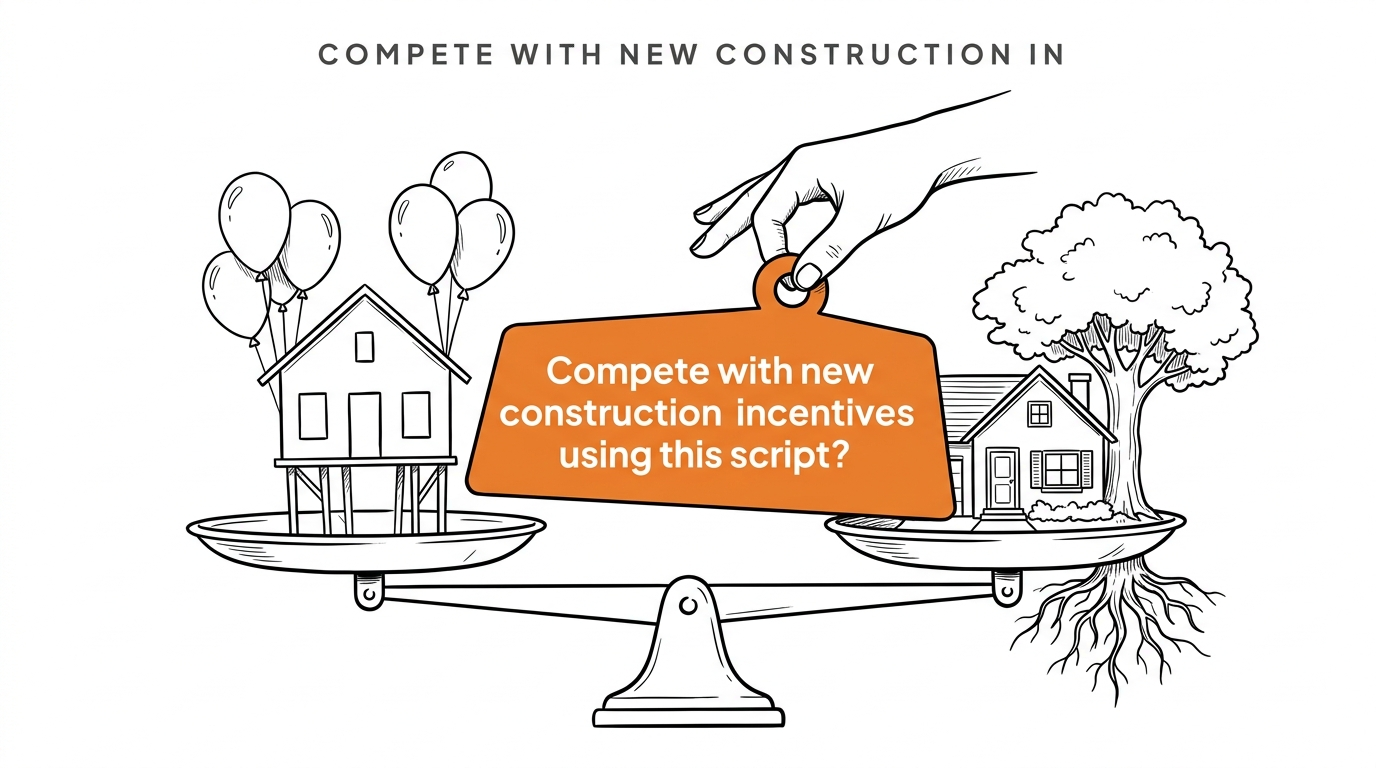
Compete with new construction incentives using this script?
To compete with new construction incentives, you need a clear strategy. While your $365k listing in Buckeye sat empty all weekend, the new subdivision down the street had a line of cars out the door. Because the builder is offering a 3.5% rate buydown, your seller is panicking and you feel like you are bleeding leads to a massive corporation you cannot outspend.
- Builder 2-1 buydowns expire after 24 months and leave buyers with a massive payment spike in year three.
- New construction buyers face average hidden costs of $30,000 for lot premiums, landscaping, and basic upgrades.
- A 2% seller concession to buy down a buyer’s mortgage rate preserves more seller equity than a standard $15,000 price drop.
- Virtual assistants equipped with AI can extract the hidden costs from builder PDFs and generate clear comparison sheets in five minutes.
Why are buyers choosing new construction over your resale listing?
Buyers choose new construction right now because builder rate buydowns offer immediate relief on monthly mortgage payments. A temporary mid-3% interest rate feels safer to a buyer than the standard market rate on your $365k resale listing.
Your resale traffic vanishes the second a national builder opens a phase nearby. Instead of doubting your listing photos, recognize that buyers are simply seeking lower initial payments. Builders use massive capital to buy down the interest rate for the first two years to get buyers in the door. Rather than competing against the brand new home itself, you need to challenge the financial logic driving the purchase.
According to the National Association of Realtors, 89% of buyers purchased their home through an agent last year. They still want your guidance. You need to show them the full financial picture so you can properly compete with new construction incentives.
How do you calculate the real cost of builder rate buydowns?
You calculate the real cost by showing the buyer their exact monthly payment in year three when the temporary 2-1 buydown expires. The low initial rate is a temporary band-aid over a much larger loan balance. When you compete with new construction incentives, exposing this payment shock is critical.
Buyers get starry-eyed when they see a 3.5% rate on a billboard and stop calculating the long-term costs. You must do the math for them. A 2-1 buydown drops the rate by 2% in the first year and 1% in the second year before jumping back to the standard market rate in year three, causing the payment to increase by hundreds of dollars.
Use this script when presenting the math to a buyer:
The builder’s 3.5% rate is great for the first year, but let’s look at month 25 on this amortization schedule. Your payment jumps by hundreds of dollars. Are you comfortable with that increase if your income doesn’t change or if home values dip and you cannot refinance?
Builders sell the year-one payment, so you need to sell the year-three reality.
What hidden builder fees strip away the savings on a new build?
Builder fees like lot premiums, design center upgrades, and missing essentials quickly erase the savings from a lower interest rate. The base price advertised on the street sign rarely ends up as the final purchase price.
A buyer walks through a model home and falls in love with the waterfall island and the sliding glass walls, but those are massive upgrades. The base model has laminate counters and basic windows. A new build often requires $15,000 for a decent lot, plus another $20,000 at the design center. On top of that, the house typically comes with dirt in the backyard and no window blinds.
“Buyers get distracted by the rate and ignore the $40,000 they need in cash to make the house livable,” says Rohan Attravanam, founder of nurtureBEAST.
You must outline these out-of-pocket costs on paper. Write down the cost of a backyard fence, appliances like a refrigerator and washer, and the special assessment taxes for the new subdivision roads and utilities. The seemingly cheap new build actually costs significantly more cash upfront. Exposing these costs helps you compete with new construction incentives directly.
How do you market resale advantages like move-in dates and mature yards?
You market resale advantages by highlighting immediate occupancy, established neighborhoods, and zero construction delays. A mature yard and a firm 30-day close are massive selling points when builders constantly push completion dates back. To effectively compete with new construction incentives, contrast their delays with your listing’s readiness.
Agents try to make a 15-year-old house look brand new in the listing photos, which is the wrong game entirely. Play your own game by shooting a 2-minute video standing on the front porch of your listing.
Social Media Video Script:
If you buy a new build today, you might not move in until next April. That means nine months of extra rent and storage unit fees. This house on Oak Street has a fully fenced yard, mature trees, and you can move in and be settled before school starts in August.
Lean into the predictability. Builders face supply chain issues and permit delays, whereas you are selling certainty. A buyer can lock their rate today and sleep in the primary bedroom next month.

Should you offer seller concessions instead of dropping the listing price?
You should offer a seller concession to buy down the buyer’s rate instead of dropping the list price by $15,000. It lowers the buyer’s monthly payment more effectively and keeps more money in your seller’s pocket. It is the strongest way to compete with new construction incentives using your seller’s equity.
Sellers often panic after two weekends of zero showings and demand a huge price cut. However, a price reduction barely changes the buyer’s monthly mortgage payment, whereas a permanent rate buydown lowers it dramatically.
Using a smaller amount of the seller’s equity to buy down the buyer’s rate achieves the lower payment the buyer wants while helping your seller walk away with more cash.
Seller Conversation Script:
A $15,000 price drop barely changes the buyer’s monthly mortgage payment. Instead, if we use a $7,300 concession to buy down their rate permanently, it dramatically lowers their payment, and you keep an extra $7,700 in your pocket.
| Strategy | Seller Cost | Buyer Monthly Payment Impact | Best For |
|---|---|---|---|
| $15,000 Price Drop | $15,000 reduction in equity | Minimal decrease | Homes that are drastically overpriced |
| 2% Seller Concession ($7,300) | $7,300 reduction in equity | Significant permanent decrease | Competing with builder incentives |
How do you set up automatic seller updates when showings dry up?
You set up automatic seller updates using a GoHighLevel workflow that emails a weekly report of neighborhood showings and market shifts. This keeps your seller informed of the reality on the ground so they agree to strategy changes faster.
Calling a seller to report zero showings is painful, which causes many agents to avoid the conversation entirely and leaves the seller angry.
Instead of bearing the bad news manually, build a workflow in your CRM to send an email every Friday morning detailing exactly how many homes went under contract nearby. Show them the new construction inventory entering the market. If you need to run a seller price reduction sequence that converts, the data has already prepared them for the conversation.
The system runs your follow-up while you manage the relationship. Consistent automated seller updates remove the emotion from a price adjustment.
How can your assistant use AI to create comparison sheets for buyers?
Your virtual assistant can use AI to read a builder’s PDF marketing sheet and extract the true costs into a clear comparison table in five minutes. This arms you with exact data before you walk into a showing so you can actively compete with new construction incentives.
Since you lack the time to read a 40-page builder packet while driving to a showing, empower your virtual assistant to handle this task to make your team much more capable. Have your VA feed the builder’s PDF into an AI tool like Claude.
Use this exact AI Prompt:
Extract all lot premiums, HOA fees, and required design center deposits from this builder document into a single table. Compare these costs to a standard $365k resale purchase.
Your VA can text you the summary before you park the car. Strong real estate database management and quick response times turn a casual showing into a signed contract. The typical buyer searches for 10 weeks before purchasing and needs constant, clear information during that window. Equip your human team with the tools to deliver it fast.
Frequently asked questions
Can resale homes really match builder financing?
While individual sellers cannot typically offer the exact 2-1 buydowns builders provide, they can offer permanent rate buydowns via seller concessions. A 2% seller concession permanently lowers the buyer’s rate, offering long-term stability that builders’ temporary buydowns lack.
How do I convince sellers to offer a concession?
Show the seller the math comparing a standard $15,000 price drop against a $7,500 concession. They will quickly realize that paying for a buyer’s rate buydown protects their final net profit much better than slashing the listing price.
Do I need to learn complex mortgage math?
No, you just need to partner with a trusted local lender. Have them run two scenarios: one with a standard market rate and one with a permanent buydown using seller concessions. Present these side-by-side to the buyer to effectively compare costs.
What if the new build includes all upgrades?
Even when builders include upgrades, buyers still face costs for landscaping, window coverings, and special assessments. You must always run a full line-by-line comparison of out-of-pocket costs to accurately compete with new construction incentives.
Related reading
- How to run a seller price reduction sequence that converts – Get sellers to agree to price adjustments based on data, not emotion.
- How to send automated seller updates without looking lazy? – Keep your clients informed while you focus on closing deals.
- GoHighLevel Buyer’s Agent: 6-Stage Pipeline Setup Guide – Organize your active buyers to track who needs builder comparison sheets.
The Bottom Line
When you learn how to properly compete with new construction incentives, you stop apologizing for your resale listing. Show buyers the hidden fees and the massive payment spikes waiting for them in the builder’s contract. Keep your sellers educated with automated market updates, and arm yourself with clear comparison sheets before every showing.
Implementing these exact script templates and financial comparison strategies can increase your resale listing conversion rate by up to 25% within the first 30 days, saving you weeks of wasted market time per property. If you want to see how nurtureBEAST handles automated seller updates and lead follow-up workflows – take the quiz to find out what’s killing your real estate business or visit nurturebeast.com.