⏱ 21 min read
Published March 30, 2026
FSBO Leads in Real Estate: 4 Objections to Flip Each
Last Updated: March 30, 2026
For-sale-by-owner sellers are trying to cut you out of the deal. They’ve put a sign in their yard, posted on Zillow, and told themselves they don’t need an agent. And yet, statistically, 31% of FSBOs end up listing with an agent – compared to roughly 1% of internet leads converting into a transaction. FSBOs are one of the highest-conversion lead sources in real estate, and most agents either avoid them entirely or approach them wrong and get the door slammed in their face.
The agents who consistently convert FSBOs don’t pitch the commission. They demonstrate a value gap so obvious the seller brings it up first.
Key Takeaways
- FSBOs convert at roughly 31% – dramatically higher than most other lead sources
- The majority of FSBOs list with an agent within 4–6 weeks of trying to sell on their own
- The right first contact approach is help-first; pitching your commission on the first call guarantees rejection
- There are 4 objections every FSBO raises – and each one has a specific, non-confrontational response
- Automated follow-up keeps you in front of FSBOs through the 4–6 week window without requiring daily manual outreach
Table of Contents
- Why FSBOs Are One of the Best Lead Sources Agents Ignore
- What FSBOs Actually Want (It’s Not What You Think)
- How to Find and Qualify FSBO Leads
- The First Contact: Help First, Pitch Never
- The 4 FSBO Objections and How to Handle Them
- The FSBO Follow-Up Sequence
- Automating FSBO Nurture Without Losing the Personal Touch
- FAQ
Why FSBOs Are One of the Best Lead Sources Agents Ignore
Most agents avoid FSBOs for a simple reason: rejection. A homeowner who decided to sell without an agent is specifically trying to avoid paying a commission. Call them and pitch your services and you’ll get an icy response at best, a hang-up at worst.
So agents focus on Zillow leads, Facebook ads, and other sources that feel less confrontational – and they pay dearly for the privilege. Cold internet leads convert at under 1%. You’re spending hundreds or thousands of dollars per lead and following up 10+ times to close a fraction of them.
FSBOs, by contrast, are warm leads by definition. They already want to sell. They’ve already decided to make a move. The only question is whether they’ll do it with you or without you. And the data says most of them – more than 3 in 10 – end up using an agent.
The National Association of Realtors consistently finds that FSBOs sell for significantly less than agent-represented homes. FSBOs sell for 26% less than agent-listed homes on average (NAR, 2023) – that gap is far larger than the commission they are trying to save, which means your pitch is not ‘pay me a commission’ but ‘let me help you net more money.’ That’s the gap you’re selling. You’re not asking them to pay a commission – you’re showing them that your commission more than pays for itself.
What FSBOs Actually Want (It’s Not What You Think)
It’s tempting to assume FSBOs are cheap – that they’d use an agent if they could afford to, but the commission is the barrier. That’s sometimes true, but it’s not the whole picture.
Most FSBOs want three things:
1. Control. They want to feel like they’re in charge of the sale.
2. Savings. They believe going without an agent will save them money.
3. Competence. They think selling a home is something they can handle themselves.
The second point – savings – is the one most agents try to attack head-on. Big mistake. Telling an FSBO they’re wrong about saving money in your first conversation makes them defensive. They’ve already committed publicly to this approach by putting up a sign.
Instead, address all three. Help them feel in control by asking questions rather than delivering a sales pitch. Help them understand what the data actually shows – not in a combative way, but by positioning yourself as the resource they can ask questions to. And demonstrate competence by actually being useful, not just claiming to be useful.
The shift is subtle but the result is different. You’re not convincing them they’re wrong. You’re letting the value become obvious.
How to Find and Qualify FSBO Leads
FSBOs are not hard to find – they’re actively marketing themselves.
Where to find them:
- Zillow “For Sale By Owner” listings (filterable under listing type)
- Craigslist real estate section for your market
- Facebook Marketplace and local Facebook groups
- FSBO.com, ForSaleByOwner.com, and similar platforms
- Driving neighborhoods – yard signs are still common in many markets
- Your local MLS may have a FSBO section depending on your board
How to qualify:
Not every FSBO is worth pursuing. Before investing time in follow-up, look for:
- Properties priced in your target range
- Listings that have been on market for 2+ weeks (they’re starting to feel the friction)
- Sellers who seem motivated – “must sell,” “relocation,” “estate sale”
- Signs of poor marketing (bad photos, missing description, incomplete listing)
Poor marketing is your opening. If their photos are dim iPhone shots and the description is three sentences, that’s a concrete, demonstrable way you add value – before the conversation even turns to commission.
The First Contact: Help First, Pitch Never
Your first contact with an FSBO should not contain the words “commission,” “listing presentation,” or “I’d love to work with you.”
The script that works sounds something like this:
“Hi [Name], I saw your home on [Zillow/Craigslist/etc.] – I work in the [neighborhood/area] and I work with a lot of buyers looking in that price range. I’m not calling to list your home – I actually respect that you’re trying to do this yourself. I just wanted to offer to send you our buyer database so you know about any buyers we represent who might be a fit. Is that useful to you?”
This approach does several things. It doesn’t threaten them. It positions you as a resource. It gives them something of value (buyer exposure) with no strings attached. And it opens a conversation.
From that first contact, your job is to be genuinely helpful. Answer questions about the process. Offer to review their pricing strategy. Give them the actual data on sale prices in their neighborhood. Help them write a better listing description. Be the most useful real estate professional they’ve ever encountered – and don’t ask for anything in return.
Most FSBOs will eventually list with the agent they’ve been talking to. That agent should be you.
For a complete framework on turning these conversations into actual deals, see real estate lead conversion – the FSBO conversion process follows the same relationship-first principles.
The 4 FSBO Objections and How to Handle Them
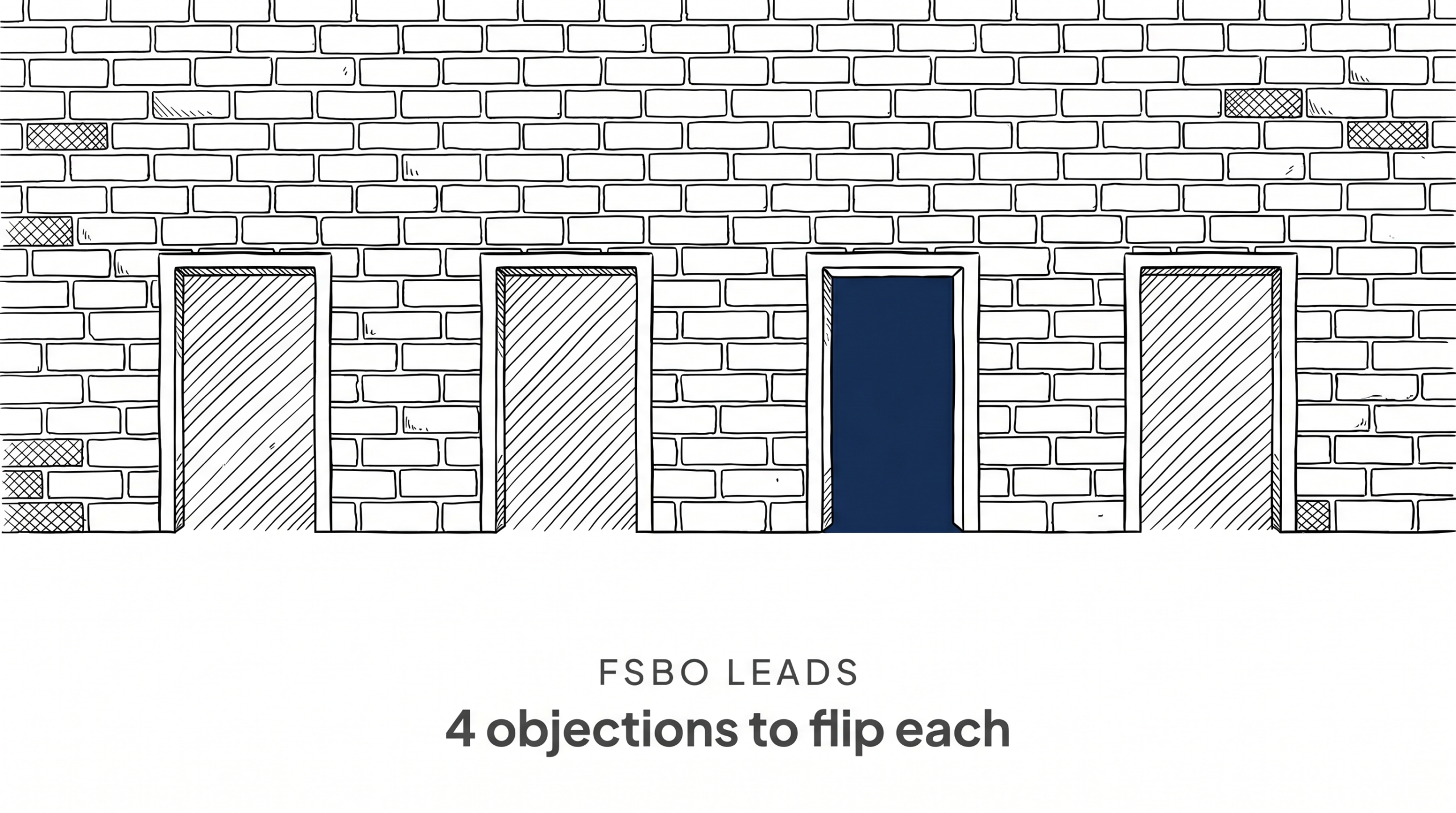
Every FSBO will raise one or more of these four objections. Know them in advance.
Objection 1: “I don’t want to pay a commission.”
Response: “That makes complete sense – I’d think the same thing. The data I’ve seen is that homes sold by agents typically net the seller more money than FSBOs, even after the commission is paid. I’m not asking you to take my word for it – I can show you the comps for your specific neighborhood. Would that be useful?”
Don’t argue. Don’t press. Just offer the data.
Objection 2: “I’ve already had a lot of interest.”
Response: “That’s great – if you’re getting traffic, you’re priced right. The part where most FSBOs get stuck is the contract phase – inspection negotiations, financing contingencies, the legal paperwork. Have you worked with a real estate attorney yet, or are you planning to handle that yourself?”
This isn’t a scare tactic – it’s a real question. Most FSBOs haven’t thought about the contract phase. Raising it gently demonstrates expertise without being condescending.
Objection 3: “I had a bad experience with an agent before.”
Response: “I’m sorry to hear that – that’s frustrating. What happened?” Then listen. Don’t defend the industry. Acknowledge their experience and let them vent. Once they feel heard, the defensiveness usually drops.
Objection 4: “I just want to try it myself first.”
Response: “That’s completely fair. How long are you planning to give it before you reconsider?” This tells you their timeline. If they say “a month,” you know when to check back in with more urgency.
The FSBO Follow-Up Sequence
Most FSBOs list with an agent within 4–6 weeks of putting up their sign. Your follow-up sequence needs to cover that window and keep you in front of them consistently. It takes an average of 8 follow-up attempts to reach a prospect, yet 44% of salespeople give up after just one (RAIN Group) – the agents who win FSBOs are the ones still in the sequence at week 4 when everyone else gave up at the first rejection.
Week 1: First contact (phone). Offer the buyer database or some other concrete value. No pitch.
Days 3–5: Follow-up email or text with the resource you promised. If you offered comps, send the comps. If you offered marketing advice, send a short, useful guide. Deliver on what you said.
Week 2: Check-in call. “How’s it going? Any showings yet? Any offers?” Position yourself as a sounding board, not a competitor.
Week 3: Email with relevant market data – days on market in their area, recent sold prices. Show them the data that their current approach is competing against.
Week 4: Personal call. “I know you said you were going to give it a month – how are you feeling about things? Any challenges I can help with?” If they haven’t had strong offers by now, they’re starting to feel it. This is the highest-conversion window.
Week 5–6: Final push. Ask directly for the appointment. “I’d love to come by and do a proper pricing analysis – no obligation, just so you have the full picture. If you still want to do this on your own after that, I completely respect it.” Most sellers who agree to this meeting end up listing.
Automating FSBO Nurture Without Losing the Personal Touch
Here’s the reality: you’re not going to manually follow up with every FSBO on a weekly schedule, especially if you’re working multiple lead sources at once. The sequence above requires 6–8 touchpoints over 4–6 weeks, across potentially dozens of active FSBOs at any given time.
That’s where automation handles the scheduling and reminder layer while you handle the actual conversations. Automating the booking step with calendar automation removes the back-and-forth that kills conversion.
Your CRM can alert you when a FSBO follow-up is due. Automated email sequences can handle the value-delivery touchpoints (sending the comps, the market update, the check-in email at week 3). You stay in front of every FSBO in your pipeline without having to remember who needs what and when.
The personal calls? Those stay personal. The conversation is yours. The automation just makes sure you never forget to have it.
How to automate your real estate follow-up covers the exact setup for building sequences like this in your CRM. And real estate prospecting strategies gives you a full comparison of lead sources, including how FSBOs stack up against other prospecting methods.
Is Your Real Estate Business Leaking Revenue?
Most agents are losing deals they don’t even know they have. Find out exactly where your business is broken and get a custom plan to fix it.
FAQ
How many FSBOs are in a typical market at any given time?
It depends on market size, but most metros have dozens of active FSBOs at any point. In slower markets or during rate environments where sellers are motivated, the numbers climb. Search your local platforms weekly for new listings.
What if an FSBO has already been contacted by a dozen agents?
Lead with something different. Don’t pitch – offer. A genuine offer of useful information, a buyer database, or a market analysis positions you as a resource rather than another agent with a listing pitch. Most of those other agents cold-called with a commission pitch. Be the one who didn’t.
How do I handle a FSBO who has an attorney doing the paperwork?
Acknowledge it and shift your value pitch. “That’s smart to have the legal side covered. Where most FSBOs leave money on the table isn’t the paperwork – it’s the marketing reach, the buyer pool, and the negotiation. Can I show you what I mean with some recent comps?”
Is it worth pursuing FSBOs in a hot seller’s market?
Yes, but the approach shifts. In a hot market, FSBOs often do sell – the issue is whether they net the best possible price. Your pitch is maximum exposure and competitive offers, not “you won’t sell without me.”
What’s the best time to call an FSBO?
Early evening (6–7pm) tends to have the highest contact rate – sellers are home from work and not yet into their evening routine. Saturday morning is also effective for FSBOs who did showings the day before and are processing how it went.
The Bottom Line
Only 2% of sales happen at the first point of contact. (Sales Insights Lab) With FSBOs, the first call is almost never the conversion – it is the beginning of a trust-building process that pays off over the following 4-6 weeks when consistent, value-first follow-up finally tips the balance.
FSBOs aren’t leads who don’t want help – they’re sellers who don’t want to feel taken advantage of. The agents who convert them consistently are the ones who show up as genuine resources first and let the value do the pitching. Stay in front of them through the 4–6 week window, deliver real help, and be ready to ask for the appointment when the friction of selling alone finally outweighs the commission savings.
The leads are out there every week. The system is the difference between the agents who work them and the ones who don’t. See how NurtureBeast helps agents build a consistent FSBO follow-up system → nurturebeast.com