⏱ 19 min read
Published March 30, 2026
Real Estate Lead Conversion: 5 Reasons Good Leads Cool
Last Updated: March 30, 2026
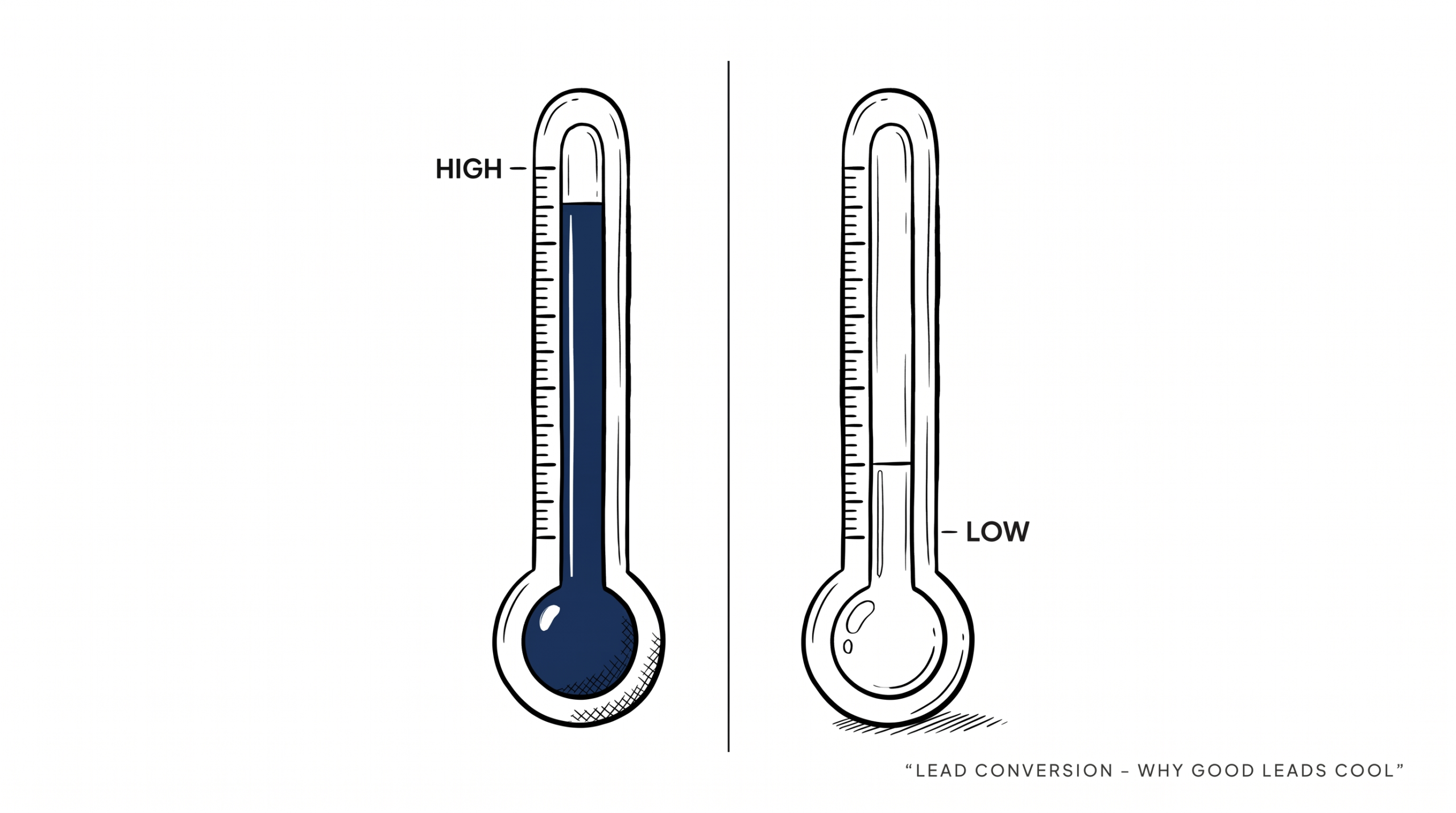
When leads stop converting, most agents blame the source. “Zillow leads are garbage.” “Internet leads never close.” “These people aren’t serious.” Sometimes that’s true. More often, the leads were fine – and what killed them was the follow-up. Too slow, too sparse, wrong channel, no value delivered. The lead didn’t go cold. The agent let it go cold.
If your lead conversion rate is lower than you’d like, the problem is almost certainly in your process, not your leads.
Key Takeaways
- Speed to lead is the single biggest conversion lever – response time within 5 minutes vs. 30 minutes can cut conversion rates in half
- The average lead requires 8–12 follow-up attempts before converting; most agents quit after 1–2
- Most leads convert in 3–18 months, not days – agents who only chase hot leads miss the bulk of their pipeline
- Value-based follow-up (market data, insights, answers) converts better than pitch-based follow-up
- Channel mix matters: some leads respond to calls, others to texts, others to email – use all three
Table of Contents
- The Lead Quality Myth
- The 5 Real Reasons Leads Go Cold
- Reason 1: Speed to Lead
- Reason 2: Not Enough Follow-Up Attempts
- Reason 3: Wrong Channel Mix
- Reason 4: Too Much Pitch, Not Enough Value
- Reason 5: Bad Timing – Not Bad Leads
- What a High-Converting Lead System Looks Like
- FAQ
The Lead Quality Myth
Agents talk about lead quality constantly. “These leads are junk.” “I need better leads.” It’s a comfortable narrative because it puts the problem outside your control.
Here’s the reality: the same lead source produces drastically different results for different agents. Two agents on the same Zillow zip code, paying the same amount, will close wildly different numbers of transactions. The leads are identical. The process is not.
Lead quality does matter at the margins. But for most agents, the gap between their current conversion rate and what’s possible is not a lead quality problem. It’s a follow-up problem. Fix the follow-up first, then evaluate the lead source.
For context on where leads come from in the first place, see Real Estate Lead Generation: 12 Strategies That Don’t Require Zillow.
The 5 Real Reasons Leads Go Cold
Five things kill real estate leads. They’re not mysterious. They’re fixable.
Reason 1: Speed to Lead
Every study on real estate lead conversion shows the same thing: response time is the biggest single predictor of whether you get a conversation. Leads contacted within 5 minutes are 21x more likely to respond than those contacted after 30 minutes – and connect rates drop by over 10x after just one hour (InsideSales.com / MIT Lead Response Management Study). A lead contacted the next day has already been called by three other agents.
When someone fills out a form or sends an inquiry, they’re in a window. That window closes fast. They’re in front of a screen, they’re thinking about real estate, and they’re receptive. Wait two hours and they’ve moved on. Wait a day and you’re chasing someone who’s already committed to another agent.
What to fix: Build an immediate response into your system. That means a phone call within 5 minutes during business hours. If you can’t call immediately – you’re showing a house, you’re with a client – you need an automated text or email that goes out instantly to acknowledge the lead and set a callback time. Silence is not neutral. Silence means you don’t care.
If you’re not sure how to build this, How to Automate Your Real Estate Follow-Up walks through the mechanics.
Reason 2: Not Enough Follow-Up Attempts
The average real estate lead requires 8–12 follow-up attempts before converting. The average agent follows up 1–2 times and stops. Only 2% of sales happen at the first point of contact (Sales Insights Lab) – meaning 98% of your leads require persistent follow-up to ever convert. The math on this is brutal: if you’re stopping at attempt 2, you’re abandoning leads that are statistically likely to convert with more persistence.
This is not a judgment about character. It’s a structural problem. Manual follow-up systems break down because agents get busy, move on to hotter leads, and stop thinking about the leads that didn’t respond immediately. Without a system that forces continuation, most leads die at attempt 2 by default.
What to fix: Build a follow-up sequence that runs to at least 8 touches over the first 30–60 days. After 60 days, move leads into a long-term nurture sequence (monthly) that runs for 12–18 months. Most agents have zero long-term nurture. That’s where the biggest conversion opportunity is sitting.
For a complete framework, read Real Estate Follow-Up System: How to Build One That Actually Works.
Reason 3: Wrong Channel Mix
Some leads don’t respond to phone calls. Some don’t respond to emails. Some only respond to texts. If you’re using one channel and getting no response, you haven’t been ignored – you may just be communicating through the wrong door.
The data on channel preferences by age and demographic is clear: younger buyers prefer text-first communication. Older buyers may prefer a call. Investors often respond well to email with data attached. There is no universal channel. The agents with the highest conversion rates use all three, in a deliberate sequence.
What to fix: Default sequence for most leads should be:
- Attempt 1: Phone call
- Attempt 2: Text (within the hour if no answer)
- Attempt 3: Email (same day)
- Attempt 4: Phone call (Day 2)
- Attempt 5: Text with a content piece or market data (Day 3)
Vary the channel every attempt. If someone never responds to calls but responds immediately to texts, you’ve learned something valuable – note it in your CRM and adjust.
Reason 4: Too Much Pitch, Not Enough Value
“Are you still looking to buy?” “Just checking in to see if you’re ready to move forward.” “I wanted to follow up on your inquiry.”
These follow-ups communicate one thing: you want something from them. They don’t give the lead any reason to respond. After 2–3 of these, leads stop responding not because they’re not interested in real estate – but because every communication from you is a reminder that you want their business without offering them anything in return.
High-converting follow-up leads with value: a market update for their target neighborhood, a new listing that matches their criteria, an answer to a question they asked, an insight that’s actually useful. Value-based follow-up positions you as a resource instead of a vendor. Resources get responded to. Vendors get ignored.
What to fix: Every follow-up should include or be a piece of value. If you have nothing to offer in a particular touchpoint, use a simple personal check-in: “Hey [name], been thinking about you – how are things going?” That’s warmer than a sales pitch. For templates and frameworks that actually work, see Real Estate Email Marketing: What Actually Works for Agents.
Reason 5: Bad Timing – Not Bad Leads
Here’s the conversion data that most agents don’t know: the majority of real estate leads who eventually close do so between 3 and 18 months after their initial inquiry. Not days. Months.
Agents who only chase leads that respond immediately in the first week are walking away from the bulk of their potential pipeline. The person who registered on your website in January and never responded to your first three emails might close a transaction with you in October – if you’re still in their inbox in October. Most agents are not.
The leads are not bad. The timing is off, and most agents’ follow-up systems run out of steam before the lead is ready to move. Nurtured leads produce, on average, a 20% increase in sales opportunities (Demand Gen Report) – and the agent who stays in contact for 12 months is the one who captures those opportunities when timing finally aligns.
What to fix: Build a long-term nurture sequence that runs for at least 12 months after a lead enters your pipeline. Monthly contact minimum. A combination of market updates, listing alerts, and personal check-ins. This does not have to be manual. Automated sequences can carry this load so you’re not manually emailing 200 dormant leads every month.
What a High-Converting Lead System Looks Like
A real estate lead conversion system has three components working together:
1. Immediate response – Phone call or automated acknowledgment within 5 minutes of inquiry, every time, regardless of time of day.
2. Multi-touch short-term sequence – 8–12 touchpoints across phone, text, and email over the first 30–60 days. Alternating channels. Value in every touchpoint. Not all pitch.
3. Long-term nurture – Monthly email or text for 12–18 months for every lead that doesn’t close or actively remove themselves. Market updates, neighborhood insights, listings. Low-effort to send, high-yield over time.
Most agents have only a partial version of component 2 and none of component 3. Adding component 3 alone – a proper long-term nurture sequence – will move the needle more than any other single change to your lead conversion process.
Real Estate Marketing Automation: What to Set Up First covers the automation stack that makes this manageable without adding 5 hours per week to your workload.
Is Your Real Estate Business Leaking Revenue?
Most agents are losing deals they don’t even know they have. Find out exactly where your business is broken and get a custom plan to fix it.
FAQ
What is a good lead conversion rate for real estate agents?
Industry benchmarks vary by lead source, but most agents close 1–3% of their internet leads. Top performers close 5–8%+. The difference is almost entirely in follow-up volume and duration. If you’re below 1%, you have a follow-up problem. If you’re at 1–2%, you’re average and have significant room to improve.
How many follow-up attempts should I make before giving up on a lead?
Don’t give up – change the cadence. After 8–12 short-term attempts with no response, move the lead to a long-term monthly nurture sequence rather than deleting them. Many leads that seem dead reactivate 6–12 months later when their life situation changes. Pair this with an AI database reactivation system to turn your cold list into booked appointments.
Should I buy more leads or fix my follow-up process first?
Fix the follow-up process first. Buying more leads with a broken follow-up system just means more leads going cold. Once you have a system that converts at a competitive rate, then scale lead volume. Adding leads to a broken system is expensive and demoralizing.
How do I follow up with leads without being annoying?
Lead with value, not pitch. If every follow-up you send is a “just checking in, are you ready to buy/sell?” – that’s annoying. If every follow-up includes something genuinely useful – a market update, a new listing, a piece of advice – you’re being helpful, not pushy. Most people appreciate consistency from someone who adds value.
What’s the fastest way to improve my lead conversion rate?
Speed to lead. If you’re not calling within 5 minutes of an inquiry, fix that first. The lift from improving response time is immediate and measurable. Second fastest: extend your follow-up sequences to run longer. Most agents stop too soon.
The Bottom Line
Good leads go cold when agents are too slow to respond, follow up too few times, use the wrong channels, lead with pitch instead of value, and stop following up before the lead is ready to move. Every one of those problems is fixable.
The agents converting at 5–8% aren’t getting better leads. They’re running a better process against the same leads everyone else has.
Is Your Real Estate Business Leaking Revenue?
Most agents are losing deals they don’t even know they have. Find out exactly where your business is broken and get a custom plan to fix it.