⏱ 19 min read
Published October 5, 2025
Let’s be honest – most real estate agents don’t use their CRM.
You signed up for one. Maybe you even paid for it. But after a few weeks of logging in, clicking through five screens to update one contact, and trying to remember which stage “Pre-Qualified but Still Shopping” falls under, you just… stopped.
And now your pipeline lives in your head, a Notes app that’s a disaster, and a stack of business cards you keep meaning to follow up on.
Here’s the thing: you don’t hate pipeline management. You hate complicated pipeline management. You hate software that feels like it was built for a Fortune 500 sales team, not someone juggling showings, open houses, and clients who ghost you for three months then suddenly want to see a house tomorrow.
This guide will show you exactly how to set up a simple CRM pipeline that actually works for real estate – including the specific stages to use, what to do at each stage, and how to know if your pipeline is healthy or broken.
What Pipeline Management Actually Means (No Jargon Version)
Pipeline management is just organizing your leads and deals so nothing falls through the cracks.
Think of it like this: every potential client is moving through stages. Maybe they’re just browsing Zillow. Maybe they’re pre-approved and ready to make offers. Maybe they’re under contract and you’re counting down to close.
A simple CRM pipeline is just a visual way to see all of that at once. You’re not trying to become a data analyst. You’re trying to make sure you remember to text Sarah about that new listing, follow up with the Johnsons who went quiet last month, and stay on top of your three active deals without your brain exploding.
The best deal tracking system for real estate isn’t the one with the most features. It’s the one you’ll actually use.
Only 2% of sales happen at the first point of contact. (Sales Insights Lab)
The 5-Stage Pipeline Framework (Copy This)
Forget complicated CRM stages. Here’s a pipeline that works in any system – even a Google Sheet if that’s all you’ve got:
Stage 1: New Lead (0-7 days)
Goal: Make contact and qualify within 48 hours
What to track:
- Source (Zillow, referral, open house, etc.)
- Contact info
- Initial need (buying/selling/both)
- Response status (reached/not reached)
Your action: First touch within 4 hours if possible. Text works better than calling for initial contact:
“Hey [Name], this is [Your Name] with [Brokerage]. Saw you were interested in [property/area]. I’m showing homes this week – any chance you’re free for a quick call tomorrow to see if I can help?”
Warning sign: If you can’t reach them after 3 attempts over 5 days, move them to a long-term nurture list. Don’t let them clog your active pipeline.
Stage 2: Qualified (Timeline: 30-180 days out)
Goal: Keep them warm until they’re ready to move
What to track:
- Buying timeline
- Budget/pre-approval status
- Must-haves vs nice-to-haves
- Current situation (renting, own, relocating)
Your action: Set follow-up based on timeline:
- 30-60 days out: Weekly check-ins + relevant listings
- 90-120 days out: Bi-weekly value touches (market updates, new listings in their criteria)
- 120+ days out: Monthly touches (neighborhood spotlights, market trends)
Sample follow-up (60 days out): “Quick check-in – still looking at homes in [area]? The market’s shifted a bit since we talked. Want to hop on a 10-min call this week so I can share what I’m seeing?”
Warning sign: If they stop responding to your messages for 30+ days, they’re either not serious or working with someone else. Move them to long-term nurture.
Stage 3: Active Buyer/Seller (Happening now)
Goal: Get to contract
What to track:
- Properties viewed/listed
- Feedback on showings
- Objections or concerns
- Competition (other offers, market conditions)
Your action: This is where you earn your commission. Daily or every-other-day contact:
- Send new listings immediately when they hit
- Follow up after every showing within 2 hours
- Provide market insights that help them make decisions
Sample follow-up after showing: “What’d you think of the place on Oak St? The kitchen had great light but I noticed you didn’t love the layout. Want to see what else came up today that might be a better fit?”
Warning sign: If they’re viewing properties but not giving you clear feedback or they keep moving the goalpost on what they want, you might have a tire-kicker. Set a gentle deadline: “Let’s plan to make a decision on something by [date] so we don’t miss out on the spring market.”
Stage 4: Under Contract
Goal: Get to closing table without drama
What to track:
- Key dates (inspection, appraisal, closing)
- Contingencies status
- Vendor contacts (lender, title, inspector)
- Open action items
Your action: Weekly updates minimum. More if things get complicated. Your job is to make them feel like everything’s handled:
“Quick update: inspection scheduled for Thursday at 10am, appraisal is ordered and should be done by next week, and I confirmed with title that we’re on track for the 15th closing. Nothing for you to worry about – I’ll let you know if anything comes up.”
Warning sign: If your buyer/seller is suddenly hard to reach or seems stressed, call them. Text doesn’t cut it here. Deals die from lack of communication, not bad inspection reports.
Stage 5: Closed Won (Your referral goldmine)
Goal: Get repeat business and referrals
What to track:
- Close date
- Property details
- Move-in date
- Personal info (spouse name, kids, interests)
Your action: Month 1: Check-in text: “How’s the new place? Everything settling in okay?”
Month 3: Market update: “Your home’s already up 3% since you bought. Market’s still hot in your area.”
Month 6-12: Quarterly touches (holiday cards, home anniversary, birthday if you have it)
Yearly: Home valuation: “Hey! Can’t believe it’s been a year. Want to see what your place is worth now? Market’s done some interesting things.”
The math: 33% of your past clients should give you referrals or repeat business within 3 years if you stay in touch. If that’s not happening, your post-close follow-up is broken.
Pipeline Health: The Numbers You Need to Track
Here’s what “good” actually looks like (benchmarks from agents closing 20-40 transactions/year):
Conversion rates:
- New Lead → Qualified: 40-50%
- Qualified → Active: 30-40%
- Active → Under Contract: 50-70%
- Under Contract → Closed: 85-95%
Time in each stage:
- New Lead: Under 7 days (move them quickly)
- Qualified: 60-120 days average
- Active: 30-60 days for buyers, 60-90 for listings
- Under Contract: 30-45 days
Pipeline velocity (how fast deals move through): If your average time from Lead to Close is over 180 days, you’re either working high-end luxury (where that’s normal) or you’re losing deals to follow-up failures.
How many leads do you need? Work backwards from your income goal:
Let’s say you want to close 24 deals this year (2 per month).
- You need 35-40 active buyers/sellers in your pipeline at any time
- Which means 90-120 qualified leads
- Which means 180-250 new leads over 12 months
That’s 15-20 new leads per month. If you’re not hitting that, you have a lead generation problem, not a pipeline problem.
Nurtured leads produce a 20% increase in sales opportunities on average. (Demand Gen Report)
The 15-Minute Pipeline Audit (Do This Today)
Want to know if your pipeline is actually working? Answer these questions:
1. Can you list every deal you have right now from memory? If no → Your pipeline is too cluttered with dead leads
2. When’s the last time you touched every active lead? If it’s been more than 14 days → You’re losing deals right now
3. Do you know what % of leads close at each stage? If no → You can’t improve what you don’t measure
4. How many leads are stuck in “qualified” for 90+ days with no movement? If more than 30% → You’re qualifying too loosely or your follow-up isn’t working
5. What’s your average time from first contact to contract? If you don’t know → Start tracking it today
6. How many past clients have referred you someone this year? If it’s under 20% → Your post-close pipeline is broken
The Follow-Up Sequences That Actually Work
Here’s the thing nobody tells you: most deals close between touch 5 and touch 12. But most agents give up after touch 3.
Here’s a proven follow-up sequence for leads that go quiet (use this in stage 2):
Day 1: Initial contact attempt (text or call) Day 3: Second attempt with value: “Saw this article about [their area] and thought of you – [link]. Still looking?” Day 7: Video message: “Hey [Name], [Your Name] here – wanted to personally check in. Noticed you were looking at [area]. Mind if I send you some insider info on what’s happening there?” Day 14: Market update specific to their needs Day 30: “Break-up” message: “Hey [Name] – haven’t heard from you so I’m guessing now’s not the right time. No worries at all. I’ll check back in a few months unless you want me to keep sending listings?”
Pro tip: 40% of “dead” leads will respond to the break-up message.
Warning Signs Your Deal Is Dying (And How to Save It)
Your pipeline will lie to you. A deal can look fine in your CRM but be totally dead. Watch for these:
Warning sign #1: They stop responding to specific questions They’ll reply to “how are you?” but ignore “when can we see houses?”
Fix: Direct call (not text): “Hey, I’m sensing maybe the timing isn’t right anymore or something’s changed. Want to fill me in?”
Warning sign #2: They’re suddenly “too busy” to meet They had time two weeks ago. Now every day is booked.
Fix: Name it: “Feels like maybe you’re having second thoughts or found someone else to work with? No hard feelings either way, just want to make sure I’m not bugging you if you’re good.”
Warning sign #3: They want to “think about it” on multiple properties Analysis paralysis usually means they’re not pre-approved or not serious.
Fix: Create urgency without being pushy: “Totally get it. Just so you know, I’m seeing offers come in within 2-3 days on anything decent right now. If you see something you love, we’ll need to move fast. Want to put together a game plan?”
Warning sign #4: You’re doing all the work You’re sending listings, scheduling showings, following up. They’re giving one-word responses.
Fix: Stop chasing. Send one last message: “I want to make sure I’m being helpful and not annoying. Should I keep sending listings or would you rather reach out when you’re ready to get serious?”
What to Do When Your Pipeline Is Broken
Most agents have one of three pipeline problems:
Problem 1: Empty pipeline (feast or famine) You close a deal, celebrate, then realize you have nothing else cooking.
Fix: Never stop prospecting. Even when you’re busy, add 3-5 new leads per week minimum. Set a daily lead gen time block (even if it’s just 30 minutes).
Problem 2: Clogged pipeline (full of dead leads) Your CRM is packed but nobody’s actually moving forward.
Fix: Do a pipeline purge. Anything over 120 days with zero engagement gets moved to long-term nurture. Be ruthless.
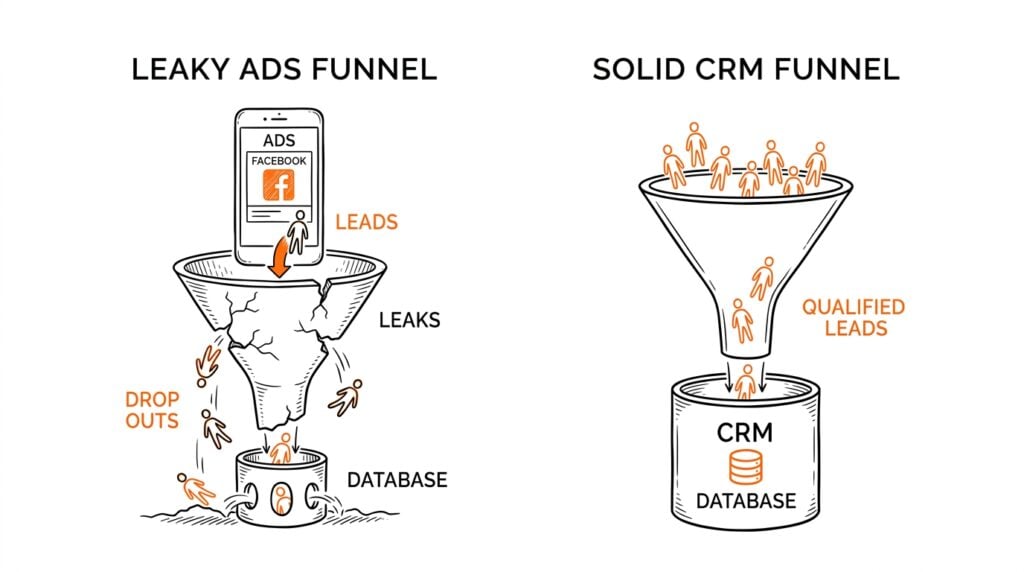
Problem 3: Leaky pipeline (good leads that go nowhere) You’re getting leads but they’re not converting.
Fix: Your follow-up is probably generic. Personalize everything. Reference previous conversations. Provide value every touch.
The Simple CRM Pipeline Setup (5 Minutes)
You don’t need fancy software. You need a system you’ll actually use.
Option 1: Google Sheets Column A: Name Column B: Phone Column C: Email
Column D: Stage (use dropdown) Column E: Next follow-up date Column F: Notes
Sort by follow-up date. Check it every morning.
Option 2: Trello/Notion Create 5 columns for your stages. Each lead is a card. Drag them as they move. Set due dates for follow-ups.
Option 3: Simple CRM If you want automation, use something built for real estate that doesn’t make you want to throw your laptop. Key features to look for:
- Mobile-friendly (you’re never at a desk)
- Automatic follow-up reminders
- Easy to update in under 10 seconds
- Integrates with your email/text
- Doesn’t require 47 fields to add a contact
The tool doesn’t matter. Consistency does.
What Actually Matters
At the end of the day, pipeline management for real estate comes down to this: can you answer these questions in under 30 seconds?
- How many active deals do you have right now?
- Who needs follow-up this week?
- Which leads have gone cold and need re-engagement?
- What’s your projected income for the next 90 days?
If you can’t answer those, you don’t have a pipeline problem. You have a system problem.
The good news? Fixing it doesn’t require a complicated CRM you’ll hate. It just requires a simple deal tracking system that works the way you actually work – and actually following up.
Because here’s the reality: the best agents don’t have better leads. They have better follow-up. They use a simple CRM pipeline that keeps them organized without making them crazy. They know their numbers. They spot dying deals before they’re dead. And they never let a good lead fall through the cracks.
You became an agent to help people buy and sell houses, not to become a CRM expert. Your pipeline management should support that, not get in the way.
Ready to manage your pipeline without the headache? Learn how nurtureBEAST uses AI and automation to handle your follow-up, track your deals, and keep you organized – without forcing you into a CRM you’ll hate. Learn More
Further reading: Real Estate Follow-Up System: How to Build One That Actually Works
Further reading: Real Estate CRM: Do You Actually Need One?
Further reading: A Simple Real Estate Follow-Up Strategy That Works | How to Audit Your Real Estate Follow-Up System | The Daily Follow-Up Routine for Real Estate Agents
Further reading: Best CRM for Real Estate Agents | Real Estate Lead Scoring
Agents who use a CRM see 29% higher sales productivity. (Salesforce State of Sales)