⏱ 20 min read
Published March 30, 2026
Real Estate Lead Scoring: 5 Signals a Lead Is Hot Now
Last Updated: March 30, 2026
You have 200 leads in your CRM. Maybe 500. You have two hours of call time today. Who do you call? Most agents either work down a list in order, cherry-pick names they recognize, or worse – call no one because the task feels overwhelming. All three approaches cost you deals.
Lead scoring is the system that cuts through the noise and tells you, based on actual behavior, which leads are warm right now. Not based on gut feel. Based on what they’re doing.
Key Takeaways
- Most agents waste call time on the wrong leads because they lack a system for prioritizing the right ones
- Lead scoring assigns point values to behaviors – email opens, link clicks, website visits, response patterns – that indicate buying or selling intent
- Automated scoring through a CRM is more accurate and less time-consuming than manual scoring
- Five specific behavioral signals reliably indicate a lead is warm right now
- When a lead’s score goes hot, the response time window is short – you need a trigger to act immediately
Table of Contents
- Why Treating All Leads the Same Kills Your Productivity
- What Lead Scoring Actually Is
- Manual Lead Scoring vs. Automated Behavioral Scoring
- The 5 Signals That Mean a Lead Is Warm Right Now
- How to Set Up Lead Scoring in Your CRM
- What to Do When a Lead Score Goes Hot
- FAQ
Why Treating All Leads the Same Kills Your Productivity
Think about what happens to a lead who enters your CRM on a random Tuesday in February. They’re probably 6 months away from doing anything. They’re browsing. They submitted a form because the listing looked interesting, not because they’re ready to write an offer.
Now think about a lead who has been in your database for 4 months, just opened 3 of your last 4 emails, clicked a link to a listing in their target neighborhood, and visited your website twice in the last week. That person is doing something. Their behavior is telling a story.
If you’re calling your February contact on day 8 of a drip sequence and completely missing your 4-month contact’s activity, you are systematically prioritizing the wrong people. This isn’t a motivation problem. It’s a visibility problem. Leads contacted within 5 minutes are 21x more likely to respond than those contacted after 30 minutes (InsideSales.com / MIT Lead Response Management Study) – lead scoring is what tells you which leads need that immediate personal outreach right now.
The agents who figure out real estate lead conversion at a high rate aren’t calling more people – they’re calling the right people at the right moment. Lead scoring is the infrastructure that makes that possible.
What Lead Scoring Actually Is
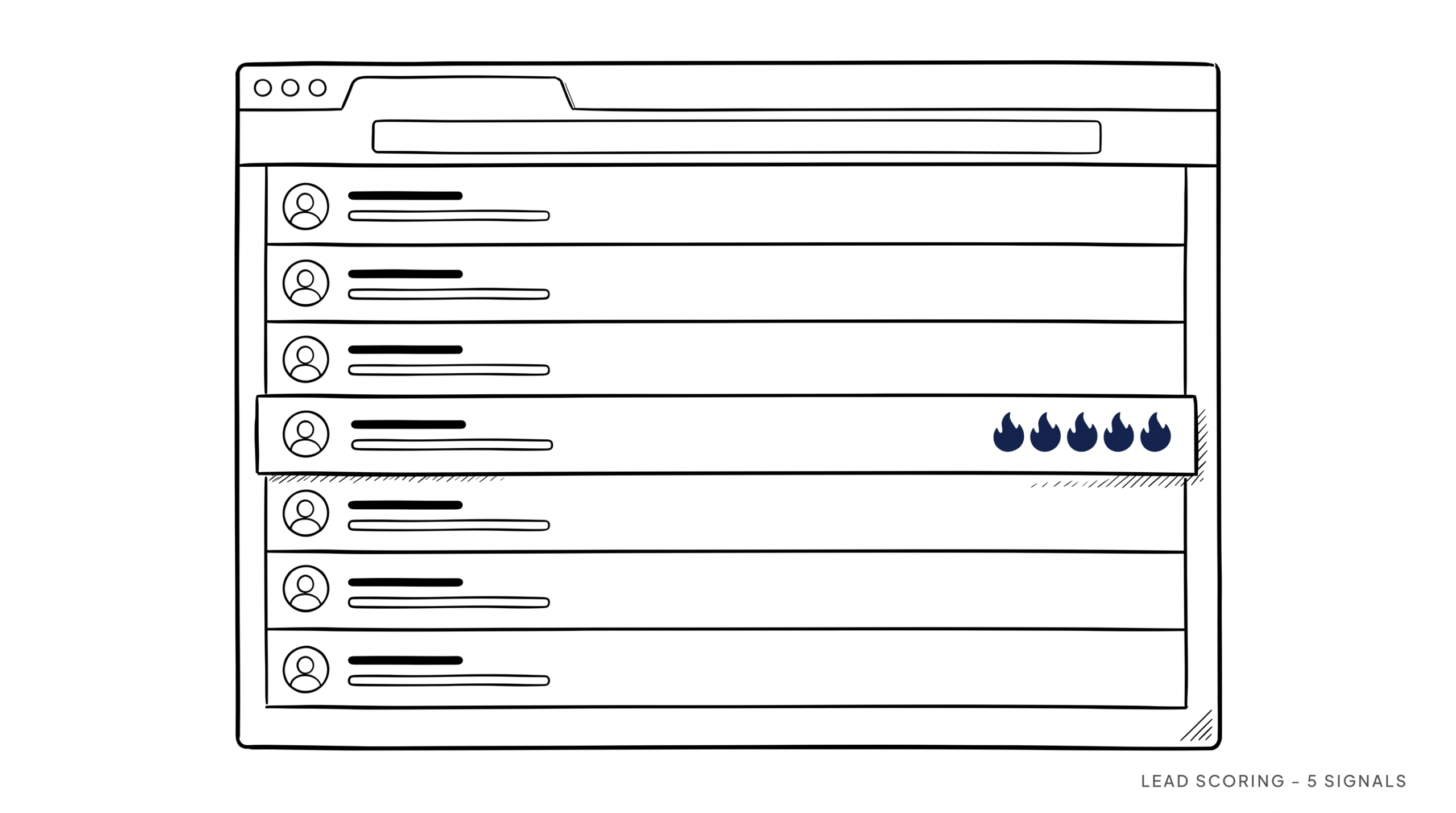
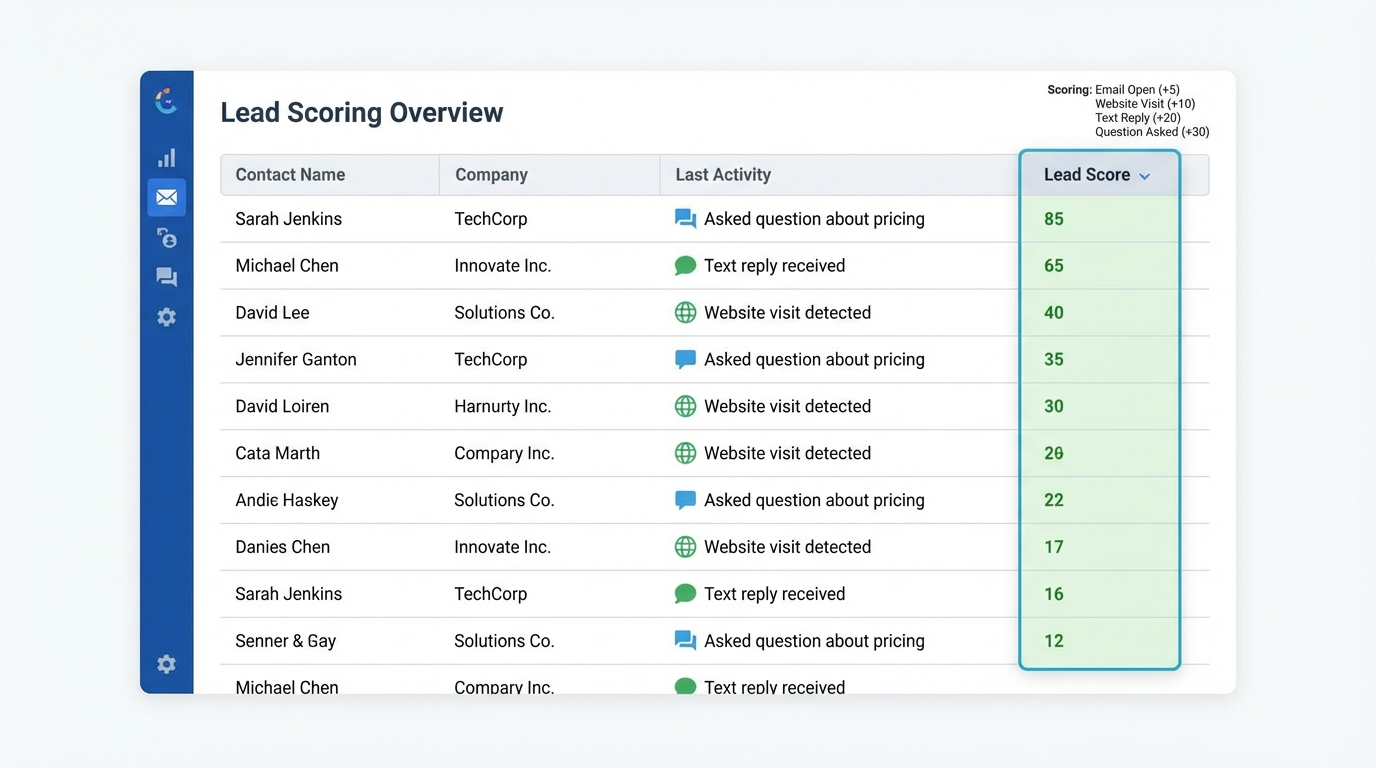
Lead scoring is a system that assigns numerical values to contact behaviors and attributes, so that at any point in time you have a ranked list of who is most likely to convert.
A basic version looks like this:
- Lead opens an email: +5 points
- Lead clicks a link in an email: +10 points
- Lead visits your website: +8 points
- Lead visits a specific listing page: +15 points
- Lead fills out a contact form: +25 points
- Lead responds to a text: +20 points
- Lead has been in database 12+ months with no activity: –10 points
Every interaction either increases or decreases the score. The result is a live, dynamic ranking of your entire database by current intent level. Instead of asking “who should I call today?” you sort by score and start at the top.
This isn’t magic – it’s just paying attention to what your contacts are already telling you through their behavior.
Manual Lead Scoring vs. Automated Behavioral Scoring
Manual scoring means you review your leads regularly and update their status based on what you know. You look at notes, remember conversations, and make judgment calls. This works fine for a database of 50 people. It breaks down completely at 200+.
Manual scoring has three consistent failure modes:
1. You only update leads you remember – meaning recent ones get scored, old ones get ignored
2. Recency bias – the lead you talked to last week feels “warm” even if they haven’t done anything since
3. It requires time you don’t have, so it doesn’t get done
Automated behavioral scoring is handled by your CRM. Every email open, link click, website visit, and form submission is tracked and scored automatically without any action on your part. Your score list is always current.
Agents who use a CRM see 29% higher sales productivity (Salesforce State of Sales) – and behavioral lead scoring is one of the highest-leverage features a CRM can offer, because it replaces guesswork with real-time intent signals.
The difference in outcomes is significant. Automated scoring catches activity spikes you would never notice manually – the lead who’s been quiet for six months suddenly visits your listings page four times in two days. Without a scoring system, that lead gets their next scheduled email in three weeks. With scoring, they’re at the top of your call list today.
A good real estate CRM with behavioral scoring built in pays for itself the first time you catch one of those spikes and make the call before your competition does.
The 5 Signals That Mean a Lead Is Warm Right Now
Not all behaviors are equally meaningful. These five signals consistently indicate a lead who is actively thinking about a move.
1. Email click – not just an open. An open might be accidental or a preview pane. A click means they read the subject, decided it was relevant, and took action. Clicks on listing-related content are the highest-value email signal you have.
2. Multiple website visits in a short window. One website visit might be curiosity. Two or three visits in 48 hours means they’re researching. If they’re hitting your listings pages specifically, they are actively shopping.
3. Re-engagement after a long quiet period. A contact who hasn’t opened anything in three months suddenly opens two emails in the same week is signaling something changed in their life or their timeline. This is one of the most underappreciated signals in any database.
4. Response to any communication – even a short one. A one-word reply (“yes,” “still interested,” “not yet”) tells you the line is still open. Prioritize anyone who responded to anything in the last 30 days.
5. Specific listing inquiry or saved search activity. This is the most direct signal – they’re looking at real properties and they’re paying attention to price, location, and features. Combined with any of the above, this indicates someone very close to taking real action.
These five signals are what real estate lead generation strategies often don’t address – generating leads is one thing, but reading the behavioral signals that tell you when to act is what separates the agents who convert at a high rate.
How to Set Up Lead Scoring in Your CRM

You don’t need a complicated system to start. A basic scoring setup in most real estate CRMs takes about 30 minutes to configure and runs automatically from there.
Step 1 – Define your scoring events. List every trackable action a lead can take. Email opens, clicks, website visits, form fills, text responses, calls answered, calls declined, time since last activity.
Step 2 – Assign point values. Higher points for higher-intent behaviors. A form submission is worth more than an email open. A visit to a listings page is worth more than a visit to your homepage. Don’t overthink the exact numbers – directional accuracy is more important than precision.
Step 3 – Add decay rules. Scores should decrease over time without activity. A lead who scored 80 points six months ago and has done nothing since is not an 80-point lead today. Decay rules keep your list current and prevent stale leads from crowding out active ones.
Step 4 – Set a threshold for “hot” leads. Decide what score triggers personal outreach. For most agents, anything above 50–60 points (on a 0–100 scale) in the current 30-day window is worth a direct call.
Step 5 – Build the notification. When a lead crosses your hot threshold, you want to know immediately – not at the end of the week when you review your CRM. Set up an alert so the system tells you when to act.
For a comprehensive look at how real estate marketing automation integrates with lead scoring, that post covers the full picture of what should be automated versus what requires your direct attention.
What to Do When a Lead Score Goes Hot
This is where most agents drop the ball. They have the system, they get the notification – and then they send an email. Don’t send an email. It takes an average of 8 follow-up attempts to reach a prospect, yet 44% of salespeople give up after just one (RAIN Group) – when a lead score goes hot, the sequence has done 7 of those attempts for you; now you need to show up in person for the one that closes the deal.
When a lead score crosses your hot threshold, call them within the hour. Here’s why the timing matters: behavioral signals are momentary. The person who just visited your listings page twice is thinking about real estate right now, today. Tomorrow they might be thinking about something else entirely. You have a short window.
The call framework when a lead goes hot:
- Don’t reference their digital activity (“I saw you were on my website”). It feels surveillance-like.
- Reference the last real conversation or the last touchpoint instead: “I was just thinking about you – we talked a few months back about [area].”
- Ask a simple open question: “How’s the search going? Are you still thinking about making a move?”
- Let them lead. If they’re warm, they’ll tell you.
If you can’t call immediately, a short personal text is the next best option. Use the same principle – conversational, no reference to tracking, just a genuine check-in.
After the call, reset their score or move them to an active pipeline stage. The scoring system has done its job. Now you’re in a live sales conversation, and real estate prospecting strategies take over from there.
FAQ
Does lead scoring work for small databases?
Yes, but it’s more impactful as your database grows. Under 100 contacts, you can probably track this mentally. At 200+, manual tracking breaks down and automated scoring becomes essential.
What CRM features do I need for lead scoring?
Look for email open and click tracking, website visitor tracking (via a pixel), automated scoring rules, score decay settings, and threshold-based notifications. Not all real estate CRMs offer all of these – check before you commit.
Can I score leads I got from Zillow or other portals?
You can score their behavior after they enter your system. Portal leads usually come with minimal data, so their score starts at zero and builds from there based on how they interact with your emails and website.
How often should I review my lead scores?
If you have threshold notifications set up correctly, you don’t need to review manually – the system alerts you when action is needed. A weekly review of your top 20 scored leads is a good habit for sanity-checking the data.
What if my CRM doesn’t support automated scoring?
You can build a manual version using tags and lead status fields – assign a status (cold, warm, hot) based on your last interaction and update it weekly. It’s more work but better than no system at all. That said, AI for real estate agents has made automated scoring accessible even on lean budgets.
The Bottom Line
Lead scoring doesn’t make you a better agent – it makes your time go to the right places. The deals you’re losing right now aren’t because you lack hustle. They’re because a warm lead in your database hit their moment and you weren’t watching. A scoring system fixes that by keeping a live read on every contact in your database, so the next time a lead goes hot, you know about it immediately.
Is Your Real Estate Business Leaking Revenue?
Most agents are losing deals they don’t even know they have. Find out exactly where your business is broken and get a custom plan to fix it.