⏱ 20 min read
Published March 30, 2026
Slow Real Estate Market: 5 Database Plays to Run Now
Last Updated: March 30, 2026
One agent went from $92,000 in GCI to zero closings for four straight months. Not because she stopped working – she was working harder than ever, chasing Zillow leads and running Facebook ads that burned through her savings. The problem wasn’t the market. It was that she had 600 people in her database who already knew and trusted her, and she hadn’t talked to any of them in over a year.
A slow market doesn’t kill real estate careers. Ignoring your database during a slow market does.
Key Takeaways
- Slow markets punish agents who rely on new leads and reward agents who work their existing database
- Reactivation campaigns targeting cold contacts can surface deals that cost nothing to generate
- The slow period is the best time to build the CRM, automation, and follow-up systems you never had time to build
- Deepening relationships without transaction pressure creates loyalty that converts when the market rebounds
- Agents who come out of slow markets ahead are the ones who treated slow time as infrastructure time
Table of Contents
- Why Slow Markets Sort the Good Agents From the Great Ones
- Stop Spending on Ads – Start Working Your Database
- The Database Reactivation Campaign to Run Right Now
- Deepening Relationships When There’s No Transaction Pressure
- Using Slow Time to Build Your System
- What Comes Out the Other Side
- FAQ
Why Slow Markets Sort the Good Agents From the Great Ones
Every market cycle separates the agents who built real businesses from the ones who were just riding the wave.
In a hot market, almost any agent can close deals. Buyers are motivated, sellers get multiple offers, and deals fall into your lap if you’re reasonably active. It feels like you built something. You didn’t – you were carried by conditions.
When conditions change, the agents without systems, without databases, without relationships – they disappear. They get part-time jobs. They let their license lapse. Meanwhile, the agents who spent the good years building something come out of every slow period with bigger market share, stronger relationships, and a book of business they actually own.
The slow market is the test. And the answer to the test is not “work harder at the things that aren’t working.” It’s: work your database.
Stop Spending on Ads – Start Working Your Database
When closings slow down, panic is the natural response. And panic in real estate usually looks like spending money on ads.
The logic seems reasonable: no deals coming in, need more leads, run ads to get leads. But this is almost always the wrong move during a slow market – for two reasons.
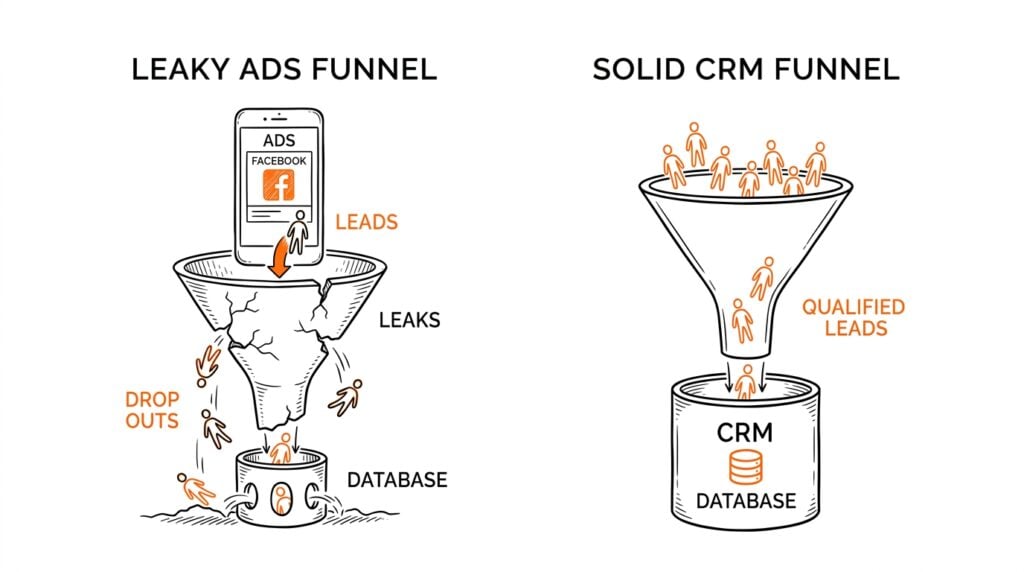
First, paid leads are cold. They don’t know you, don’t trust you, and require 8–12 follow-up attempts before they convert. In a slow market, your competitors are also running more ads, which drives up cost-per-lead while conversion rates drop. You’re spending more to get worse results.
Second, you already have leads. You have them in your database right now – past clients, open house visitors, people you met at networking events, family friends who “said they’d use you when the time was right.” These people already have some level of trust in you. Converting a warm contact costs a fraction of what it costs to convert a cold internet lead.
The agents who survive slow markets and come out ahead don’t outspend their competition. They outwork their database when everyone else is chasing cold traffic. Database reactivation campaigns have an average 15-20% response rate when personalized (HubSpot) – that’s a conversion rate most paid lead sources can’t touch, from people who already know you.
If your database has gone cold, the fix isn’t new leads – it’s reactivation. A good real estate database reactivation campaign can surface active buyers and sellers from contacts you already have.
The Database Reactivation Campaign to Run Right Now
A reactivation campaign has one goal: find out who in your database has a need right now that you don’t know about.
Here’s the simplest version:
Step 1: Segment your database. Pull out everyone you haven’t spoken to in 6+ months. This is your reactivation list. Don’t overthink it – if they’re cold, they’re on the list.
Step 2: Send a direct, human message. Not a newsletter. Not a market update. A personal-feeling message that checks in and opens a conversation. Something like: “Hey [Name] – I was going through my contacts and realized I haven’t talked to you in way too long. How are things going? Are you still in [city], or have your plans changed at all?” Short. Casual. Curious.
Step 3: Follow up with value. For anyone who doesn’t respond to the personal message, follow up a few days later with something useful: a current market snapshot for their neighborhood, a home value estimate, or a “what’s your home worth today” invitation. This isn’t a sales pitch – it’s a door-opener.
Nurtured leads produce a 20% increase in sales opportunities on average. (Demand Gen Report) A slow market is the best time to build the nurture infrastructure that pays dividends in every future market cycle.
Step 4: Identify the actives. Anyone who responds saying they’re thinking about selling, buying, or moving? That’s a hot lead that was already in your database, costing you nothing. Move them into an active pipeline.
Step 5: Everyone else goes into long-term nurture. People who respond but aren’t ready for anything – they go into a consistent monthly drip. People who don’t respond at all – they stay on the list and get the drip too. Cold today doesn’t mean cold in four months.
For a deeper breakdown of this process, the guide to reactivating a dead real estate database covers it step by step.
Deepening Relationships When There’s No Transaction Pressure
Here’s something most agents never do: call a past client when there’s nothing to sell.
Think about what that call looks like from the client’s perspective. They hear from their agent twice: when they were buying, and when the agent thinks they might buy or sell again. That’s a transactional relationship, not a real one. And transactional relationships don’t generate referrals – real relationships do.
A slow market gives you time to make the calls you never make when you’re busy closing deals.
Call your past clients and ask how they’re settling in. Ask about the neighborhood, the renovation they mentioned, the kids’ new school. Don’t pitch anything. Just show up as a person who cares about their experience and wants to stay connected.
These calls take 5–10 minutes. They generate more goodwill than a year of automated drip emails. And when that person’s coworker mentions they’re thinking about selling – your client will think of you first, because you’re the agent who called just to check in.
This is also the right time to reconnect with your sphere. Not to pitch the market – to genuinely ask how people are doing, what’s changed in their lives, whether there’s anything you can help with. Slow markets are relationship-building seasons for the agents who treat them that way.
Staying top of mind with past real estate clients is the long-term game that pays dividends when the market reactivates.
Using Slow Time to Build Your System
Every busy agent has a list of things they’ve been meaning to set up: the CRM they keep putting off, the follow-up sequences they’ve never written, the automation that would save them hours every week. During a good market, there’s never time. During a slow market, there’s nothing but time.
Use it.
The agents who dominate the next market cycle are the ones who build their infrastructure during the quiet periods. That means:
Agents who use a CRM see 29% higher sales productivity. (Salesforce State of Sales) In a slow market, productivity is the entire game – the agents who close deals are the ones who built systems that work for them while they focus on what matters.
Setting up a real CRM. Not a spreadsheet. Not contacts saved in your phone. A real estate CRM that holds your database, tracks your conversations, and triggers follow-up automatically. If you’ve been functioning without one, this is the time to fix that.
Building follow-up sequences. A sequence for new buyer leads. One for seller leads. One for past clients. One for open house visitors. These don’t take long to build when you have the time – and once they’re built, they run on autopilot forever. Real estate marketing automation can handle the heavy lifting once your sequences are in place.
Cleaning your database. Go through your contacts. Update old phone numbers. Add missing emails. Tag people by relationship type, likely timeline, and lead source. A clean database is dramatically more useful than a messy one – and this is the one task that’s nearly impossible to do when you’re busy.
Auditing your lead sources. What actually produced deals last year? What cost money and produced nothing? Slow time is the right time to make those decisions with a clear head instead of during a panic.
Is Your Real Estate Business Leaking Revenue?
Most agents are losing deals they don’t even know they have. Find out exactly where your business is broken and get a custom plan to fix it.
What Comes Out the Other Side
The market will move again. It always does.
When it does, two types of agents will be ready: the ones who spent the slow period in a panic, burning through savings on ads, and the ones who used the time to build something.
The second group comes out with a database that’s been reactivated and re-engaged. They have follow-up sequences running. They have relationships that deepened during the quiet months. When a seller is finally ready to list, they call the agent who sent them a thoughtful market update every month – not the one who ran a Facebook ad at them in February.
The slow market is not your enemy. It’s the sorting mechanism. And if you treat it as an opportunity to build what you should have been building all along, you will come out of it in a better position than you went in.
FAQ
How many contacts should I have in a healthy real estate database?
There’s no magic number, but a general benchmark is 200–300 meaningful contacts for an established agent – people who actually know you and would take your call. More is not better if most of the names are cold and unorganized. Quality and engagement matter more than size.
What if I haven’t talked to someone in 2+ years – is it too late to reactivate?
Rarely. Most people understand that agents get busy. A genuine, human check-in message almost always gets at least a response. The ones who don’t respond were probably not going to refer you anyway. You have nothing to lose by trying.
Should I lower my commission during a slow market to win more business?
Be very careful here. Competing on price trains your clients to expect discounts and attracts buyers and sellers who are purely transactional. The better move is to demonstrate more value – better communication, better systems, better marketing – rather than cutting your fee.
Is it better to focus on buyers or sellers during a slow market?
Sellers, in most cases. Inventory is the constraint in most slow markets. The agent who wins listings controls the deals. Focus your reactivation and nurture efforts on potential sellers first – people who’ve mentioned moving, empty nesters, people who bought 5–7 years ago and might be ready to upsize or downsize.
How long does a typical database reactivation campaign take to see results?
Most agents start seeing responses within the first week of running a personal reactivation outreach. Full pipeline impact – leads entering active conversations, appointments booked – usually shows up within 30–60 days, depending on database size and engagement frequency.
The Bottom Line
The agents who struggle through slow markets are the ones who wait for the market to come back to them. The agents who thrive are the ones who go to work on what they already have – the database, the relationships, the system. That work doesn’t produce results overnight, but it produces results that compound. For leads who don’t convert on the first touch, retargeting ads keep your brand in front of them across the web.
Don’t waste a slow market on expensive ads chasing cold leads when you already have a database full of people who know you. Work what you have. See how NurtureBeast helps agents build a system that works in any market → nurturebeast.com