⏱ 19 min read
Published March 30, 2026
How to Nurture Listing Leads: 6-Step Pre-Listing Plan
Last Updated: March 30, 2026
You did a CMA for a homeowner who wasn’t quite ready. You followed up twice, heard nothing, and moved on. Six months later, you see the listing hit the MLS – with a different agent’s name on it. That seller was ready. They just called someone else.
Pre-listing leads are the most valuable leads in real estate. They’re also the most wasted. The agents who dominate listings in their markets aren’t necessarily the best negotiators or the slickest presenters – they’re the ones who stayed in front of seller leads for months while everyone else gave up after two follow-ups.
Key Takeaways
- Pre-listing seller leads can take 6–18 months to convert – most agents quit at 2 attempts and lose the listing to someone who didn’t
- A monthly value-first touchpoint keeps you top of mind without feeling like harassment
- The right content for seller nurture is hyper-local: their neighborhood, their street, their specific home value
- Behavioral signals – email opens, home value requests, engagement – tell you when a seller lead is warming up
- The agent who has been showing up consistently wins the listing appointment almost by default
Table of Contents
- Why Pre-Listing Leads Are Your Most Valuable Asset
- The Mistake Most Agents Make With Seller Leads
- What Pre-Listing Nurture Actually Looks Like
- Content That Keeps Sellers Engaged Over Months
- The Sequence: From First Contact to Listing Appointment
- How to Know When a Seller Lead Is Ready
- FAQ
Why Pre-Listing Leads Are Your Most Valuable Asset
Think about the math.
A buyer lead might buy one home and refer you one or two deals over the next few years. A seller lead generates a listing – and listings generate both the sell-side commission and, in many cases, a buy-side commission when that seller needs a new home. Plus, a well-marketed listing produces buyer leads from open houses and sign calls.
One well-nurtured seller lead can be worth 2–3 transactions. And yet most agents spend the majority of their lead generation budget on buyer leads, because buyers feel more urgent. Buyers have deadlines. Buyers call you back.
Only 2% of sales happen at the first point of contact. (Sales Insights Lab) For pre-listing seller leads specifically, the entire game is staying present through the other 98% of the decision window – which is exactly what a long-term nurture sequence is built for.
Sellers move on their own timeline. That timeline might be 3 months, or it might be 18 months. The agents who build nurture sequences for seller leads are patient enough to stay in front of them through the entire decision window – and they collect the listing at the end because they never disappeared.
The Mistake Most Agents Make With Seller Leads
The standard approach looks like this: homeowner requests a home value estimate or calls about listing. Agent does a CMA, sends it over, follows up once or twice. Homeowner says “we’re not ready yet.” Agent marks them cold and moves on.
This is the wrong response to “not ready yet.”
“Not ready yet” doesn’t mean “not interested.” It means their timeline doesn’t match yours. And if you disappear because their timeline doesn’t match yours, you’ve handed that listing to the next agent who stays in touch.
The mistake is treating readiness as a binary: either they’re ready to list now, or they’re not worth your time. The reality is that pre-listing leads who say “not yet” are on a path to listing. The question is whether you’ll be there when they arrive.
A real estate follow-up system that handles long-term seller nurture automatically is what separates the agents who win these listings from the ones who lose them to whoever stayed patient.
What Pre-Listing Nurture Actually Looks Like
Pre-listing nurture is not a barrage of “are you ready to list yet?” messages. That approach doesn’t build relationships – it builds resentment.
Real pre-listing nurture is value delivery. It’s showing up consistently in a seller’s inbox with information that is genuinely useful to them as a homeowner – information about their neighborhood, their local market, their home’s current value. You’re not pitching. You’re being the most useful real estate resource in their orbit.
When done right, this feels less like marketing and more like having a friend in real estate. The seller gets a market update email and thinks, “Oh, prices in my neighborhood are up 7% – interesting.” They don’t think “this agent is trying to get my listing.” But when the time comes to list, who do they call? The person who has been showing up in their inbox with useful information for the last eight months.
This is how the real estate email marketing approach pays off for listing generation – it’s not about blasting a newsletter, it’s about delivering hyper-relevant content to the right people at the right cadence.
Content That Keeps Sellers Engaged Over Months
The content you send to pre-listing leads needs to be relevant enough to actually get read. Generic market reports don’t cut it. Here’s what works:
Monthly neighborhood market updates: Days on market, list-to-sale price ratios, recent sold comps – all filtered to their specific neighborhood or zip code. Not the metro market. Their neighborhood. This is the data that directly affects their decision.
Quarterly home value estimates: A simple, personalized update on what their home is worth right now. You can use an automated valuation tool or do this manually for your highest-potential leads. Either way, receiving this feels like a service, not a sales pitch.
Local community content: School boundary changes, new development, neighborhood news. This positions you as the local expert – the agent who actually knows the market, not just the agent who farms the market.
Market milestone alerts: “Homes in [subdivision] are selling in under 10 days right now – inventory is extremely low.” These time-sensitive signals create urgency without you having to create it artificially.
Annual home anniversary emails: On the date they bought their home, send a note celebrating the anniversary and showing them how much their home value has grown since purchase. This one generates more responses than almost any other automated email agents send.
One framework for keeping this content flowing without it consuming your week is real estate marketing automation – once the sequences are built, they deliver the right content at the right time without your constant involvement.
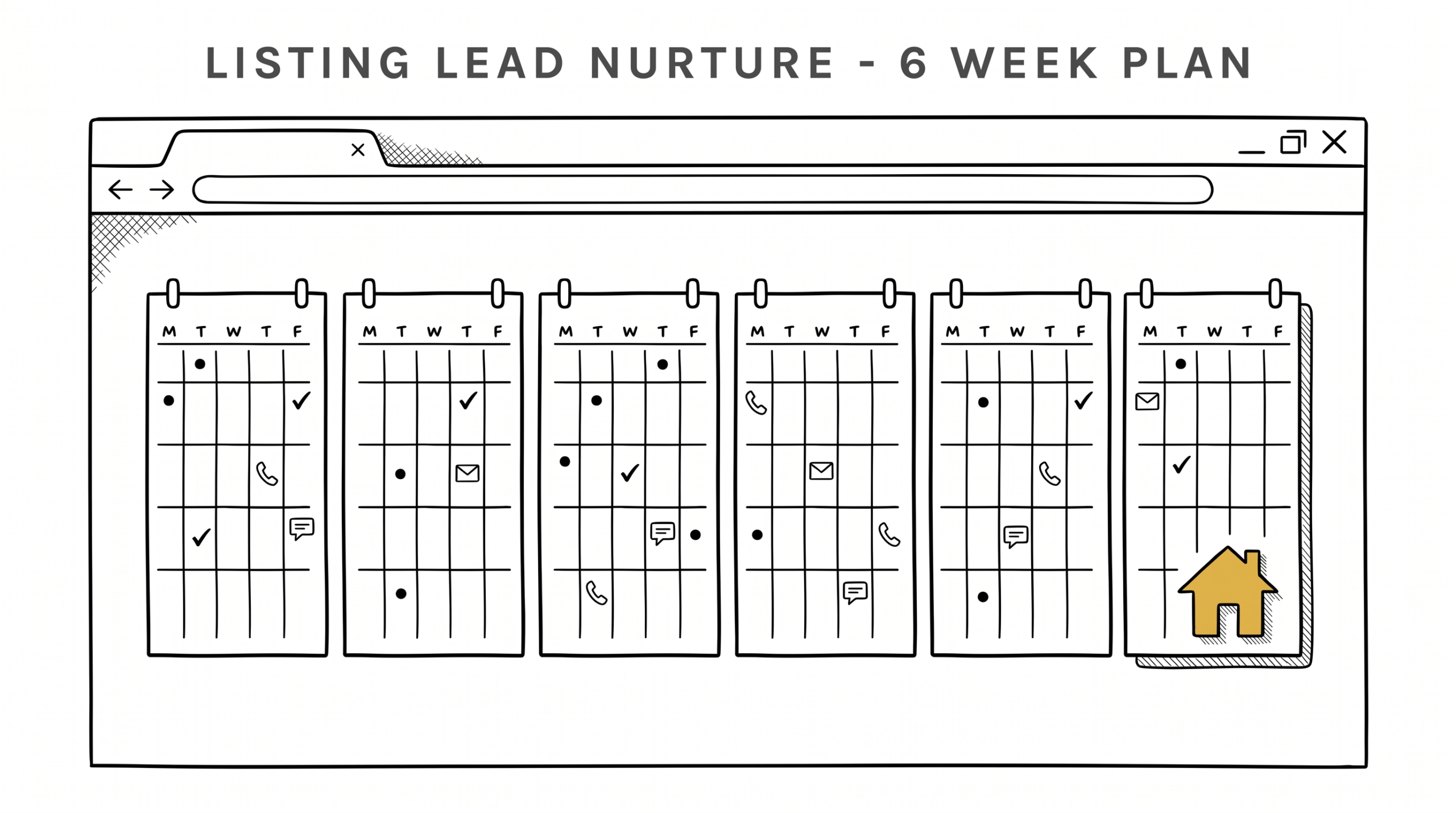
The Sequence: From First Contact to Listing Appointment
Here’s how the full nurture arc should look for a pre-listing lead:
Week 1 – First Contact:
Deliver the CMA or home value estimate they requested. Thank them for their time. Ask one qualifying question: “Is there a timeline you’re working toward, or are you more in the exploratory phase right now?” Whatever they say, enter them into your nurture sequence.
Month 1:
Send a neighborhood market update. Keep it specific. One paragraph, 2–3 key data points, a link to more detail if they want it. No pitch.
Months 2–3:
Continue monthly market updates. Add a quarterly home value refresh. Include one “reply to this” touchpoint – a simple question that invites a response without requiring them to be ready to list. “I’ve noticed prices in your area have moved since we last talked – have your plans changed at all?”
Month 4–6:
By this point, most sellers who are actively planning to list will start showing signals. Check your email open rates – are they opening every market update? That’s a warm signal. Did they click the home value link? Even warmer. Personal check-in call or text: “Hey [Name], I was thinking about you – I know you mentioned you were thinking about timing the market. Are things lining up at all, or still TBD?”
It takes an average of 8 follow-up attempts to reach a prospect, yet 44% of salespeople give up after just one. (RAIN Group) Pre-listing lead nurture is the long version of that truth – the agents who win listings are the ones who never stop touching the lead while everyone else gave up at attempt 2 or 3.
Month 6–12+:
Continue the sequence. Don’t stop. Some sellers take 18 months. The ones who’ve been receiving your content for a year are far more likely to call you than someone they’d have to start over with. The cost of maintaining the sequence is minimal; the cost of dropping someone who lists 14 months later is enormous.
How to Know When a Seller Lead Is Ready
Most sellers don’t call you and say “I’m ready.” They warm up gradually and give you signals – but only if you’re watching for them.
Email behavior: A lead who opens every email you send, especially if they click on the home value links, is engaged. Engagement precedes intent.
Direct questions: If they start asking more specific questions – “What do you think the market will look like in spring?” or “How long does it usually take to get a home ready to list?” – these are pre-listing questions, not idle curiosity.
Life events: Did they mention a job change, a new baby, a child heading to college? Life transitions drive real estate decisions. If you’re having real conversations with your database contacts, these signals surface naturally.
Responsiveness: A seller who went months without replying who suddenly replies quickly has something going on. Follow up personally.
When you spot these signals, don’t hesitate. Move the lead from long-term nurture to active pipeline and reach out personally. The window between “thinking about it” and “calling three agents” can be short. You want to be the first call, not the third.
Real estate lead conversion breaks down exactly how to handle a lead once they move from nurture to active consideration – don’t let the appointment slip away after months of patient follow-up.
FAQ
How many pre-listing leads should I be nurturing at any given time?
There’s no cap – the beauty of automated nurture is that it scales. A solo agent can maintain 50–100 active pre-listing leads in a sequence without it consuming their week. The more pre-listing leads you’re nurturing, the more predictable your listing pipeline becomes.
What’s the right frequency for touching a pre-listing lead?
Monthly is the sweet spot for most sellers. Frequent enough to stay top of mind; infrequent enough not to annoy. Quarterly is the minimum if you want to stay relevant. Anything less and they’ll forget who you are.
What if they’re already working with another agent?
Ask. If they say yes, note it and stay in your long-term sequence. Agent relationships end. Sellers change agents before listing more often than people realize. The agent who’s been consistently showing up is the natural replacement.
Should I use the same content for all pre-listing leads?
No. Segment by neighborhood and home type at minimum. A seller with a $2M home in a gated community has different concerns than a seller in a starter neighborhood. The more tailored the content, the better the engagement.
How do I get more pre-listing leads in the first place?
Home value landing pages, neighborhood farming, referrals from past clients, and open house visitors who are homeowners. See the full real estate lead generation strategies guide for a complete breakdown.
The Bottom Line
The average homeowner stays in their home for 13 years. (NAR, 2023) Every homeowner in your database is a pre-listing lead at some point in that window – the agents who build systematic nurture sequences capture those listings; the ones who don’t hand them to whoever stayed in touch.
Pre-listing leads don’t convert on your timeline – they convert on theirs. The agents who win the most listings aren’t the ones with the best listing presentations. They’re the ones who were still in the seller’s inbox when the seller finally made their decision.
Build the nurture sequence, deliver real value, and watch for the signals. The listing appointment is the reward for the agent who was patient enough to stay. See how NurtureBeast automates pre-listing lead nurture for real estate agents → nurturebeast.com