⏱ 17 min read
Published May 24, 2026
Buyers Waiting for Rates to Drop: 4 Moves to Win Now
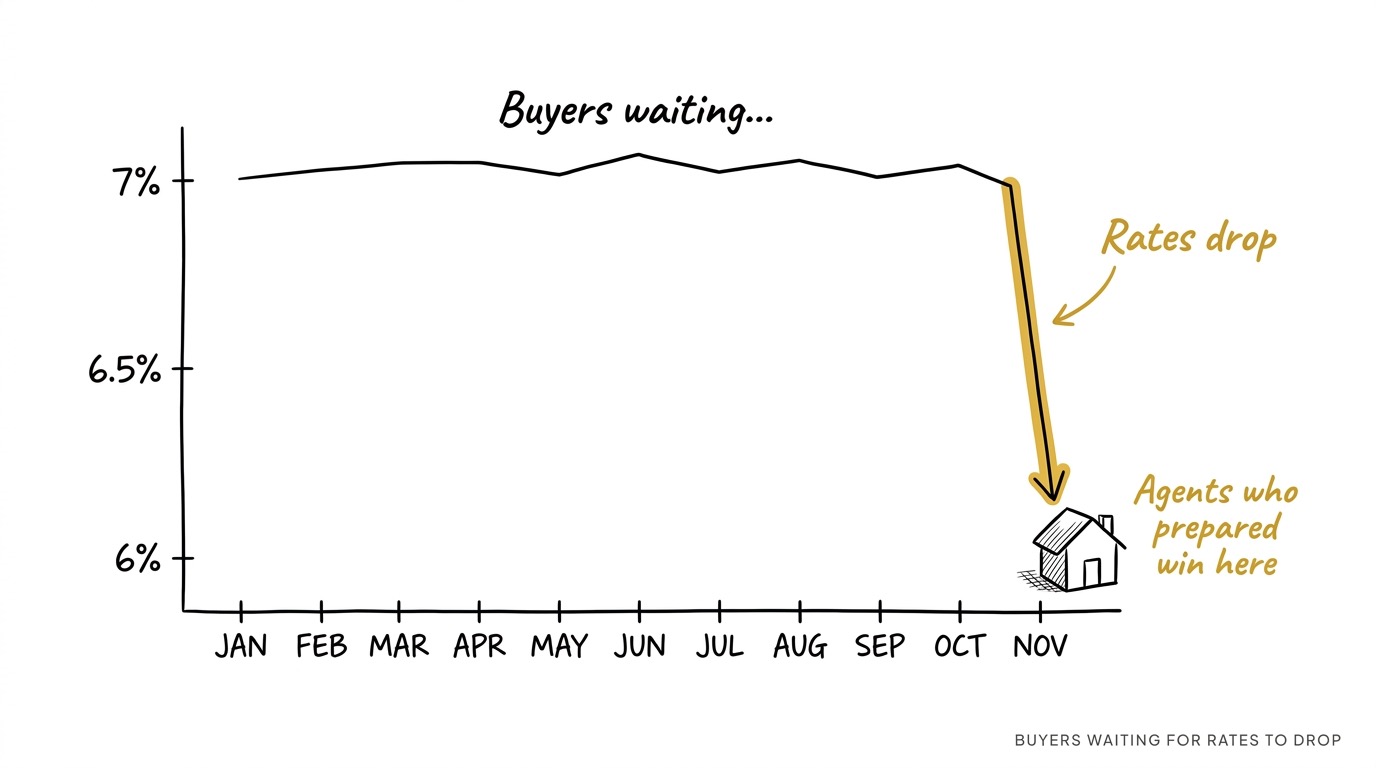
Buyers waiting for rates to drop are already in your CRM. Rates fall half a point on a Tuesday morning, and the agent who tagged their fence-sitters six months ago has three appointments booked before noon. You’re still scrolling, trying to remember who said “call me when things change.” That gap comes down to a 20-minute setup one agent did months earlier.
Is Your Silent Pipeline Costing You Rate-Drop Deals?
Every agent carries buyers waiting for rates to drop who went quiet for one reason: the payment didn’t pencil. They asked you to circle back when things shifted. You said absolutely. Then they got buried in your CRM, untagged, unsorted, invisible until it mattered.
On rate-drop day, those buyers don’t wait. They call the first agent who reaches them. If that’s not you, it’s whoever sent a text that morning.
Freddie Mac’s Primary Mortgage Market Survey tracks 30-year fixed rates weekly. Your rate-watch buyers notice when that number moves. Your CRM should be ready before the news cycle.
Agents who win rate-drop days set up a system months earlier and hit send. The system takes 20 minutes to build.
Running a full CRM audit pairs well with this if your database is messy. The tag comes first.
Step 1: Tag Your Rate-Sensitive Leads Right Now
Block 20 minutes this week. Search your CRM for any buyer you’ve spoken to in the last 18 months who mentioned rates, affordability, or “we’re waiting.” In GoHighLevel, create a tag called “rate watch” and apply it to every one of those contacts.
That’s the whole step. One tag.
Not sure who qualifies? Use this test: did they go quiet because of rates and not because they found a home, moved away, or changed their mind? Tag them.
Most agents skip this because it feels tedious. Twenty minutes, done once. When rates move, it’s the difference between reaching 40 warm contacts and guessing who said what.
Step 2: Pick a Trigger and Decide Who Fires It
Rate-drop days come with noise. Phones ring. News alerts fire. Every agent in your market starts texting leads at the same time. You can’t make a good decision that day. Make it now.
Pick your number. What does “rates dropped” mean for your specific buyers? A move from 7% to 6.5% may not shift the math enough. At 6.25%, the calculation changes for many buyers waiting for rates to drop in your market. Know your threshold before the day comes.
Then decide who fires the campaign. Solo agent: you do it manually using the pre-written messages from Step 3. You have a VA: they trigger the sequence in GHL. Either way, write it down now.
“When 30-year fixed hits ___%, I trigger the rate-watch campaign. [Name] sends the first touchpoints.”
Removing that decision from the moment means you move in hour one. Everyone figuring it out that day moves in hour six, after you’ve already booked the appointments.
Step 3: Write the Outreach Before the Moment Hits
The agent who drafts copy on a rate-drop day loses. Their outreach arrives late and generic. Write three messages now and save them where you can find them in 30 seconds.
Voicemail script (30 seconds):
“Hey [Name], it’s [You]. Quick heads up, rates just moved to [X]%. You mentioned waiting on this. Worth a call to see if the numbers change anything for you. Call me back when you get a chance.”
Text:
“Hey [Name], rates just dipped to [X]%. You mentioned waiting. Want me to pull up the monthly payment on the homes you liked?”
Email subject: Rates just moved. Your updated payment numbers are below.
“[Name], the 30-year fixed just hit [X]%. Based on what you were looking at in [neighborhood], your monthly payment would be roughly [estimated range]. Want a quick call this week to look at updated numbers? Reply here or text me.”
Fill in the brackets now. Use their price target and 20% down for the estimate. Confirm the specifics on the call.
These messages aren’t perfect. They’re fast and personal. That’s what wins.
The 3-Touch Sequence and Timing
Rate-drop days are competitive. Every buyer hears from someone. Your job is to be first and feel personal.
Call first. Same day, within the first hour of seeing the rate move. Most buyers won’t answer. Leave the voicemail. The call shows up in their missed calls and voicemail at the same time, which is personal in a way a text isn’t.
Text second. Same day, two to three hours after the call. Some buyers don’t check voicemail. The text catches them. Keep it short. Reference the call if they missed it.
Email third. Next morning. Some buyers need to sleep on it. The email gives them something to read over coffee, forward to a spouse, and act on at their own pace. Include the payment estimate.
The order matters. Calling first signals real effort. Texting second meets them where they are. The email third gives them room to decide. Reversing that order feels transactional. There’s a reason why buyers ghost: touch order and timing are bigger factors than most agents recognize.
What Do You Say When They Still Hesitate?
When buyers waiting for rates to drop hear from you and still say the rates aren’t low enough, skip the push. Two responses work: redirect to payment math, or reset the search. Neither is a close, and both keep the conversation alive.
Redirect to monthly payment math:
“Fair enough. At [X]% on a $450,000 home, your payment is about $2,400. Six months ago that was $2,650. That’s $250 a month back. Does it feel different when you look at it that way?”
Reset the search:
“Makes sense. Want to use this as a chance to update your search? Inventory’s shifted since we last talked. Might be worth seeing what’s actually available at your budget now, even if you’re not ready to commit.”
The goal is a showing or a call, not a commitment. The real estate objection handling guide has more frameworks if you want to build this out further.
- ✓The 20-minute CRM search to find every rate-sensitive buyer in your pipeline
- ✓Step-by-step Rate Watch tag setup in GoHighLevel
- ✓Pre-written voicemail, text, and email scripts – ready to send the moment rates drop
- ✓The 3-touch sequence timing that gets responses
- ✓Monthly nurture templates to keep warm buyers from going cold before the moment hits
How Do You Keep Rate-Watch Buyers Warm Until Rates Move?
One monthly touch keeps buyers waiting for rates to drop from forgetting you exist. You’re not nurturing them toward a decision. You’re staying present so your name surfaces the moment the math works for them.
One touch a month is enough. Keep it short.
The format: one market update sentence, one housing stat, one personal sentence.
Example: “Market’s still tight in [area], only 12 active listings under $500K. Median days on market dropped to 18. Let me know if you want a current list. Hope your summer is going well.”
No call to action. No pressure. Just presence.
If you use nurtureBEAST, this is the kind of sequence you set once: a monthly drip that keeps your rate-watch contacts warm without touching it manually each month. The real estate drip campaign guide shows how to structure sequences like this in GHL.
The agents first to call on rate-drop day kept their name in the buyer’s head long before rates moved.
Frequently asked questions
How long does it take to set up a rate-watch system in my CRM?
Plan for 20 minutes. Search your CRM for any buyer who mentioned rates or affordability in the last 18 months, apply a single tag, and save three pre-written messages somewhere you can grab them fast. You do this once. The system runs from there.
What rate threshold should I use as my trigger?
It depends on where your buyers paused. A half-point drop often moves the math enough to open a conversation but not always close a deal. Pick a number that shifts the monthly payment by roughly $150 to $200 for your typical buyer, then write it down before rates ever move.
How often should I touch buyers waiting for rates to drop?
Once a month is enough. More than that and you become noise. Less than that and they forget you when rates shift. One short message with a market update, one stat, and one personal line keeps your name present without feeling like a campaign.
Will buyers waiting for rates to drop actually convert when rates move?
Some will. Some need another half-point. The goal of the system isn’t to guarantee a close on rate-drop day. It’s to make sure you’re the agent they call when they’re ready, not the agent they forgot while someone else stayed in touch.
Related reading
- Real Estate Buyer Lead Nurture: 3-Phase Showing Sequence – the framework for moving a tagged, warmed-up buyer from interested to showing-ready.
- Why Buyers Ghost You: 6 Real Estate Texts That Reawaken Them – what to say when rate-watch leads go cold in the months before the trigger.
- Lead Reactivation for Realtors: 30-60-90 Day Framework – how to revive contacts who have been silent longer than six months.
The Bottom Line
Rates will move. Buyers waiting for rates to drop are already in your CRM, untagged and unsorted. The agents who win that day tagged their contacts, wrote their messages, and picked their trigger number weeks before it mattered. Twenty minutes of setup now turns a chaotic rate-drop morning into booked appointments by noon. The list is already there. It just needs a tag and a plan.
Is Your Real Estate Business Leaking Revenue?
Most agents are losing deals they don’t even know they have. Find out exactly where your business is broken and get a custom plan to fix it.