⏱ 17 min read
Published May 26, 2026
Realtor Relationship System: Scale Past 80 Clients Without Burnout
A realtor relationship system is what separates agents who mean well from agents who actually scale. Every Tom Ferry stage has someone nodding hard when the speaker says relationships will save you from AI disruption. They’re right. But the question no one asks out loud: of your 300 contacts, how many heard from you this month?
If the honest answer is “maybe 12,” the relationship advantage is an idea, not a system.
The Relationship Moat Is Real
Zillow has data. Redfin has tech. Every portal competes on price and speed.
None of them can replicate what you have: an actual human who remembers your client cried when they got the keys, who called after the basement flooded, who their kids recognize by name.
That trust is worth real money. Referrals from past clients cost nothing in ad spend. Repeat buyers don’t shop around. A warm introduction beats 50 cold leads on conversion rate.
The agents winning right now are not winning on commission splits or fancy tools. They built genuine trust with 30, 50, 100 people who would never call anyone else.
The moat is real. But it only works if you stay in contact with the people inside it.
Does “Relationship-First” Actually Hold Past 80 Clients?
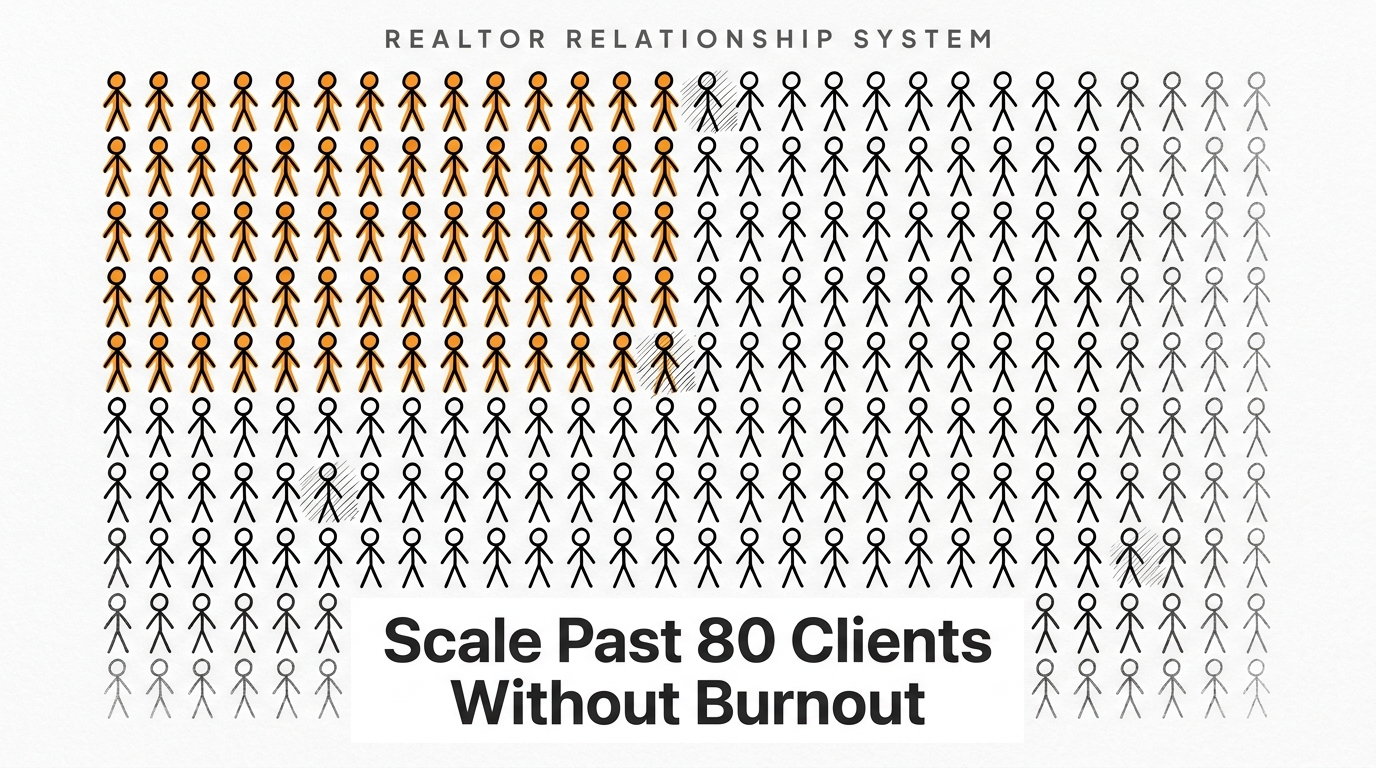
Past 80 contacts, the math breaks the promise. A realtor relationship system built on memory and good intentions collapses under volume: the 220 contacts beyond your inner circle stop hearing from you, forget your name, and call someone else when they’re ready to move.
You can maintain genuine, consistent contact with about 80 people. Maybe 100 if you’re disciplined. You know their kids’ names. You remember to check in. You text on birthdays without needing a reminder.
Past 80, memory fails. Life gets busy. The 220 contacts beyond your inner circle hear from you whenever you get around to it.
What happens to those 220? They don’t hate you. They don’t fire you. They forget you. When their neighbor mentions a listing or their coworker needs a recommendation, they say, “I think I used someone a few years back. Can’t remember the name.”
According to NAR’s annual Profile of Home Buyers and Sellers, only 26% of sellers used their previous agent again — despite the fact that 91% of buyers said they’d use their agent again or recommend them. The gap between intention and action is the forgetting problem.
That gap is also why 80% of past clients can’t recall their agent’s name within two years of closing. Not because the relationship was bad. Because there was no system keeping it alive.
This is not a relationship problem. It is a volume problem. Volume problems need systems, not more effort.
Does AI Make Your Client Relationships Feel Fake?
No. A realtor relationship system powered by AI sends the touchpoints you would send yourself if you had unlimited time. It does not replace your warmth — it clears the logistical backlog that was burying it. You stay focused on conversations where your presence actually changes the outcome.
There is a real fear underneath this question: “If I use AI to follow up, clients will know. I’ll lose the personal touch.”
That fear is based on a misunderstanding of what AI actually does inside a realtor relationship system.
The reason you don’t text all 300 contacts on their birthdays isn’t that you don’t care. You don’t have 300 extra minutes on any given day to look up who’s born when, draft a message, and send it.
The reason your past clients aren’t getting monthly market updates isn’t that you think they don’t want them. Writing 300 messages while juggling showings, offers, and negotiations isn’t realistic.
AI handles the remembering, the scheduling, the sending, so you show up for the conversations that actually matter.
Your warmth doesn’t disappear. It finally has room to operate.
3 Touchpoints AI Handles Better Than You
This is not about being fake. It is about being consistent.
1. Market updates on autopilot. Your database wants to know what’s happening in their neighborhood. Sending automated market reports consistently, month after month without fail, is exactly what a system does well. You set it up once. Your contacts get value on a schedule.
2. Anniversary and birthday texts that don’t slip. Most agents intend to send these. Fewer than 20% do it consistently across their full database. A system sends a personalized text on closing anniversary day, every year, to every client. No forgotten ones. That one message keeps more relationships alive than most agents realize.
3. Lead follow-up that doesn’t cool off. 78% of buyers go with the first agent who responds. Most agents drop off after one or two attempts. Real estate lead nurturing sequences keep reaching out on schedule while you’re focused elsewhere.
None of that is fake. It’s reliable. Reliable contact outperforms sporadic contact on referrals, conversions, and retention across every measure.
The 20% Only You Can Do
AI cannot read the room at an open house when a couple is having a quiet argument and you know to give them space.
It cannot sit across a table and tell a seller their price expectation is off, and have them trust you enough to adjust.
It cannot be the person who shows up to help someone move three weeks after closing because they mentioned they were overwhelmed.
It cannot make the referral ask feel natural because you genuinely know what someone does for a living and who in your database needs that service.
The lunch, the hard conversation, the handwritten note after a loss. That’s you. That’s irreplaceable.
The job of a realtor relationship system is to protect that 20% by not burying you in the 80% that can be handled differently.
- ✓The 3-tier database split (Inner Circle / Active Pipeline / Warm Database)
- ✓AI touchpoint layer — what to automate and exact cadence
- ✓Human touchpoint layer — the 3 conversations AI cannot replace
- ✓Word-for-word scripts for the check-in call, referral ask, and hard conversation
- ✓One-page system map: who gets what, how often
A Simple Split: AI Does the Staying-In-Touch, You Do the Closing
The realtor relationship system has two layers, and keeping them separate is the whole point.
AI layer: Automated sequences keep your full database warm. Monthly newsletters go out consistently. Birthdays, anniversaries, and market updates get sent on time. New leads get immediate responses and follow-up touches. Nothing falls through the cracks because you were in back-to-back showings.
Human layer: You handle the calls. You run the showings. You negotiate the offers. You have the coffee meeting with the sphere contact who just got promoted and is ready to upsize.
Tools like nurtureBEAST handle the AI layer: sphere-of-influence newsletters, follow-up sequences, listing content, so agents stay present for the conversations that actually need them. Your sphere of influence stays warm even on your busiest weeks.
The split ensures the staying-in-touch actually happens, so the closing conversations have someone ready to land them.
How Do You Know Your Client Relationships Are Slipping?
Three signals show up before the GCI drop does. A realtor relationship system catches them early; without one, you find out six months late, after the referrals have already gone to someone else.
These don’t feel like emergencies. That’s what makes them dangerous.
1. You keep hearing “oh, I didn’t know you were still in real estate.” When people in your database are surprised you’re still active, the contact cadence broke down a long time ago.
2. Referrals have gone quiet without a market explanation. If your transaction count hasn’t changed but referral volume has dropped, someone else is staying in contact with people who should be sending you business.
3. Every quarter feels like starting from zero. Agents with strong relationship systems don’t feel like they’re always hunting. If every month feels like restarting from scratch, the database isn’t working for you. Agent burnout follows fast when that hunting never stops.
Catch these signals early. The fix is a system, not more hustle.
Frequently asked questions
How many clients can a realtor manage without a system?
Most agents can maintain genuine, proactive contact with 80 to 100 clients on memory and goodwill alone. Past that threshold, contact frequency drops, follow-through slips, and the relationships that should be generating referrals go quiet. A realtor relationship system extends that ceiling significantly without requiring more hours.
What is the difference between a CRM and a realtor relationship system?
A CRM stores contact information. A realtor relationship system uses that information to automatically send market updates, anniversary messages, and follow-up sequences on a consistent schedule. The CRM is the database; the system is what actually reaches people.
Will clients know if a message was automated?
Clients notice inconsistency far more than they notice automation. An agent who remembers your closing anniversary two years running feels attentive, whether the reminder came from memory or software. The message content and timing matter more than the mechanism behind them.
How long does it take to set up an automated realtor relationship system?
Most agents can configure a basic nurture sequence, market report automation, and anniversary messaging in a single afternoon. The setup is one-time; the contact with 300 people runs on its own from there.
Related reading
- Why Past Clients Forget You: 80% Can’t Recall Your Name — Explains the mechanism behind relationship decay and why silence costs more than agents realize.
- Agent Burnout: Why 67% of Realtors Hit It (And How to Stop) — The manual relationship grind is one of the biggest burnout drivers — covers what to fix first.
- Sphere of Influence Real Estate: 7 Steps to Systematize — Practical framework for turning warm contacts into a working referral pipeline.
The Bottom Line
The relationship advantage is real. But “being a relationship agent” without a system to back it up is an intention, not a strategy. Past 80 clients, the human brain can’t keep up, and the relationships that should be driving referrals quietly go cold.
The agents who scale past 100, 150, 200 clients aren’t working harder. They’ve split the work: AI handles the consistent touchpoints, they show up for the moments that matter.
Is Your Real Estate Business Leaking Revenue?
Most agents are losing deals they don’t even know they have. Find out exactly where your business is broken and get a custom plan to fix it.