⏱ 18 min read
Published March 31, 2026
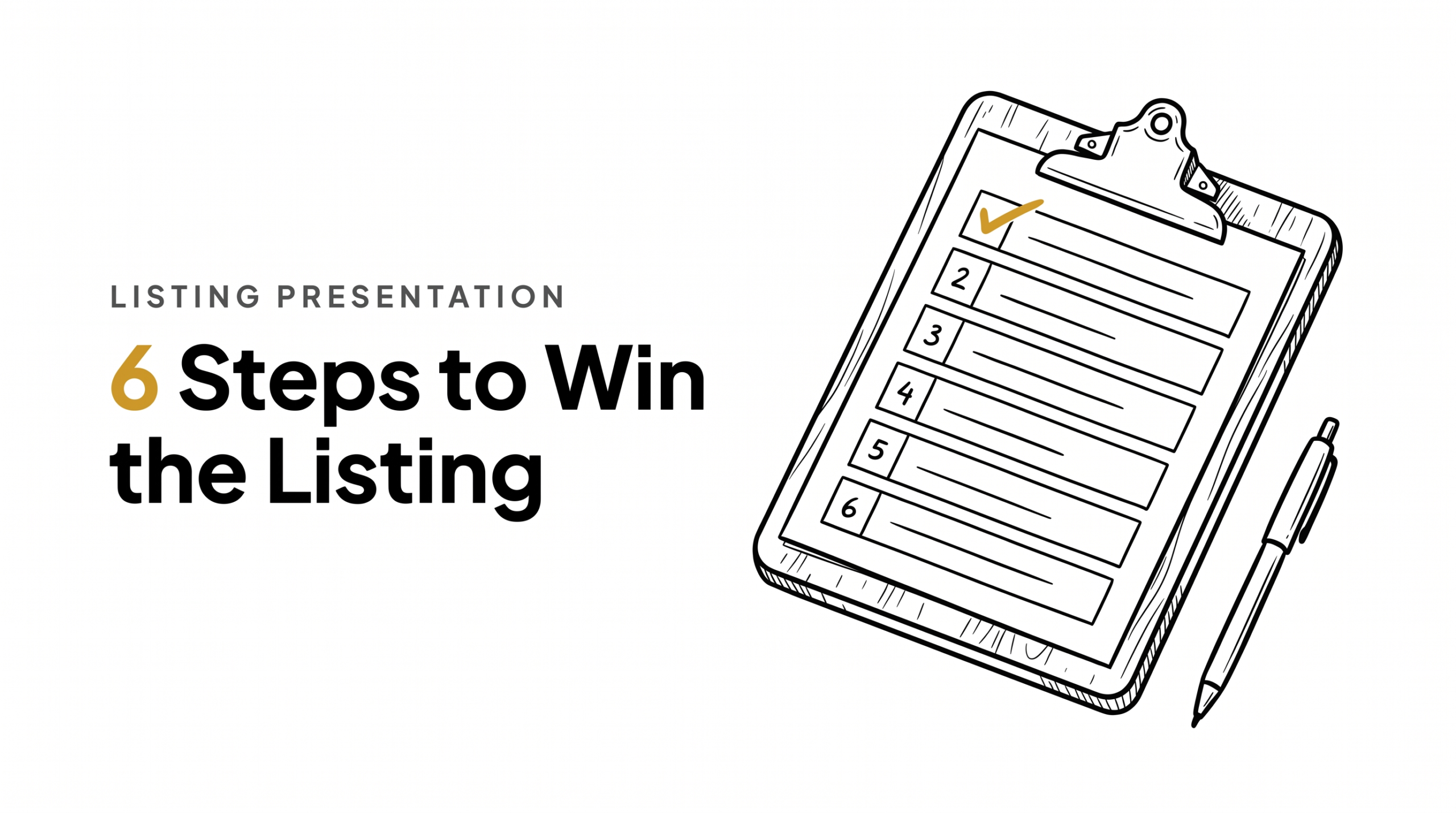
6 Steps to Structure a Listing Presentation That Actually Converts
Last Updated: March 31, 2026
Most agents lose listings in the first 10 minutes – not because a competitor offered a better marketing plan, but because they failed to establish why they are worth full commission before the conversation turned to price. A listing presentation is not a slideshow. It is a structured value conversation that moves a seller from “I’m interviewing three agents” to “I want to work with you.” This guide covers what to put in your presentation, how to structure it, and how to handle the commission objection without discounting.
Key Takeaways
- The listing appointment is won before you arrive – your pre-listing package sets the frame
- Lead with your results (data), not your process (features)
- Price is almost never the real objection – it’s a trust and value gap
- The CMA is a tool for pricing conversation, not the centerpiece of the presentation
- Follow-up after the appointment is where most listings are actually won or lost
Want a printable PDF of this guide?
Keep this at your desk. Enter your email below and I’ll send the Cheat Sheet straight to your inbox.
Table of Contents
- Before You Arrive: The Pre-Listing Package
- How to Structure the Appointment
- The CMA: How to Present Price Without Losing the Listing
- Handling the Commission Objection
- Closing the Appointment
- Follow-Up After the Appointment
- FAQ
Before You Arrive: The Pre-Listing Package
The listing appointment starts before you walk in the door. A pre-listing package sent 24-48 hours before the appointment does three things: it signals professionalism, it pre-answers common questions, and it frames you as the prepared agent before any competitor has said a word.
What to include in a pre-listing package:
- A brief bio and recent sales in the area (not your entire career history – just the relevant proof)
- Your marketing plan overview (where the home will be listed, how it will be promoted)
- 3-5 client testimonials, ideally from sellers in similar situations
- A brief explanation of your pricing process (sets expectations before the CMA conversation)
- Your contact info and a note about what to expect at the appointment
Send it as a PDF via email, and follow up with a text to make sure it landed. Sellers who read your pre-listing package arrive at the appointment already familiar with your track record. Sellers who haven’t received anything arrive cold.
This is also a qualifying signal: a seller who doesn’t read your package and arrives asking only about commission is showing you where their head is.
How to Structure the Appointment
The biggest mistake agents make is leading with their marketing plan. Sellers do not care about your marketing plan until they trust that you understand their situation.
The right order:
1. Ask questions first (10-15 minutes). Before you present anything, ask: Why are you thinking about selling now? Where are you going? What’s your timeline? Have you spoken with other agents? What matters most to you in this process?
Listening before presenting accomplishes two things: it gives you the information you need to tailor your presentation, and it shows the seller that you are interested in their situation, not just your pitch.
2. Present your track record (5-10 minutes). Specific data from your recent sales – average days on market, list-to-sale ratio, homes sold in this neighborhood or price range. Numbers beat claims. “I typically sell homes in under 14 days” is a claim. “My last 8 listings in this ZIP code averaged 11 days on market at 101% of list price” is proof.
3. Walk through your marketing plan (10 minutes). What specifically will you do that other agents won’t. Professional photography, video, 3D tour, targeted digital advertising, database marketing to buyers. Be specific. Generic “I’ll put it on the MLS and social media” is table stakes – every agent says this.
4. CMA and pricing discussion (15-20 minutes). Save price for after you’ve established value. A seller who trusts you will listen to your pricing recommendation. A seller who doesn’t trust you yet will reject your CMA as self-serving.
5. Commission and next steps (10 minutes). Address compensation last, after value is established.
The CMA: How to Present Price Without Losing the Listing
The comparative market analysis is where many listing appointments go wrong. Agents present a range, the seller anchors to the top number, and a gap opens that either ends the appointment or leads to an overpriced listing that sits.
How to present the CMA:
Lead with the data, not the number. Walk through the comparable sales: what sold, what didn’t, what the market is telling you. Let the data speak before you name a price.
Present a range, but have a recommended price. “The market data supports a range of $485,000-$510,000. Based on your home’s condition and the current supply in this neighborhood, I’d recommend listing at $495,000 to generate maximum competition in the first 10 days.”
Explain the cost of overpricing explicitly. Homes that sit get stigmatized. Price reductions signal to buyers that something is wrong. The data consistently shows that homes priced correctly from day one net more than homes that start high and reduce. NAR research on pricing strategy supports this – overpriced listings average more days on market and lower final sale prices.
If the seller pushes for a higher price, don’t argue. Ask: “What are you basing that number on?” Listen. Then walk back through the comps together. You’re not telling them they’re wrong – you’re showing them what the market is telling you both.
Handling the Commission Objection

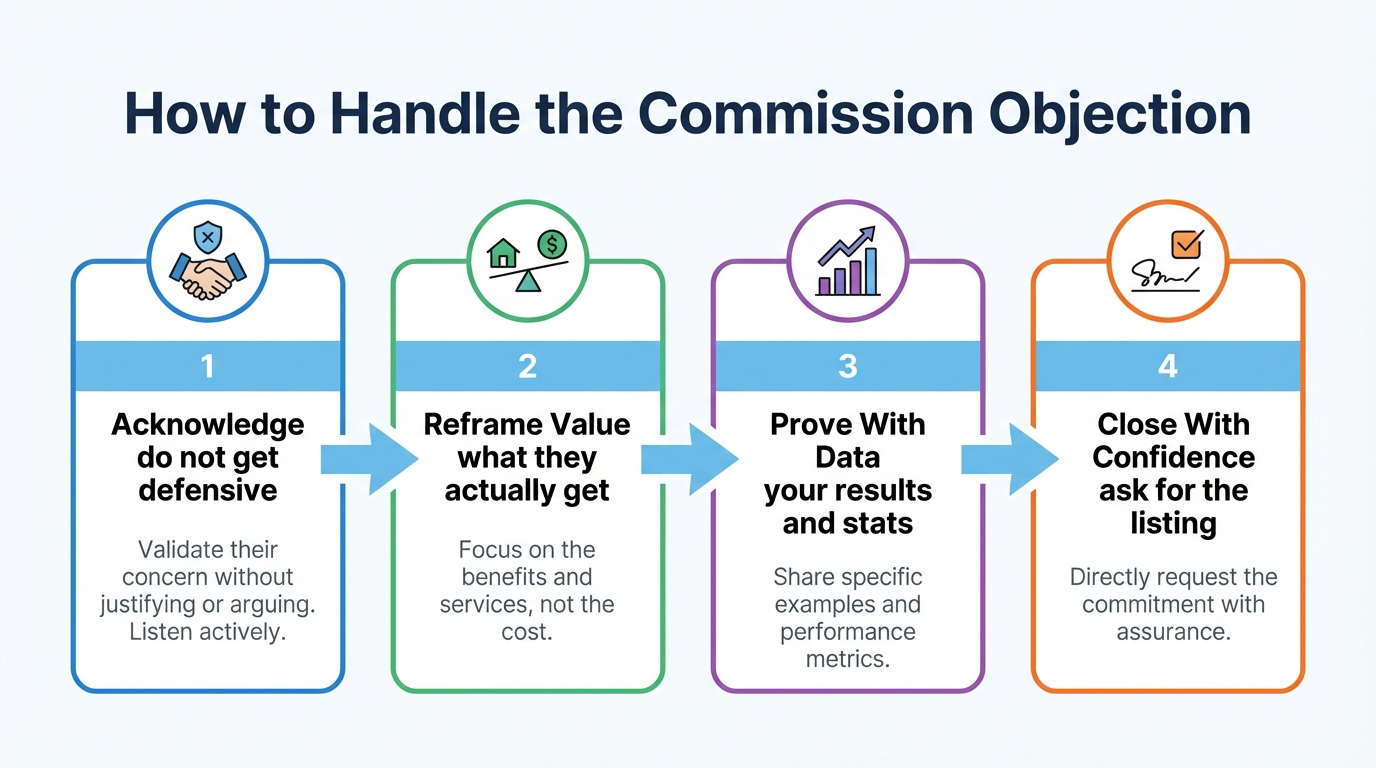
“Another agent said they’d do it for 1% less.” This objection is almost never really about 1%. It is about whether the seller believes the difference in service justifies the difference in cost.
The right response:
“I appreciate you telling me that. Can I ask – if both agents were going to net you the exact same amount at closing, would the fee matter?”
Most sellers say no. Then: “So the real question is whether I’m going to sell your home for enough more than the other agent to cover the difference – and then some. Let me show you what my average list-to-sale ratio has been versus the market average in this area.”
The conversation shifts from fee to net proceeds. A seller who nets $8,000 more through better pricing and negotiation doesn’t care about a $3,000 commission difference.
If a seller is genuinely price-sensitive and the only way to get the listing is to discount: decide whether it’s worth it. An underpriced listing that consumes 60 days of your time and produces referrals to low-fee clients is not a good business decision.
Closing the Appointment
Don’t leave without asking for the listing. Many agents present beautifully, answer every question, and then wait for the seller to say “let’s do it.” Sellers rarely volunteer that. You have to ask.
“Based on everything we’ve talked about, I’d love to be your agent on this. Are you ready to move forward, or is there anything else you need from me before you decide?”
If they’re not ready: “What would you need to feel confident moving forward?” Get a specific answer. Then address it.
If they’re interviewing other agents: “Totally understand. When do you plan to make a decision? I’ll follow up on [specific day].” Get a date. Put it in your CRM. Follow up on exactly that day.
Follow-Up After the Appointment
More listings are won in the follow-up than in the appointment itself. Sellers who are interviewing multiple agents often make their decision in the 24-48 hours after the last appointment.
Day of appointment: Send a thank-you text or email within 2 hours. Brief. “Thank you for your time today – it was great learning more about your plans. I’m here if you have any questions as you make your decision.”
Day 1 after: Email with something of value – a relevant article about the local market, a link to one of your recent sales in the area, or a brief note addressing a specific concern they raised in the appointment.
Day 2-3: Personal call or text. “Just checking in to see if you had any questions after our meeting.”
If no decision after 5 days: One more touch, then move to a low-frequency drip sequence in your CRM. Some sellers take weeks to decide. Stay present without being pushy.
This follow-up sequence is exactly why a real estate CRM matters for listing agents, not just buyer agents. The listing won in week three by the agent who kept following up is real.
FAQ
How long should a listing presentation be?
45-60 minutes is ideal. Under 30 feels rushed and doesn’t build enough trust. Over 90 minutes and you’re losing the seller’s attention. The listening portion at the start is the most important investment of time.
Should I leave behind a printed pre-listing package or go digital?
Digital is fine for most sellers. A printed package stands out for older demographics or luxury sellers where physical presentation signals premium service. Know your audience.
What if the seller already has a price in mind that’s too high?
Don’t agree to list at an unrealistic price just to get the listing. An overpriced listing damages your reputation, wastes your time, and usually ends in a price reduction anyway. Present the data clearly and honestly. If they won’t move, it’s okay to walk away.
How do I compete against a discount broker?
Don’t compete on price – compete on net proceeds. Show your list-to-sale ratio and days on market versus the market average. If you consistently sell homes for more and faster, the math usually favors full commission. Make that case with data.
Should I present virtually or in person?
In person whenever possible. Body language, the ability to walk the home together, and the personal connection of a face-to-face meeting all favor in-person. Virtual works for relocation sellers or initial consultations, but in-person closes at a higher rate.
The Bottom Line
A listing presentation is a trust-building conversation, not a pitch. Ask questions first. Lead with proof. Present price after value is established. Handle the commission objection by shifting the conversation to net proceeds. And follow up consistently until you get a decision.
The agents who win listings consistently are not necessarily the best presenters in the room. They are the most prepared, the most data-driven, and the most persistent in follow-up.
Is Your Real Estate Business Leaking Revenue?
Most agents are losing deals they don’t even know they have. Find out exactly where your business is broken and get a custom plan to fix it.