⏱ 20 min read
Published March 30, 2026
Automating the booking step with calendar automation removes the back-and-forth that kills conversion.
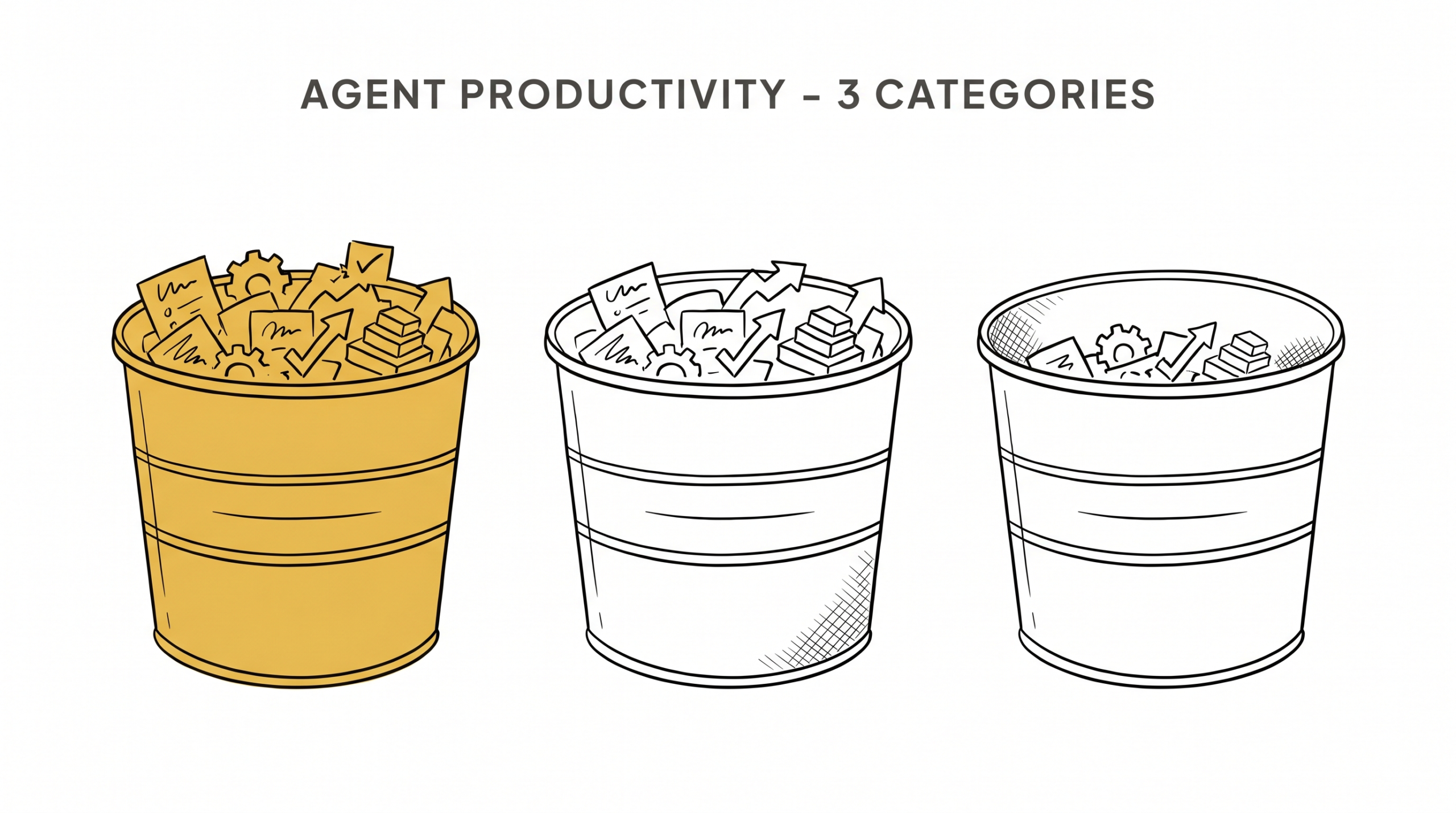
Agent Productivity: 3 Categories of Real Estate Work
Last Updated: March 30, 2026
The $300k agent and the $100k agent are often working the same hours. They have the same number of leads. They work in the same market. The gap isn’t talent, luck, or connections – it’s systems. The top producer has eliminated the manual, low-value work that consumes the average agent’s entire afternoon. What’s left is a calendar full of activities that actually generate income.
This post is about building that gap deliberately – understanding exactly where your time goes, deciding what to automate, and structuring your days around the work that moves the needle.
Key Takeaways
- Most agents can’t account for 40–50% of their workweek – that’s time being consumed by low-value tasks disguised as productivity
- Agent work falls into three categories: high-value (do this yourself), medium-value (batch or delegate), and should-be-automated (never do manually again)
- Time-blocking protects your most valuable hours from reactive, low-leverage activities
- Follow-up and database management are the two highest-value activities most agents are doing manually – and shouldn’t be
- The daily structure of a high-output agent is boring by design: consistent, protected, and ruthlessly prioritized
Table of Contents
- The Productivity Myth in Real Estate
- Where Your Time Actually Goes (The Honest Audit)
- The 3 Categories of Agent Work
- Time-Blocking for Dollar-Productive Activities
- What to Automate First
- The Daily Structure of a High-Output Agent
- FAQ
The Productivity Myth in Real Estate
Real estate culture glorifies hustle. Grinding. Being available 24/7. The agent who works every weekend, answers every text at 10pm, and never takes a day off is held up as the example to follow.
The data doesn’t support it. The highest-earning agents in any market are almost never the busiest-looking ones. They work normal hours. They take vacations. They don’t respond to every message immediately. What they have is a system that handles the low-value, repetitive work – so when they show up, they’re doing the things only they can do.
The productivity myth sells the idea that more effort equals more income. The truth is that more leverage equals more income. Effort is an input. Leverage – applied through systems, tools, and intelligent prioritization – is a multiplier.
Agents who break through income ceilings don’t do it by working more. They do it by eliminating the work that doesn’t need to happen manually at all. Agents who use a CRM see 29% higher sales productivity (Salesforce State of Sales) – the system multiplies your output without multiplying your hours.
Where Your Time Actually Goes (The Honest Audit)
Before you can fix your schedule, you have to see it clearly. Most agents have a rough sense of what they do but have never actually tracked it.
For one full week, log every activity and how long it took. Be specific. “Worked on follow-up” is not a time entry. “Sent 14 individual follow-up emails manually” is a time entry.
What most agents find when they do this honestly:
- 25–30% of the week goes to manual follow-up activities – texts, emails, calls to leads who never respond, check-ins that could be automated
- 15–20% goes to administrative work – updating the CRM, organizing contacts, scheduling, paperwork
- 10–15% goes to reactive communication – answering messages as they come in, regardless of importance
- 10% goes to prospecting activities (calls, door-knocking, networking) that directly generate new leads
- 15–20% goes to active client work – showings, negotiations, contracts, closings
For most agents, only about 25–35% of their week is spent on activities that directly generate or close business. The rest is overhead – some of it necessary, most of it automatable.
This is where real estate prospecting strategies fall apart in practice. Agents know what to do. They don’t have the time to do it because the low-leverage work has colonized their calendar.
The 3 Categories of Agent Work
Once you’ve done the audit, categorize every activity into one of three buckets.
Category 1: High-Value (Do This Yourself)
This is work that requires your judgment, your relationships, or your expertise. It directly generates revenue or converts existing opportunities.
- Listing appointments and buyer consultations
- Price negotiations and contract strategy
- High-value prospecting calls to warm leads and past clients
- Showing homes to motivated buyers
- Closing transactions
This is where your hours are most valuable. Protect this time at all costs.
Category 2: Medium-Value (Batch or Delegate)
Work that needs to happen but doesn’t need to happen constantly or require your real-time attention.
- Responding to inbound inquiries (can be batched twice a day instead of reactive)
- Reviewing and updating your CRM
- Creating and reviewing marketing materials
- Administrative tasks (scheduling, paperwork coordination)
Batch these into designated time blocks. Do them all at once, twice a day max. Don’t let them interrupt Category 1 activities.
Category 3: Should-Be-Automated (Never Do Manually Again)
These are the activities consuming the largest portion of your week for the lowest return.
- Initial follow-up with new leads
- Nurture emails to warm leads and past clients
- Appointment reminders
- Database check-ins at scheduled intervals
- Market update emails to your list
Real estate agents who prospect daily close 3x more transactions than those who prospect sporadically (REAL Trends) – but that daily prospecting only happens when Category 3 work is no longer consuming the same time slot. Automation is what creates the space.
Every hour you spend doing Category 3 work manually is an hour stolen from Category 1. This is the core argument for building a real estate follow-up system – not because manual follow-up is bad, but because automated follow-up frees you to focus on the work that requires a human.
Time-Blocking for Dollar-Productive Activities
Time-blocking means scheduling your high-value activities before anything else gets on your calendar. Not after. Not in the gaps. First.
A workable time-blocking structure for a full-time agent:
Morning block (8am–10am): Prospecting and outreach. Calls to warm leads, past clients, and referral sources. This is the hardest work to do – which is exactly why it has to happen first, before the day fills up with reactive tasks. Two hours of focused prospecting every morning is enough to build a serious business.
Mid-morning block (10am–12pm): Active client work. Appointments, showings, negotiations, contracts. The work that’s already in motion.
Afternoon block (2pm–4pm): Administrative and medium-value work. CRM review, follow-up responses (batched), marketing review. Do it all at once instead of scattered throughout the day.
Evening – no new work. If you’re doing the morning block correctly, evening shouldn’t be for working a new lead. It’s for existing client commitments that can’t be scheduled otherwise.
The key discipline: when someone requests your time during a protected block, you have a standing answer – “I have an appointment that time. I’m free at [X].” That appointment is your block. It’s real.
What to Automate First

If you’ve never automated anything in your business, start with these three, in order.
1. New lead follow-up. The first 14 days after a lead enters your database should run without your manual involvement. An instant text response, a 2-day follow-up, a value email on day 4 – all automated. This is the highest-leverage automation in real estate because speed matters most at the start, and manually doing this for every lead at all hours is impossible to sustain.
Nurtured leads produce a 20% increase in sales opportunities on average. (Demand Gen Report) Past client nurture is one of the highest-ROI activities in real estate – automating it means you capture that 20% lift without dedicating manual hours to it every month.
2. Past client nurture. Monthly value emails, quarterly home value updates, annual anniversary touchpoints – all of this should run automatically. The relationship is the most valuable asset in your business. Protecting it shouldn’t depend on you remembering to send an email.
3. Database reactivation sequences. Leads who have gone quiet for 90+ days should get a reactivation campaign without you having to identify them manually, build a list, and send individual messages. Let the system handle it. You step in when someone responds.
Real estate marketing automation covers the full technical picture of what tools make this possible and how they fit together. The short version: if it’s a repeatable message with a predictable trigger, it should be automated.
AI for real estate agents is also making some Category 2 tasks automatable that weren’t before – worth understanding where that’s going if you’re building systems for the long run.
The Daily Structure of a High-Output Agent
High-output agents don’t have exciting schedules. They have boring, consistent, protected ones.
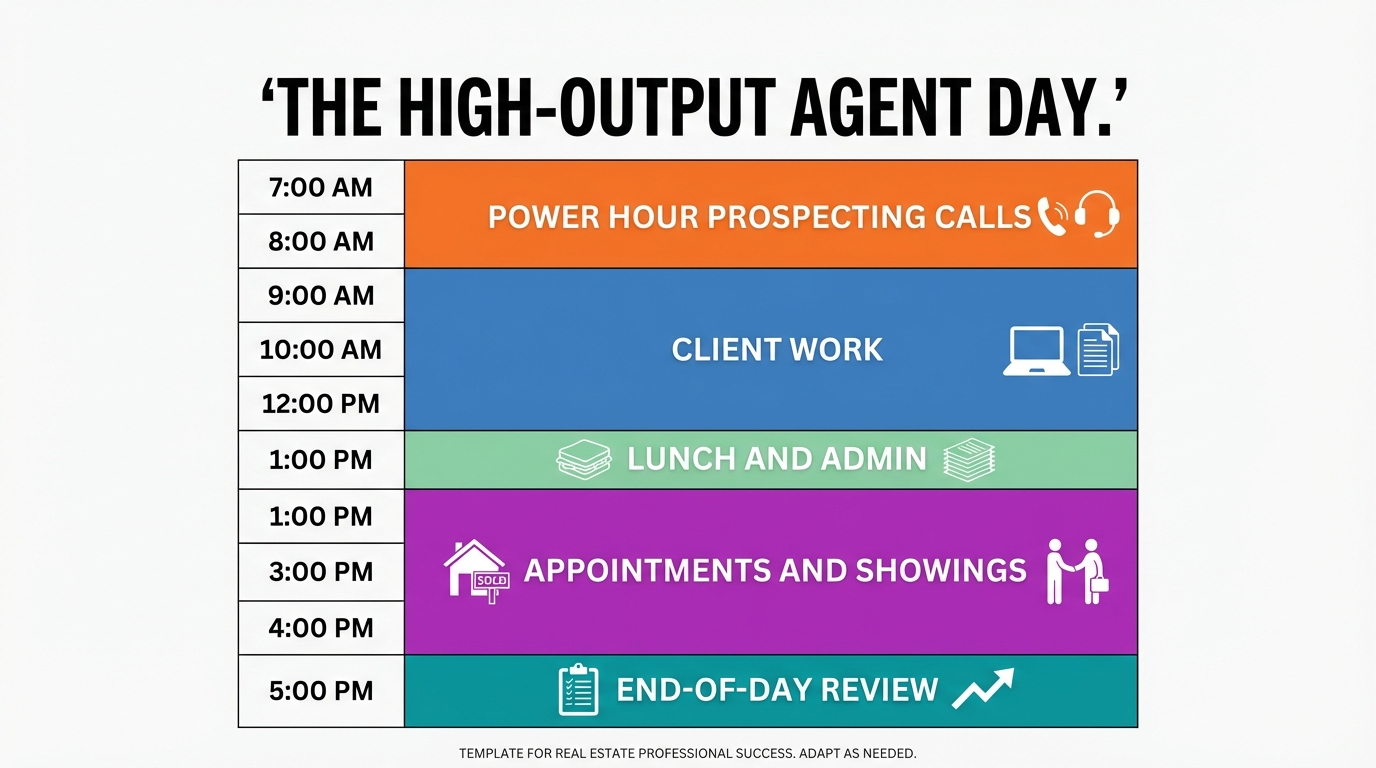
6:30–7:30am: Personal – exercise, breakfast, no phone.
7:30–8:00am: Review the day. Check your CRM for hot leads (anyone whose score spiked overnight, any responses that came in), confirm your morning call list, review your schedule. Fifteen minutes of preparation replaces an hour of reactive scrambling.
8:00–10:00am: Prospecting block. Calls only. No email, no texting during this window unless it’s a direct response to someone you just called. The goal is conversations – new and existing leads who need your personal attention.
10:00am–12:00pm: Client-facing appointments, showings, listing activity. If you have no appointments, this is prep time for upcoming ones or strategic work on your business.
12:00–1:00pm: Lunch. Not at your desk.
1:00–3:00pm: Transactions. Active deals – contracts, negotiations, inspections, closing coordination. This work has deadlines and belongs in a defined window, not scattered throughout the day.
3:00–4:30pm: Administrative block. CRM updates, batched email and text responses, marketing review, training, business development tasks.
4:30pm: Done. Your automation is handling everything else.
This is a structure, not a prescription. Adjust for your market, your family, your lead volume. The principle that doesn’t change: your highest-leverage activities are scheduled first and protected from interruption. Everything else fits around them.
FAQ
How do I get disciplined about time-blocking when real estate is unpredictable?
The unpredictability of active deals is real – closings move, inspections get complicated, clients have emergencies. But most of what agents call “unpredictable” is actually reactive habit – answering every message the moment it arrives. The fix is not a perfect schedule. It’s having a default structure that you return to when disruptions pass.
What if I’m a new agent and I don’t have enough clients to fill this schedule?
Double your prospecting block. If you have no active clients, you have 4 hours a day for prospecting. Most new agents use that time to look busy instead of doing the uncomfortable work of making calls.
How does automation help with productivity without making my follow-up feel robotic?
The best automated real estate follow-up feels personal because it’s written in your voice, references the lead’s specific situation, and is timed based on their behavior rather than a calendar. The automation handles the timing and delivery. You write the messages once, well.
How do I know which leads to prioritize in my morning prospecting block?
Lead scoring. Sort your CRM by behavioral score and call the highest-scored contacts first. The agents who do this well never wonder who to call – the answer is always the person whose score says they’re warm right now.
Is it really possible to work 40 hours a week and hit $300k?
Yes. Not in year one, and not without systems. But once your database is managed automatically, your follow-up runs without you, and your daily structure is protected, the income ceiling lifts. The work that generates revenue doesn’t require unlimited hours – it requires consistent, focused execution of a small number of high-leverage activities.
The Bottom Line
The productivity gap in real estate is a systems gap. Top producers don’t have more hours – they have fewer activities wasting them. They’ve automated the repeatable work, time-blocked the high-value work, and built a daily structure that defaults to dollar-productive activity instead of reactive noise.
Start by doing the honest time audit. Identify what you’re doing manually that should be running automatically. Then protect two hours every morning for the work that actually closes deals.
Is Your Real Estate Business Leaking Revenue?
Most agents are losing deals they don’t even know they have. Find out exactly where your business is broken and get a custom plan to fix it.