⏱ 14 min read
Published March 30, 2026
The Real Reason Zillow Leads Don’t Convert: 70% Stat
Last Updated: March 30, 2026
Most agents who struggle with Zillow leads will tell you the same thing: “The leads are garbage.”
Some of them are right.
But a lot of them are wrong – and the distinction matters more than you’d think.
Because if the problem is the leads, the fix is to stop paying for Zillow. If the problem is your process, the fix is free.
Let me show you why it’s usually your process.
The Numbers Behind the Frustration
Here’s what Zillow doesn’t put on their sales page:
Online real estate leads – from any platform – convert at roughly 0.5% to 1.5% on average. That means for every 100 leads you pay for, between 99 and 99.5 of them don’t close.
But here’s what almost nobody talks about: the national average for sphere-of-influence and past client referrals is 10–20%.
Same industry. Same market conditions. 10–20x difference in conversion rate. That gap is why 87% of real estate sales come from referrals or repeat clients (NAR, 2023) – the people who already know and trust you are almost always your highest-converting leads.
The leads aren’t the variable. The relationship is.
Why Zillow Leads Feel Like a Waste
You pay $500–$2,000 per month. Leads come in. You call them. Half don’t answer. The other half say “just browsing” and disappear. You follow up a few more times, nothing happens. You write them off.
Sound familiar?
Here’s what’s actually happening in that sequence:
Speed-to-lead is brutal. Studies consistently show that leads contacted within 5 minutes are 100x more likely to convert than leads contacted 30 minutes later. Research from InsideSales.com and MIT confirms that leads contacted within 5 minutes are 21x more likely to respond than those contacted after 30 minutes. (InsideSales.com / MIT Lead Response Management Study) Zillow shares leads with multiple agents simultaneously. You’re not just competing with yourself – you’re competing with whoever calls first.
Most agents follow up 2–3 times and stop. Industry data shows the average consumer needs 8–12 touchpoints before making a real estate decision. The average agent gives up after 2. In fact, it takes an average of 8 follow-up attempts to reach a prospect, yet 44% of salespeople give up after just one. (RAIN Group) Your “bad lead” is usually just an under-nurtured lead.
Cold leads need a different approach. Someone who clicked a Zillow listing at 11pm is not in the same mindset as someone who was referred to you by their best friend. They’re curious, not ready. Treating them the same way gets the same results – which is nothing. Pair this with an AI database reactivation system to turn your cold list into booked appointments.
The Real Problem: No Follow-Up System
Let’s be honest about what happens when a Zillow lead comes in for most agents.
Day 1: Call, no answer. Leave a voicemail.
Day 2: Text. No response.
Day 3: Maybe another call.
Day 7: Nothing. Lead gets forgotten.
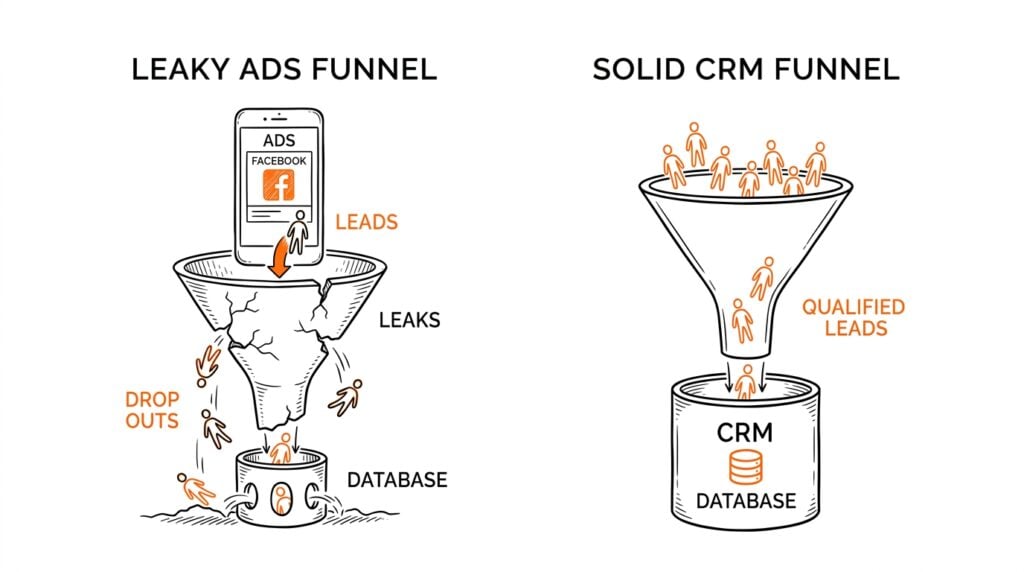
That’s not a lead quality problem. That’s a follow-up process problem.
The agents consistently converting Zillow leads (they exist – I’ve seen the numbers) are doing something different:
- Immediate automated response – text or email within minutes, not hours
- Multi-channel follow-up – phone, text, email, not just one
- Long-term nurture – 6 months to 2 years of consistent touchpoints
- Value before ask – market updates, local content, useful information before ever pitching
Most agents don’t have this system. So they pay for leads, follow up 2–3 times, get frustrated, blame Zillow, and either quit or keep paying while complaining.
The Math That Exposes the Real Problem
Let’s put actual numbers on this.
Say you spend $1,500/month on Zillow. That’s $18,000/year.
You close 3 deals from those leads. Average commission: $8,000. Total from Zillow leads: $24,000. Net after spend: $6,000 before expenses.
That feels okay-ish. Until you look at the opportunity cost.
You have a database of 200 past clients and sphere contacts. You’re barely touching them – birthday texts, holiday cards, sporadic social posting.
What if even 5% of those 200 people referred you just once this year? That’s 10 referrals. Closing 7 of them (70% conversion vs. sub-2% for cold) at $8,000 each = $56,000.
You left $56,000 on the table to fight for $6,000.
The leads aren’t garbage. Your allocation is.
When Zillow Leads Are Actually a Problem
To be fair: sometimes the leads really are low quality.
Zillow’s model incentivizes high volume over high intent. They’ll sell you leads from people who clicked a listing once at midnight without any real interest in buying for two years.
There are markets and price points where Zillow leads perform reasonably well. There are others where you’re basically paying for a list of people who were browsing instead of buying.
The honest test: If you had a legitimate 12-touch nurture sequence running for every lead you’ve ever received – text, email, phone, value content – and your conversion rate was still under 2%, then yes, the leads are the problem.
But most agents have never run a real nurture sequence. Most have followed up 2–3 times and stopped.
So before you blame the lead source, run the math on your follow-up first.
The Agents Getting ROI from Zillow
They exist. Here’s what they have in common:
Speed. They’re calling within minutes of a lead coming in – not hours. This alone separates the top converters from everyone else.
Automation doing the heavy lifting. CRM automations send an immediate personalized text, follow-up email, and enroll every lead in a 12-month nurture sequence. The agent doesn’t have to remember to follow up – it happens automatically.
A real database strategy running in parallel. The agents getting ROI from cold leads aren’t relying on cold leads. They’re using Zillow to fill gaps while their sphere and database does most of the heavy lifting. Cold lead conversion pays for the system. Database referrals build the business.
A longer game. They treat every Zillow lead as a 12-18 month opportunity, not a this-week opportunity. Leads that “don’t convert” in 30 days get nurtured for 6 months until they’re actually ready.
What to Do With This
You have two levers.
Lever 1: Fix your follow-up. Before you decide whether to keep paying Zillow, put every past lead into a real nurture sequence. 12 touchpoints over 6 months. Track what actually converts. You might find you’ve been sitting on a list of warm leads this whole time.
Lever 2: Reallocate. If Zillow is genuinely underperforming even with a real nurture system, take half that budget and put it into your database. Consistent content, automated post-close sequences, quarterly personal outreach to your sphere. Your existing contacts convert at 10–20x the rate of cold leads. That math always wins.
The goal isn’t to never run paid ads or never use lead platforms. The goal is to build a business where your database does most of the work – so you’re not dependent on whatever platform decides to raise prices next quarter.
Want to find out where your biggest conversion leak is? Take the 2-minute quiz – it diagnoses your specific bottleneck: are you a lead chaser, an invisible agent, or something else? Takes 2 minutes.
Or if you want to see how the math works for your specific database, try the Lead Nurture ROI Calculator – plug in your numbers and see exactly what your database should be generating.