⏱ 20 min read
Published March 30, 2026
Real Estate Drip Campaign: 3 Sequences Every Agent Needs
Last Updated: March 30, 2026
Your drip campaign isn’t working – and you probably already know it. Leads opt in, get three generic emails about “the home buying process,” and never respond again. The problem isn’t that drip campaigns don’t work. The problem is that most agents build them wrong.
The campaigns that convert don’t look like campaigns. They feel like a real agent paying attention to a real person at the right time.
Key Takeaways
- Generic drip sequences fail because they ignore where a lead actually is in their journey
- Every agent needs three separate drips: new lead, warm lead, and past client
- The first 14 days after a lead comes in are the highest-leverage window you have
- Email timing matters as much as email content – send based on lead behavior, not a calendar
- Pull people out of automation the moment they show real buying or selling intent
Table of Contents
- Why Most Drip Campaigns Fail
- The 3 Drip Campaigns Every Agent Needs
- New Lead Drip: The First 14 Days
- Warm Lead Nurture: The Long-Game Drip
- Past Client Drip: Monthly Value That Keeps You Top of Mind
- Writing Emails People Actually Open
- When to Pull Someone Out of the Drip
- FAQ
Why Most Drip Campaigns Fail
Open rates on generic real estate drip emails hover around 15–20%. Click rates are often below 2%. That’s not a content problem – it’s a relevance problem. Nurtured leads produce a 20% increase in sales opportunities on average (Demand Gen Report) – but only when the nurture is relevant and consistent, not when it is generic noise that trains people to ignore you.
Most drip campaigns fail for the same reasons:
They’re written for a fictional average lead. A first-time buyer in month one of their search gets the same sequence as a relocating executive who needs to close in 45 days. Different people, same emails.
They’re timed to a calendar, not behavior. Email 1 goes out on day 1, email 2 on day 4, email 3 on day 7 – regardless of whether the lead opened anything, clicked anything, or called you.
They’re about the agent, not the lead. “I’ve been in real estate for 15 years.” “Our team sold $42 million last year.” No one cares. They care about their situation.
They have no exit. Good drip sequences have triggers. When someone shows real intent – responding, scheduling a call, visiting your site multiple times – they leave the automated sequence and get your personal attention. Most campaigns just keep running forever until someone unsubscribes.
A good real estate follow-up system starts with segmentation. Before you write a single email, you need to know who you’re writing it for.
The 3 Drip Campaigns Every Agent Needs
Don’t build one drip campaign. Build three – and keep them separate.
1. New Lead Drip – For contacts who just entered your database and haven’t had a real conversation yet. Goal: establish relevance, earn trust, get them to respond.
2. Warm Lead Nurture – For contacts who’ve engaged but aren’t ready yet. Maybe they’re 3–6 months out. Maybe they’re watching the market. Goal: stay top of mind until their timeline activates.
3. Past Client Drip – For people who already closed with you. Goal: keep the relationship alive so you get the referral and the repeat business.
Each campaign has a different tone, a different cadence, and a different goal. Treating all three the same is what creates the generic, ignored drip sequence every agent complains about.
New Lead Drip: The First 14 Days
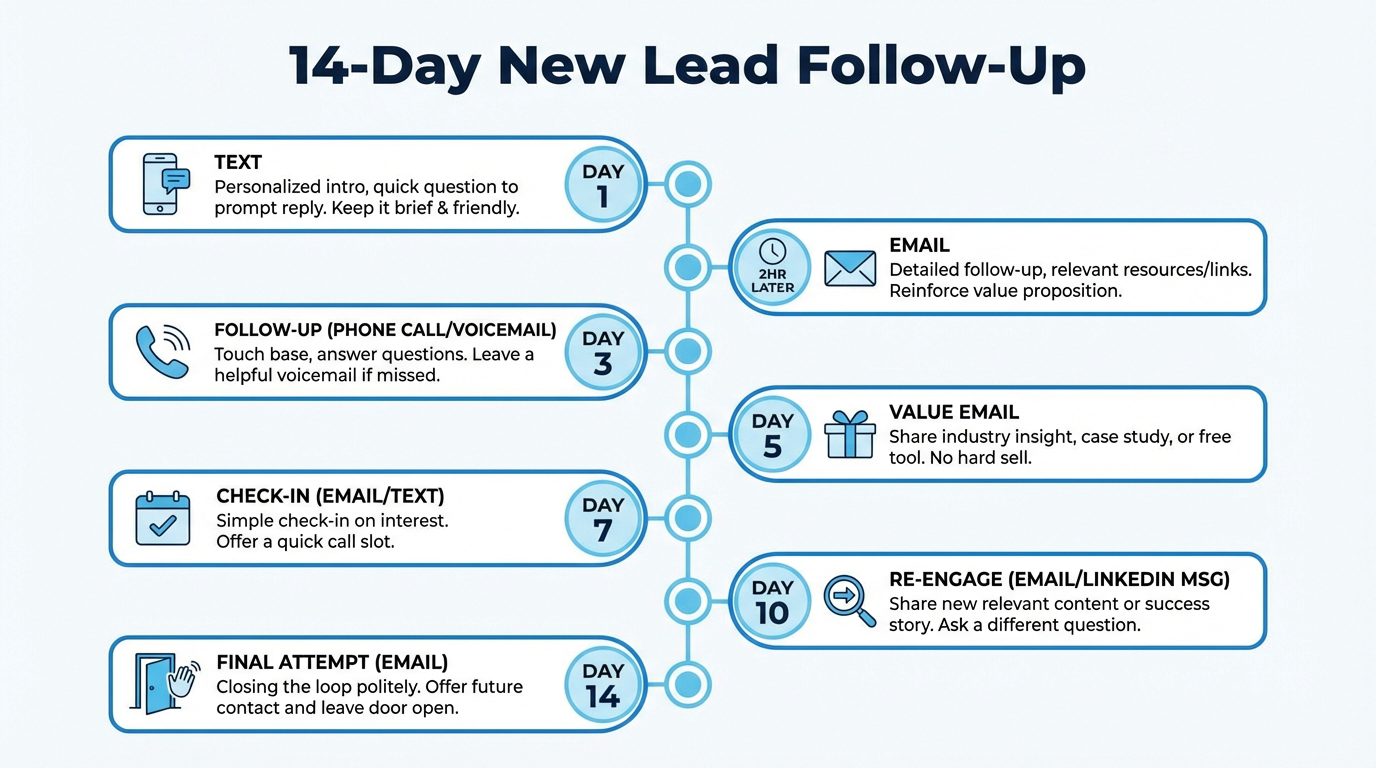
The first two weeks after a lead comes in are your highest-leverage window. They just took action. They’re thinking about real estate right now. This is when you have the most attention and the least competition.
Only 2% of sales happen at the first point of contact. (Sales Insights Lab) A 14-day new lead sequence is designed to build the trust and familiarity that covers the other 98% of the decision journey.
Day 1 – Immediate response (within 5 minutes if possible): Not a form letter. A short, human message that references how they came in. “Hey [Name] – saw you requested info on homes in [neighborhood]. Happy to help. What’s your timeline looking like?” If you can’t respond personally in 5 minutes, automate real estate follow-up so the first touch is instant and the personal call comes shortly after.
Day 2 – Local market snapshot: One specific data point about their target area. Not a generic market report – a one-paragraph update on what’s happening in the neighborhoods they care about. Show them you know the market and you’re paying attention to their specific situation.
Day 4 – Value email: Something useful with no ask attached. A checklist, a common mistake first-time buyers make in that market, a breakdown of what closing costs actually look like. Give before you ask.
Day 7 – Social proof + soft CTA: A short client story (not a wall of testimonials) that mirrors their situation. End with a low-friction ask: “Would it make sense to hop on a quick call this week?” Showing social proof on demand at the exact moment a lead hesitates can dramatically lift response rates.
Day 10 – Hyperlocal content: Neighborhood-specific. Schools, commute times, walkability, what’s been selling and for how much. This is what separates agents who know the market from agents who send Zillow links.
Day 14 – Check-in: Simple, direct, short. “Still thinking about [area]? Happy to help whenever the timing is right.” No pressure. No pitch.
After day 14, if there’s no response, the contact moves to the warm lead nurture sequence.
Warm Lead Nurture: The Long-Game Drip
Most deals don’t close in two weeks. Buyers and sellers spend months – sometimes over a year – before they’re ready to act. The agents who win those deals are the ones still in the inbox when the moment arrives.
Warm lead nurture runs longer and slower. Once a month is usually right. The goal isn’t conversion – it’s presence.
What works in a monthly warm lead sequence:
- Market updates with a point of view. Not just data – your read on what the data means. “Inventory is up 12% in [area] but days on market hasn’t moved, which tells me sellers still have leverage. Here’s what I’d do if I were buying right now.”
- Hyperlocal news. New development, school rating changes, infrastructure projects – anything that affects property values in the neighborhoods they care about.
- Seasonal timing emails. Spring market preview. Summer slowdown. Fall buying window. These feel timely and create a natural reason to reach out.
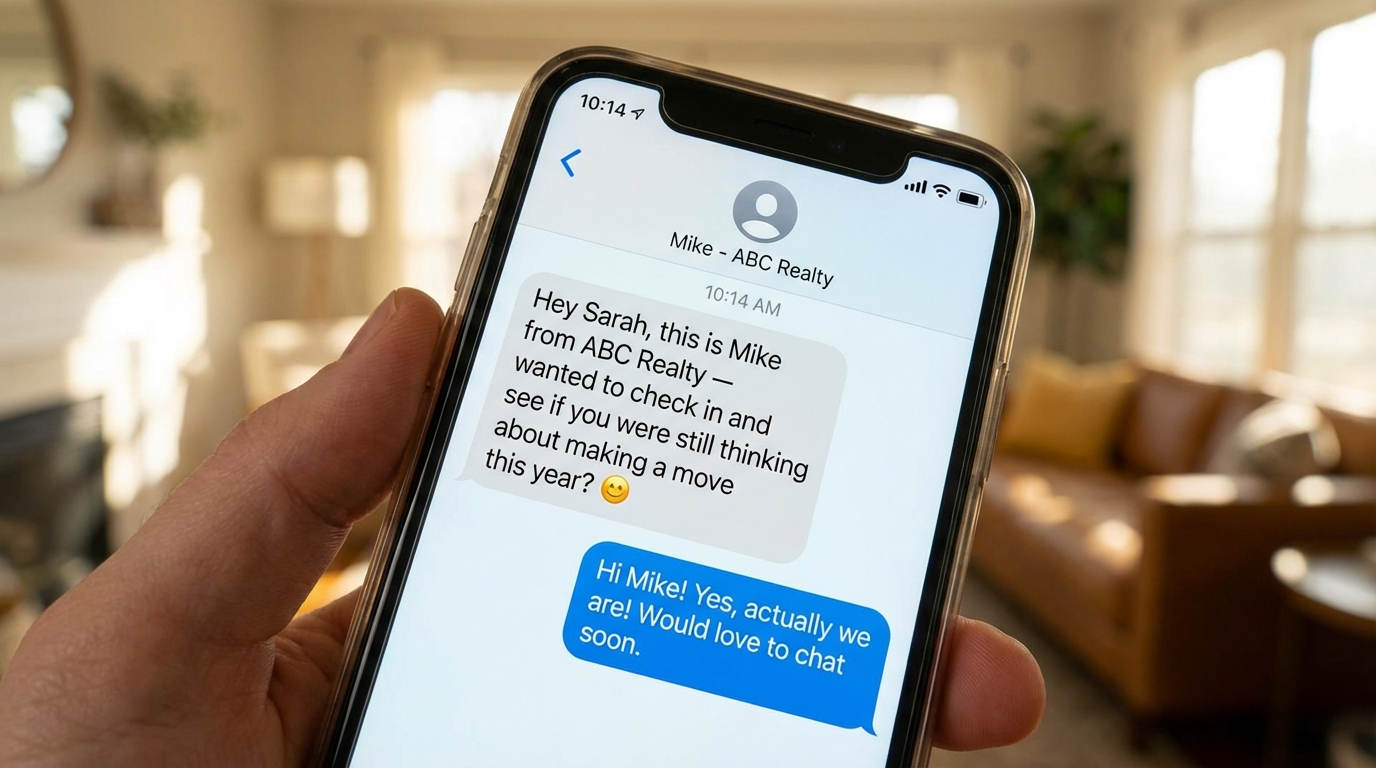
- Low-friction check-ins. Every 90 days, a short personal note: “Still on your radar to make a move this year? Just checking in.” The bar to respond is low, and these generate more replies than any content email.
For a deeper look at how real estate email marketing fits into a long-term nurture strategy, that post covers the mechanics in detail.
Past Client Drip: Monthly Value That Keeps You Top of Mind
Your database is your most valuable asset. The agents who figure this out stop chasing new leads and start protecting the relationships they already have. It takes an average of 8 follow-up attempts to reach a prospect, yet 44% of salespeople give up after just one (RAIN Group) – your past client drip is what keeps you in the game long enough to earn the referral and the repeat business.
Past clients should hear from you monthly, minimum. But not with “just checking in” fluff – with actual value.
What past clients care about after closing:
- Their home’s value. Send a quarterly home value update specific to their address. Not a Zillow estimate – your read on what their home would sell for today based on recent comps.
- Neighborhood news. What’s changing near them. New businesses, development projects, school changes. They care because they live there.
- Home maintenance reminders. Seasonal tips. HVAC filters, gutter cleaning, winterizing pipes. Practical, useful, zero sales pressure.
- The annual check-in. Once a year, reach out personally – call or text – around the anniversary of their closing. This one touch alone generates more referrals than most agents’ entire marketing budgets.
A well-managed real estate database should tell you when every past client’s anniversary is, what they bought, and when they’re likely to move again.
Writing Emails People Actually Open
Subject lines determine whether your email gets opened or deleted. A few rules that work:
- Keep it under 50 characters. Mobile preview cuts off anything longer.
- Make it specific. “3 homes sold in [neighborhood] this week” outperforms “Market Update – [Month]” every time.
- Use their first name sparingly. Once in a while it works. Every email looks like a mail merge.
- Avoid spam trigger words. “Free,” “guaranteed,” “limited time,” “act now” – these put you in the promotions folder or junk before anyone sees the subject line.
- Plain text outperforms HTML for personal feel. Heavy templates with headers and logos look like mass marketing. A clean text email looks like it came from a real person.
Short paragraphs. One main point per email. One CTA – never more than one.
When to Pull Someone Out of the Drip
Automation is a bridge, not a relationship. The moment someone shows real intent, they should come out of the sequence and into your personal attention.
Signals that someone is ready for direct outreach:
- They replied to any email – even a one-word response
- They visited your website multiple times in a short window
- They clicked a link about a specific listing or neighborhood
- They called or texted you unprompted
- Their timeline shortened (you found out they’re moving for a job, divorce, etc.)
At this point, the drip campaign has done its job. Stop the automation, pick up the phone, and have a real conversation. This is where real estate lead conversion actually happens – not in the sequence itself, but in the handoff from automated to personal.
FAQ
How many emails should be in a real estate drip campaign?
For a new lead drip, 5–7 emails over 14 days is enough. Warm lead nurture should run indefinitely at roughly one email per month. Past client drips should be monthly with a quarterly home value update mixed in.
What’s the best time to send real estate drip emails?
Tuesday through Thursday, between 9–11am or 1–3pm in the lead’s time zone. Avoid Monday mornings and Friday afternoons – inboxes are either overwhelming or empty.
Should I use a CRM to run my drip campaigns?
Yes. Trying to manage drip campaigns manually in Gmail is not a system – it’s wishful thinking. A real estate CRM with automation lets you trigger sequences based on behavior, not just time. Check out Real Estate CRM: Do You Actually Need One? if you’re still on the fence.
How do I avoid landing in spam?
Use a verified sending domain, keep your list clean (remove bounces and unsubscribes immediately), avoid spam trigger words, and send from a real email address – not a generic “info@” or “noreply@” address.
What if someone never responds to any email?
After 6–12 months of no engagement on a warm lead, send a final re-engagement email: “Is [goal] still on your radar, or should I remove you from my list?” That email often gets responses from people you’d written off – and cleanly removes the ones who are truly gone.
Want to skip building this from scratch? The nurtureBEAST database reactivation system combines automated drip sequences with AI-powered follow-up so you get consistent conversations without managing it manually.
The Bottom Line
A drip campaign that works isn’t a spray of generic emails – it’s a structured system that delivers the right message to the right person at the right time and hands them off to you the moment they’re ready to act. Build your three sequences, write for a real person instead of an imaginary average lead, and set clear triggers for when automation ends and your personal follow-up begins.
Is Your Real Estate Business Leaking Revenue?
Most agents are losing deals they don’t even know they have. Find out exactly where your business is broken and get a custom plan to fix it.