⏱ 18 min read
Published March 31, 2026
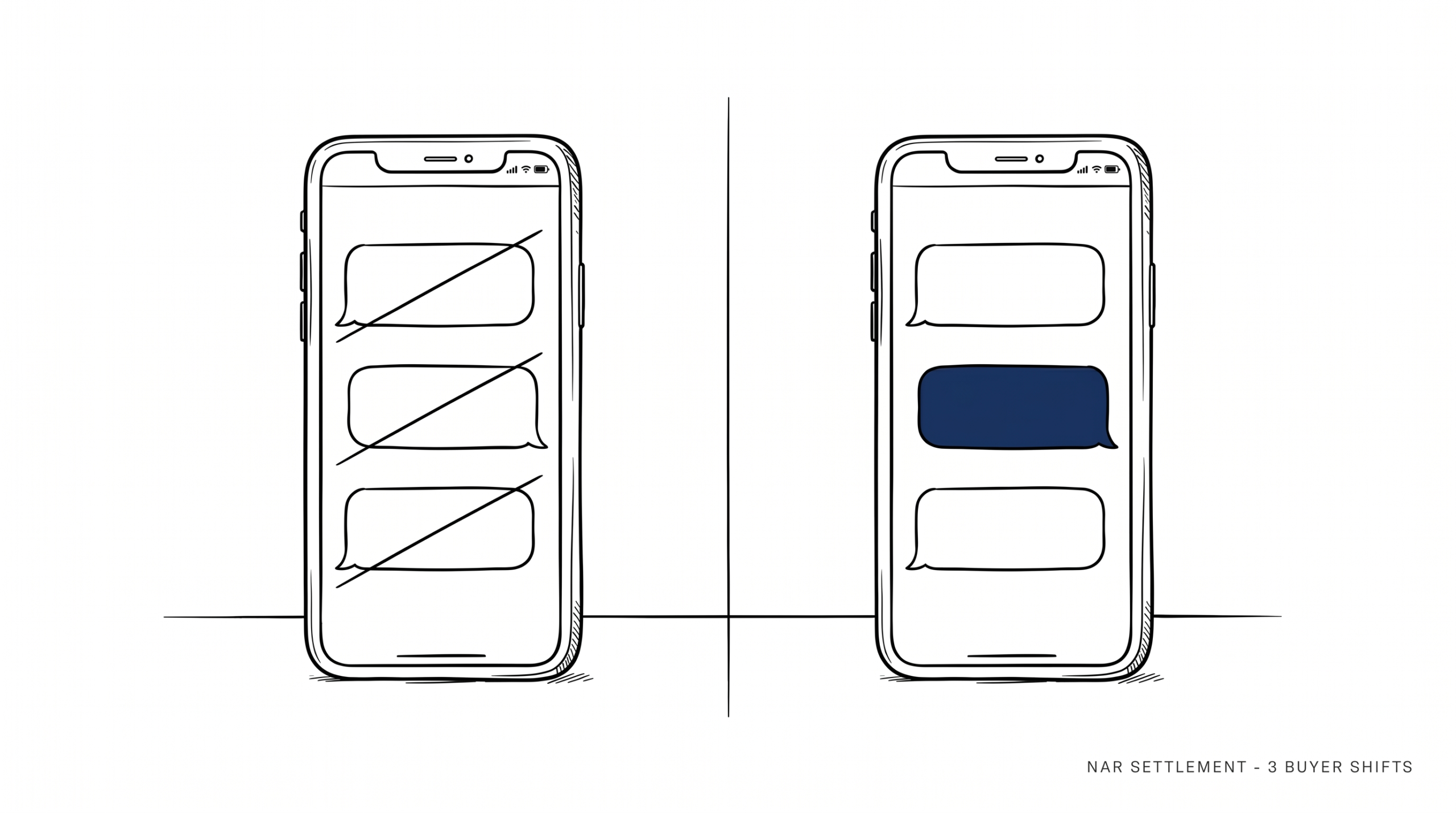
NAR Settlement: 3 Buyer Follow-Up Shifts You Need Now
Last Updated: March 31, 2026
The NAR settlement that took effect in August 2024 changed the rules around buyer agent compensation and MLS offers of compensation. For many agents, the immediate reaction was anxiety. For agents with strong databases and clear follow-up systems, it turned out to be less disruptive than feared – and in some cases a competitive advantage. This post explains what actually changed, what it means for how buyers engage with agents today, and how to adjust your follow-up and communication strategy to win in the new environment.
Key Takeaways
- The NAR settlement banned sellers from offering buyer agent compensation on the MLS – it doesn’t ban compensation itself
- Buyers can still negotiate for sellers to cover buyer agent fees, and many still do
- The change puts more pressure on agents to articulate their value early, before the buyer is committed
- Your follow-up system needs to be adapted to get to a buyer representation agreement conversation faster
- Agents who had strong databases before August 2024 reported less disruption than those dependent on cold leads
Table of Contents
- What the NAR Settlement Actually Changed
- What Stayed the Same
- How Buyer Behavior Has Shifted
- Adapting Your Follow-Up for the New Environment
- The Value Conversation: How to Have It Early
- Why Your Database Matters More Now
- FAQ
What the NAR Settlement Actually Changed

The settlement – formally the Burnett v. NAR case – resulted in NAR agreeing to a series of rule changes that took effect in August 2024.
The key rule change: Sellers can no longer offer buyer agent compensation through MLS listings. Before August 2024, it was standard for a seller to offer, say, 2.5-3% to a buyer’s agent as part of the MLS listing. That offer would show up in the MLS data and create an implicit understanding that the seller was funding the buyer side.
What this does not mean: It does not ban buyer agent compensation. Buyers and sellers can still negotiate compensation in multiple ways:
- The buyer pays their agent directly, negotiated in the buyer representation agreement
- The buyer asks for the seller to cover their agent’s fees as part of their purchase offer – this is still legal and common
- The seller voluntarily offers compensation in marketing materials outside the MLS
The practical effect is that compensation is now negotiated deal by deal rather than preset in MLS. This adds friction and requires agents to have a clear compensation conversation before showing homes.
What Stayed the Same
Buyer representation is still valuable. Buyers still need someone to navigate contracts, negotiate terms, handle inspections, coordinate with lenders, and manage the transaction. That value didn’t disappear.
Most deals still involve buyer agent compensation. In the months following August 2024, the majority of transactions continued to include buyer agent compensation – just negotiated through the offer rather than preset in the MLS. NAR’s own tracking of post-settlement transaction data showed minimal change in actual compensation rates in most markets.
Seller-paid compensation is still common. In a buyer’s market or with motivated sellers, concessions are expected. Buyers routinely ask for seller-paid buyer agent fees as part of their offer, and sellers accept – especially when the alternative is a less competitive offer or a longer time on market.
How Buyer Behavior Has Shifted
The settlement has made buyers more aware that agent compensation is negotiable. That awareness changes how they engage early in the process.
More buyers now Google “do I have to pay a buyer’s agent” before selecting one. More are open to discount or flat-fee representation for simple transactions. Some are attempting to go unrepresented on purchases, particularly for new construction (where builder sales reps represent the builder, not the buyer).
What this means practically: agents who relied on buyers simply “picking them up” through open houses or referrals with no early value conversation are losing some of those buyers to agents who can articulate their value clearly and early.
The buyers who do work with agents are making that choice more deliberately. They’re selecting based on track record, responsiveness, and demonstrated knowledge – not just convenience. This favors agents with strong reputations and consistent follow-up.
Adapting Your Follow-Up for the New Environment
The follow-up change the settlement requires is simple but important: have the representation agreement conversation earlier.
Before August 2024: Many agents showed homes first, built rapport, and then moved toward a representation conversation organically. The compensation was implied by MLS norms.
After August 2024: You need a buyer consultation and signed representation agreement before showing homes. This is now the MLS rule. The conversation has to happen sooner.
What this means for your lead follow-up sequence:
Your first contact with a buyer lead – whether through an automated text or a personal call – should include language that sets up a buyer consultation. Not in a heavy-handed way, but something like: “Before I start sending you listings, I’d love to do a quick 20-minute call so I can understand exactly what you’re looking for and explain how I work with buyers. That way I can save you time and make sure I’m actually helpful.”
A buyer who agrees to that call is significantly more likely to sign a representation agreement than one who just gets sent listings. The consultation is your opportunity to demonstrate value before the buyer has any reason to question your fee.
Your real estate follow-up system should have a specific buyer consultation booking sequence as a step in the buyer lead workflow.
The Value Conversation: How to Have It Early
The settlement has effectively forced a conversation that good agents were already having. Here is how to frame it:
Lead with what you do, not what you charge. “I’m going to help you find the right home, negotiate the price and terms, manage the inspection process, coordinate with your lender, and handle everything through to closing. Here’s what that looked like on my last five transactions…” Then show results.
Address compensation directly and without apology. “As of August 2024, I work under a buyer representation agreement that spells out how my fee works. In most cases, we negotiate for the seller to cover it as part of your offer – which means you typically don’t write a check. But if we’re in a situation where that’s not possible, here’s how it works…” Confidence and transparency close more deals than hedging.
Reference your track record. Days on market, average list-to-sale ratio, inspection successes, competitive market wins. Numbers make the value conversation concrete.
Agents who were already doing this – who had a real buyer consultation process – reported the smoothest transition post-settlement. Those who were winging it found the new environment harder.
Why Your Database Matters More Now
Cold buyer leads – people who found you through Zillow or a Facebook ad with no prior relationship – are more likely to shop around on compensation now that they know it’s negotiable. Referral buyers and past clients are not.
A buyer referred by a past client comes in pre-trusting you. The conversation about representation and compensation is much easier because the trust is already established. 87% of real estate sales come from referrals or repeat clients (NAR, 2023) – that number reflects exactly this dynamic.
This is why agents who entered August 2024 with a healthy, active database of past clients and sphere reported minimal disruption. Their buyer leads came through relationships where value was already understood.
If your business is heavy on cold online leads, the settlement creates additional pressure to convert those buyers to committed clients faster – which requires better follow-up and an earlier consultation process.
For building and maintaining that database, see our guides on sphere of influence marketing and real estate database reactivation. Pair this with an AI database reactivation system to turn your cold list into booked appointments.
FAQ
Can sellers still offer to pay the buyer’s agent commission?
Yes – just not through an MLS listing. Sellers can offer buyer agent compensation in marketing materials, in purchase negotiations, or by accepting a buyer’s request for seller concessions that cover the buyer agent fee.
Do I need a buyer representation agreement before showing homes?
Under the new NAR rules (for NAR member agents), yes – written representation agreements are required before showing homes. The specifics vary by state, as some states had this requirement already.
How has the settlement affected agent income in practice?
Early data suggests most agents in most markets have not seen dramatic income changes. The bigger impact has been on agent selection – buyers are more deliberate, which means agents with clear value propositions and strong reputations are competing better, while agents who relied on passive conversion are struggling more.
What should I include in my buyer consultation to justify my fee?
Your track record (homes found, deals negotiated, what you saved clients), your process (how you handle inspections, contingencies, and the transaction), and your local market expertise. Numbers and specifics outperform generic promises.
Is this a good time to reduce my buyer agent fee to compete?
Competing on price in a relationship-based business is generally a losing strategy. Most buyers are not selecting their agent based on a 0.25% fee difference. They’re selecting based on trust, competence, and responsiveness. Focus on demonstrating those rather than discounting.
The Bottom Line
The NAR settlement changed the mechanics of buyer agent compensation – not the underlying value of buyer representation. Agents who can articulate their value clearly, start the representation conversation early in the follow-up sequence, and maintain a strong database of past clients and sphere are navigating the post-settlement environment well.
The agents struggling most are those who depended on implied compensation norms and passive buyer conversion. The fix is the same as it was before August 2024: build a strong database, stay top of mind with past clients, and have a clear buyer consultation process that earns a signed agreement before the first showing.
Is Your Real Estate Business Leaking Revenue?
Most agents are losing deals they don’t even know they have. Find out exactly where your business is broken and get a custom plan to fix it.