⏱ 18 min read
Published March 31, 2026
Power Dialer for Real Estate: 50% More Calls, Worth It?
Last Updated: March 31, 2026
A power dialer can triple the number of leads you reach in a prospecting session. It can also be an expensive distraction if your database isn’t large enough to justify it or your follow-up system isn’t ready for the calls it produces. This guide explains what a power dialer does, when it actually makes sense for a real estate agent or team, what to look for in a tool, and what the alternatives are if you’re not at the scale where one makes sense yet.
Key Takeaways
- A power dialer automates dialing so agents spend time talking, not waiting for connections
- The ROI depends heavily on call volume needs and database size – solo agents rarely need one
- Multi-line dialers reach more leads faster but require TCPA compliance awareness
- The best dialer is one that integrates with your CRM so every call is automatically logged
- Most agents need better follow-up cadence before they need a faster way to dial
Table of Contents
- What a Power Dialer Does
- Single-Line vs. Multi-Line Dialers
- When Does a Power Dialer Make Sense?
- Key Features to Look For
- Compliance: What Agents Need to Know
- Alternatives to a Power Dialer
- FAQ
What a Power Dialer Does
A manual calling session has a lot of dead time. You dial. You wait for the phone to ring. You get voicemail. You leave a message. You manually log the call. You dial the next number. By the time you’ve made 20 call attempts, you’ve spent most of your time on mechanics, not conversations.
A power dialer eliminates most of that dead time. It dials the next number the moment a call ends (or voicemail is detected), automatically drops a pre-recorded voicemail message when it hits voicemail, and logs the call outcome to your CRM without manual entry. You spend your time talking to people who answer.
The result: a productive agent might make 30-40 dials per hour manually. With a power dialer, that number climbs to 60-80 dials per hour for a single-line dialer, or higher with multi-line dialers.
For teams running high-volume prospecting – expired listings, geographic farming calls, lead database follow-up – that multiplier is significant. For a solo agent making 20 calls a day, it’s probably not the priority.
Single-Line vs. Multi-Line Dialers
Single-line (predictive sequential) dialers. Dials one number at a time, moves to the next when the call ends or goes to voicemail. The agent is on one call at a time, as usual. The speed advantage is the automatic dialing, voicemail drop, and CRM logging. Good for most teams.
Multi-line (parallel) dialers. Dials multiple numbers simultaneously and connects the agent to the first person who answers. Higher contact rate per hour, but requires careful TCPA compliance because it may create “abandoned calls” when multiple people answer simultaneously. These are used primarily by high-volume ISA operations.
For most real estate teams, a single-line power dialer is the right starting point. Multi-line dialers are for teams running 100+ dials per day per ISA and who have compliance processes in place.
When Does a Power Dialer Make Sense?
You have a high call volume requirement. If your prospecting plan requires 80-100 dials per day (expired listings, geographic farming, large online lead volume), a power dialer is a productivity multiplier. If you’re making 20-30 calls a day, the efficiency gain doesn’t justify the cost.
You have a dedicated ISA. An inside sales agent whose entire job is calling lives in a power dialer. The tool is designed for full-time callers. For a producing agent who calls between appointments, the setup and context-switching cost reduces the benefit.
Your database is large and organized. A power dialer is only as good as the list it’s calling. If your CRM has duplicates, bad numbers, and no segmentation, you’ll blast through a messy database faster – which is not useful. Clean your CRM database before adding dialing speed.
Your CRM integration is solid. If the dialer logs calls to your CRM automatically, it saves significant time. If you’re manually reconciling call logs between two systems, you lose much of the efficiency gain.
Key Features to Look For
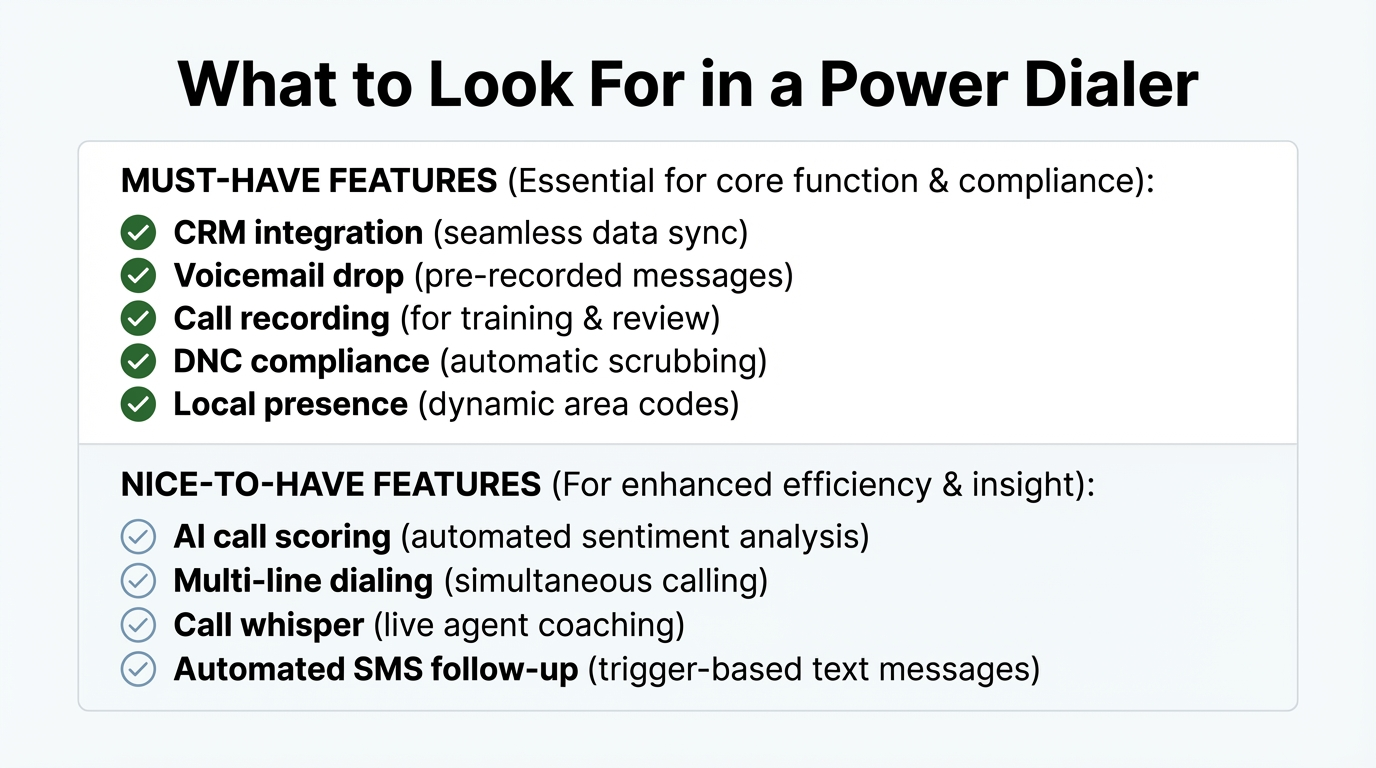
CRM integration. The dialer should connect directly to your CRM and log call outcomes, duration, and notes automatically. Most major real estate CRMs (Follow Up Boss, Sierra Interactive, Lofty/Chime) have native dialer integrations or connect via Zapier.
Voicemail drop. Pre-recorded voicemail messages that drop automatically when the dialer hits voicemail. You record the message once; it plays every time. Saves 30-60 seconds per voicemail attempt.
Local presence dialing. Calls that display a local area code have higher answer rates than calls from unfamiliar out-of-area numbers. Most power dialers include this.
Call recording. Recordings let you review calls for coaching, dispute resolution, and training new ISAs. Make sure you comply with your state’s recording consent laws before enabling this.
List management. The ability to segment and prioritize call lists directly in the dialer. You want to call hot leads before cold ones, new leads before old ones.
Reporting. Dials per hour, contact rate, conversations per session. Without metrics, you can’t evaluate whether the tool is producing results.
Compliance: What Agents Need to Know
The Telephone Consumer Protection Act (TCPA) governs automated calling and has specific rules that apply to power dialers:
Do Not Call (DNC) list scrubbing. Every list should be scrubbed against the national DNC registry before dialing. Most reputable power dialer platforms include automatic DNC scrubbing.
Consent for mobile numbers. Texting and auto-dialing to mobile numbers requires prior express consent under TCPA. This is especially relevant if you’re dialing leads who gave their number on a form – that form should include consent language.
State laws vary. California has stricter requirements than most states. If you’re in a state with its own TCPA-equivalent laws, check with your broker or a compliance attorney before running high-volume campaigns.
Multi-line dialers and abandoned calls. If a multi-line dialer connects to multiple live answers and the agent only takes one call, the other calls are “abandoned.” Federal law requires abandoned call rates below 3% and a live agent available within 2 seconds. This is why multi-line dialers need active monitoring.
Non-compliance isn’t a technicality risk. TCPA violations carry statutory damages of $500-$1,500 per call. Real estate teams have faced significant lawsuits from this.
Alternatives to a Power Dialer
If you’re not at the volume level where a power dialer makes sense, the higher-leverage investments are:
Better CRM follow-up sequences. Most agents don’t need to call faster – they need to call more consistently. A real estate follow-up system with automated text and email touches between calls keeps leads warm so the calls you do make are more likely to connect.
Voicemail drop without a full dialer. Tools like Slybroadcast let you drop pre-recorded voicemails to a list without live dialing. Lower cost, lower complexity, useful for specific outreach campaigns.
Callback workflows. Instead of cold-dialing a list, trigger calls based on lead behavior – a lead who opens an email or visits your website is a warmer call than a 90-day-old contact. Behavior-triggered outreach improves contact rate without requiring dialing volume.
Text-first outreach. For many lead types, a text reaches more people than a call. Real estate text message scripts that feel personal and get responses can replace a significant percentage of call volume for leads who are text-responsive.
FAQ
What does a real estate power dialer cost?
Most single-line power dialers run $100-$200/month per seat. Multi-line dialers are typically $200-$400/month per seat. Factor in the CRM integration cost and any per-minute calling charges on top of the subscription.
What are the most popular power dialers used in real estate?
Mojo Dialer is the most widely used in residential real estate, specifically for expired and FSBO prospecting. PhoneBurner, Kixie, and REDX Dialer are also common. Each integrates differently with different CRMs.
Can I use a power dialer as a solo agent?
Yes, but the ROI math is harder to justify. A solo agent making 30 calls per day will see real gains at prospecting-focused periods (January-March push for expired listings, geographic farming launches). If you’re calling daily at that volume, it’s worth evaluating.
Does using a local number on caller ID actually increase answer rates?
Yes. Studies vary, but most data suggests a 30-50% improvement in answer rate when the displayed number has the same area code as the person being called. This is one of the more impactful features of power dialers.
Is there a risk of my number getting spam-labeled if I use a power dialer?
Yes. High-volume calling from a single number can trigger carrier spam filters. Local presence dialing rotates numbers, which reduces this risk. Most enterprise dialers have number reputation management tools built in.
The Bottom Line
A power dialer is a speed multiplier, not a strategy. It makes a good prospecting system faster. It does not fix a broken one.
Before investing in a dialer, ask: do I have a large enough database to justify the volume? Is my CRM clean and segmented so the right contacts are being called? Do I have an ISA or dedicated calling time where a dialer would actually be in use?
If the answer to those questions is yes, a power dialer – specifically one with CRM integration, voicemail drop, and local presence – is a legitimate productivity investment. If the answer is no, the higher-leverage move is building the system the dialer would run on top of.
Is Your Real Estate Business Leaking Revenue?
Most agents are losing deals they don’t even know they have. Find out exactly where your business is broken and get a custom plan to fix it.