⏱ 18 min read
Published March 31, 2026
Real Estate Buyer Lead Nurture: 3-Phase Showing Sequence
Last Updated: March 31, 2026
Buyer leads are a patience game. Most online buyer leads are 60 to 180 days away from making an offer when they first contact you. The agents who convert them are not necessarily the best negotiators or the ones with the most listings – they’re the ones who stayed in contact through the entire research and decision period. This guide gives you a specific, repeatable buyer lead nurture sequence from first contact through showing booked, with timing, messaging, and the automation that keeps it running.
Key Takeaways
- Most buyer leads take 60-180 days to convert – not 60-180 days of active searching, 60-180 days of total decision time
- Speed of first response determines whether nurture is even possible – you have to make contact first
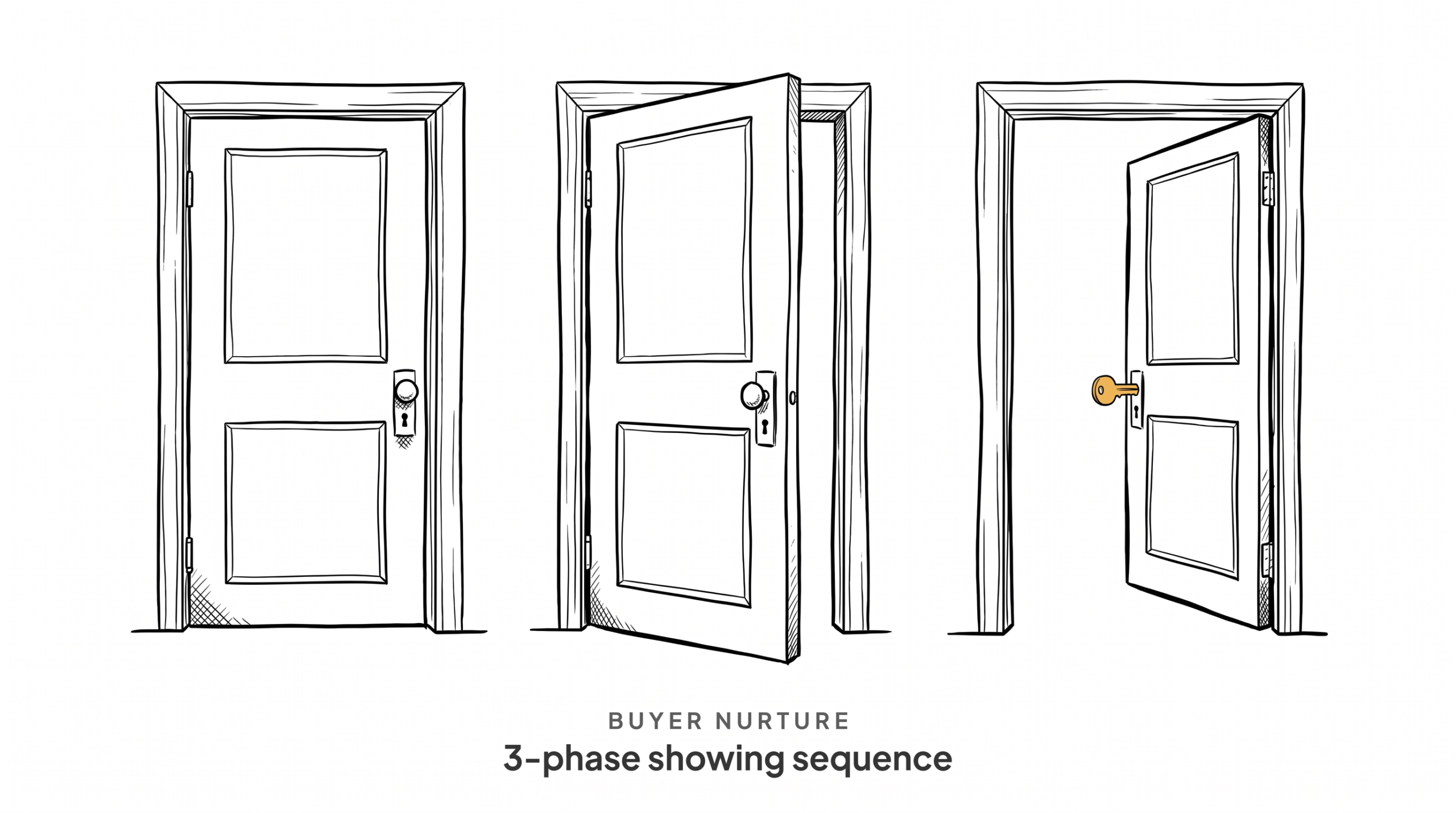
- The nurture sequence has three phases: spark (days 1-7), stay-present (weeks 2-8), long-burn (months 2-6)
- Value-first content (market updates, neighborhood guides, buying tips) outperforms property listings for nurture
- A signed buyer representation agreement is the conversion goal, not a showing – get the consultation first
Table of Contents
- Why Buyer Lead Nurture Is Different From Seller Lead Nurture
- Phase 1: The Spark (Days 1-7)
- Phase 2: Stay Present (Weeks 2-8)
- Phase 3: Long-Burn Nurture (Months 2-6)
- The Buyer Consultation: Your Conversion Goal
- Segmenting Buyer Leads by Readiness
- FAQ
Why Buyer Lead Nurture Is Different From Seller Lead Nurture
Seller leads are relatively binary: they either want to sell now or they don’t. The decision cycle is shorter, and the content that moves them is market data and home value.
Buyer leads are different. A buyer who submits a form on Zillow might be:
- 30 days from making an offer (rare)
- 6 months from getting pre-approved (common)
- 12+ months from being emotionally and financially ready (very common)
The research phase for most buyers is long and non-linear. They browse listings for months before they’re ready to work with an agent consistently. They go quiet, then come back. They change their target neighborhood or price range. They wait for rates to move. For leads who don’t convert on the first touch, retargeting ads keep your brand in front of them across the web.
Nurturing a buyer lead means staying relevant and available through an uncertain and often long timeline without being annoying. The content strategy is different: buyers need education, local market information, and a sense that you understand their specific situation – not a stream of listing alerts they didn’t ask for.
For comparison, see how nurturing seller leads works differently.
Phase 1: The Spark (Days 1-7)
The first 7 days determine whether a buyer lead enters your nurture sequence as a live contact or a database entry that goes cold.
Day 0 – immediate (within 5 minutes): Automated text fires the moment the lead is created in your CRM. “Hey [Name] – I saw you were checking out homes in [Area]. Are you looking to buy in the next few months, or more exploratory right now?” Short. Direct. Asks a question to open a conversation. See why speed to lead matters this much.
Day 0 – within the hour: You call personally. If they responded to the text, you have a warm opening. If not, you’re calling while your automated message is still fresh. Leave a brief voicemail: “Hey [Name] – left you a text a bit ago. Wanted to put a real voice to the name. Give me a call back or just reply to the text. No pressure.”
Day 1: Automated email with a neighborhood guide or buyer’s guide relevant to their search area. Not listings. Content that helps them understand the market they’re looking in.
Day 3: Automated text check-in. “Did you have a chance to check out that guide I sent? Happy to answer any questions about the [Area] market.”
Day 7: Another personal call attempt. If you’ve had no contact by now, leave a voicemail and send a text version simultaneously. “Hey [Name] – still happy to help if the timing works. No rush on my end – just want to make sure you have what you need.”
CRM note: Log every touch attempt. After day 7, if there’s been zero response, move the lead to Phase 2 on an automated sequence. Do not keep manually chasing a silent lead in Phase 1.
Phase 2: Stay Present (Weeks 2-8)
Phase 2 is about maintaining visibility without creating pressure. The buyer is still in research mode. Your job is to be the most helpful, most present agent in their inbox.
Week 2: Automated email. Market update for their target area: recent sales, price per square foot, days on market. Specific to the ZIP or neighborhood they searched. Not generic market commentary.
Week 3: Automated text. “Rates moved a bit this week – have you connected with a lender yet? Happy to refer a good one if useful.” Even if they don’t respond, this positions you as someone who’s tracking conditions for them.
Week 4: Listing alert (if your CRM supports it). A curated selection of properties that match their search – not every listing that technically fits the criteria, but 3-5 that you’d actually recommend looking at. Personalization beats volume here.
Week 6: Email with a buyer FAQ or guide. “Most common questions buyers ask me before making an offer.” Educational content that builds trust and positions you as an authority.
Week 8: Personal call or text. “Hey [Name] – just checking in. Has anything changed with your timeline or search criteria? Happy to set up some showings if you’re getting closer.”
The tone throughout Phase 2 is curious, not pushy. You’re checking in, not selling.
Phase 3: Long-Burn Nurture (Months 2-6)

Buyers who haven’t moved to a showing or consultation by month two are either on a longer timeline or not ready yet. Phase 3 is low-frequency but consistent – enough to stay in their awareness without being annoying.
Monthly: One automated email with a neighborhood or market update. Specific to their search area. Data-driven.
Every 6 weeks: Automated text. Varies: a question (“Still thinking about [area]?”), a market observation (“Inventory in [area] just dropped – worth knowing if you’re getting closer”), or a value offer (“Happy to do a quick call if you want to see what’s changed”).
Quarterly: Personal call or text. Brief. “Hey [Name] – just a quick check-in. Are you still in the market for a home in [area]? Happy to send some new listings if timing is getting closer.”
Life-event triggers: If you know any life events from earlier conversations (job change, lease ending, expecting a child), time a personal message around those. “Hey – if I remember right, your lease was coming up around now. Still thinking about buying?”
Long-burn nurture is where real estate drip campaigns do their best work. Automate the regular touches so you’re not trying to remember who to contact in month four.
The Buyer Consultation: Your Conversion Goal
The goal of buyer lead nurture is not a showing – it’s a buyer consultation. A buyer who has met with you, reviewed the process, and signed a representation agreement is committed. A buyer who has just been sent listing alerts is still shopping agents.
When to invite the consultation:
- Any time a buyer responds with real engagement (asks a question, expresses a specific timeline, mentions pre-approval)
- At the end of Phase 1 if you’ve had real two-way contact
- After any warm response in Phase 2 or 3
How to invite it: “It sounds like you’re getting closer to being ready. Would you want to do a quick 30-minute call so I can walk you through exactly how I work with buyers and show you what the process looks like? That way if you’re ready to move, we can hit the ground running.”
Low-pressure. Clear value. Specific ask.
Post-NAR settlement, the buyer consultation is also where you explain your representation agreement and compensation. Getting to this conversation is what separates a nurtured lead from a closed client.
Segmenting Buyer Leads by Readiness
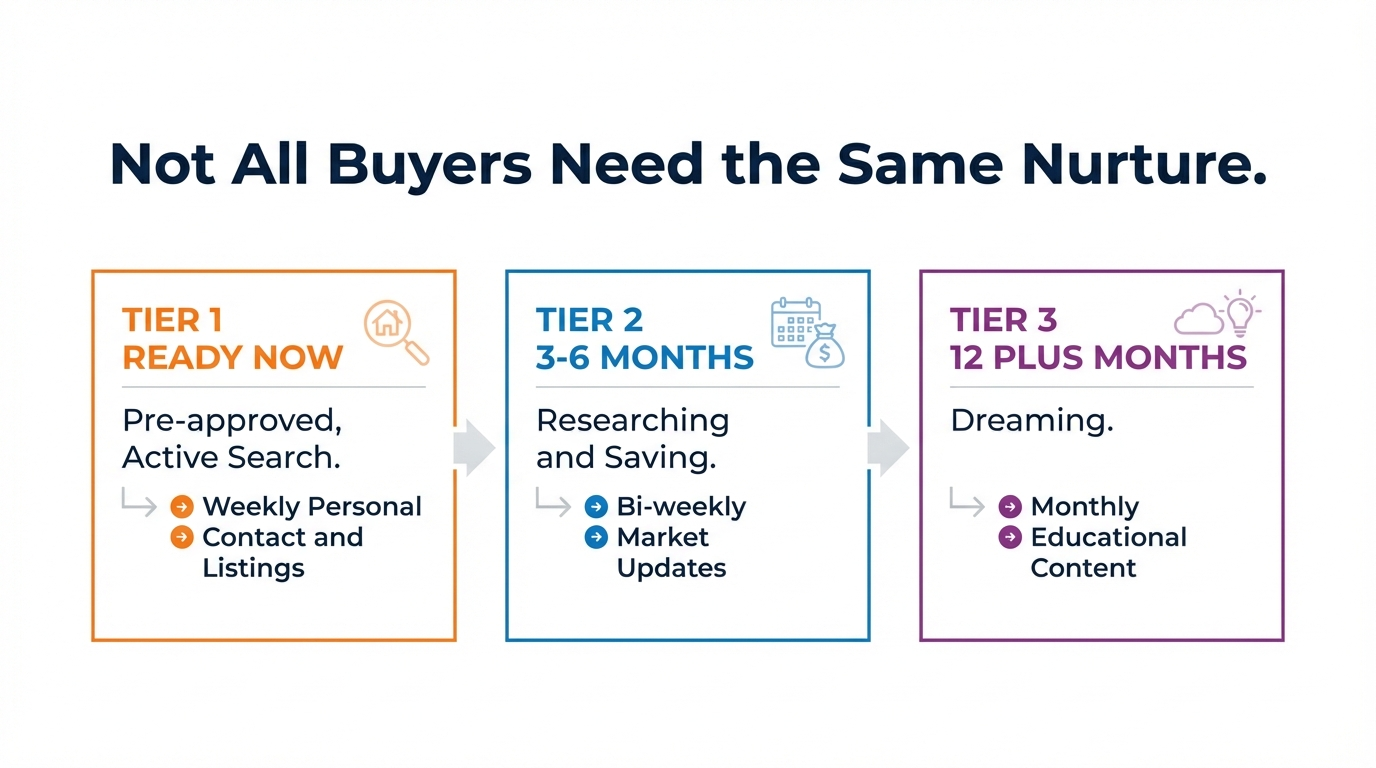
Not all buyer leads belong in the same sequence. Tag leads in your CRM by readiness from the first conversation:
Hot (30-60 days to purchase): Prioritize personal outreach. Weekly calls. Consultation booked ASAP.
Warm (2-4 months out): Phase 1 + Phase 2 sequence. Monthly personal check-in.
Cool (6+ months out): Move to Phase 3 immediately after initial contact sequence. Automate the touches.
Unknown: Run through Phase 1. Their response (or lack of) tells you which bucket they belong in.
Proper segmentation means hot leads get the human attention they deserve and long-timeline leads get automated nurture that keeps you present without consuming your time. This is exactly what a real estate CRM should be managing.
FAQ
How long should I nurture a buyer lead before giving up?
At minimum, 6 months of low-frequency automated nurture. Some buyer leads convert after 12-18 months. The cost of keeping a lead in a long-burn drip is near zero; the cost of deleting a lead who buys with someone else in month 8 is real. Keep them in the system.
Should I send buyer leads listing alerts automatically?
Only if you can curate them. A flood of every listing that technically fits their criteria gets leads to unsubscribe. Better to send fewer, better-matched properties with a brief personal note about why you picked them.
What’s the difference between nurturing buyer leads and just spamming them?
Value and relevance. A spam sequence sends the same content to everyone on a fixed schedule. A nurture sequence delivers content that’s specific to the buyer’s search area and timeline, and includes personal touches that show you actually remember who they are.
How do I know when a buyer lead is warming up?
Watch for engagement signals: email opens, link clicks, property saves, form re-submissions. Your CRM should surface these. A buyer who suddenly opens three emails in a row after 60 days of silence is warming up – call them.
Should I text or email buyer leads?
Both, at different stages. Texts get opened. Emails deliver depth. In Phase 1, lean heavily on text for speed and response rate. In Phases 2 and 3, email delivers market content and educational material. Personal check-ins are best as text.
The Bottom Line
Buyer leads rarely convert immediately. The agents who win long-timeline buyers are the ones who set up a structured nurture sequence – fast first contact, consistent value-first content, and personal touches at the right intervals – and then let it run automatically so they don’t have to remember who to follow up with in month three.
The sequence is not complicated. What takes discipline is doing it for every lead, every time, without shortcuts. A real estate follow-up system built on a solid CRM is what makes that possible at scale.
Is Your Real Estate Business Leaking Revenue?
Most agents are losing deals they don’t even know they have. Find out exactly where your business is broken and get a custom plan to fix it.