⏱ 19 min read
Published March 31, 2026
Speed to Lead: 5 Minutes That Decide Real Estate Deals
Last Updated: March 31, 2026
Speed to lead is one of the most important – and most ignored – variables in real estate. Research from InsideSales.com and MIT found that leads contacted within 5 minutes are 21 times more likely to respond than those contacted after 30 minutes. Not 21 percent more likely. 21 times. Most agents are calling back in hours, if they call back at all. That gap is where deals go to die.
This post explains exactly what happens during that 5-minute window, why most agents fail to hit it consistently, and how to build an automated response system so speed becomes a structural advantage – not something that depends on whether you’re near your phone.
Key Takeaways
- Leads contacted within 5 minutes are 21x more likely to respond – every minute after that, the odds drop sharply
- Most agents respond to new leads in 2 to 24 hours – by which point the lead has already talked to someone else
- Speed to lead is a structural problem, not a discipline problem – you can’t manually respond instantly to every lead at all hours
- Automation handles the first response instantly; your job is to follow up personally when a conversation starts
- The 5-minute window doesn’t just improve contact rate – it changes the entire tone of the relationship from the start
Table of Contents
- What the Data Actually Says
- What Happens After the Window Closes
- Why Most Agents Miss the Window Anyway
- What an Instant Response System Looks Like
- The Human Follow-Up That Comes After Automation
- FAQ
What the Data Actually Says
The 21x stat gets cited a lot, but what’s actually happening in those first minutes that makes the difference so dramatic?
When someone fills out a lead form on Zillow, Realtor.com, or your website, they’re in a specific mental state: active. They just took an action. They have a question or a goal in front of them. They’re thinking about real estate right now. That window – the few minutes after they submit the form – is when your response is most welcome, most relevant, and least likely to feel like an interruption.
Every minute that passes, the mental state shifts. They move on to something else. Another tab opens. Another agent’s automated response lands in their inbox. By the time you call three hours later, you’re cold-calling someone who has already been contacted, and who has already moved that mental state to the background.
Only 2% of sales happen at first contact – that’s true. But first contact still decides whether a second contact ever happens. If you miss the window, there is no follow-up sequence to save you. They’ve either gone with someone else or gone cold.
The agents who consistently win on speed to lead aren’t more disciplined. They’ve built a system that removes the human delay entirely for the first touch.
What Happens After the Window Closes
It’s worth being specific about this, because most agents underestimate how quickly the situation deteriorates.
0 to 5 minutes: The lead is active. Response rate is highest. They expect a fast reply because they’re still in the mindset of the search they just did.
5 to 30 minutes: Response rate drops sharply. They’ve moved on to something else, but they haven’t fully disengaged. A call or text at this point still lands reasonably well.
30 minutes to 2 hours: You’re now an interruption. They submitted the form a while ago and it has slid to the back of their mind. If another agent has already made contact, you’re now the second option by default.
2 to 24 hours: You’re a cold call. The lead doesn’t remember exactly when they submitted the form. They may have already had a real conversation with someone else. Your response feels random and late.
24+ hours: Contact rate approaches zero. 44% of agents give up after one attempt – and many of those attempts happen a day too late. The lead has either gone cold or converted with a competitor.
This timeline matters because it reframes the problem. Speed to lead isn’t about being eager or aggressive. It’s about catching people when they’re in the right mental state to have the conversation that moves the relationship forward.
Why Most Agents Miss the Window Anyway
The obvious answer is: agents are busy. They’re in showings. They’re driving. They’re with a client. They’re sleeping. A lead notification comes in at 9pm on a Thursday and they don’t see it until Friday morning.
But the deeper problem is structural. Most agents are set up to fail at speed to lead before the first lead ever comes in.
There’s no automatic first response. The agent’s entire follow-up system is manual – which means it’s only as good as their availability at any given moment. The system has a single point of failure: the agent themselves.
Leads from different sources come in through different channels with no unified routing. A Zillow lead triggers one notification. A website lead triggers another. An open house registration is on a paper sheet. There’s no consistency, no automation, and no guarantee that any of it gets seen fast enough.
This is not a motivation problem. The most disciplined agent in the world cannot manually respond to every lead within 5 minutes, around the clock, indefinitely. It’s a systems problem – and systems problems need systems solutions.
Building a real estate follow-up system that handles the first response automatically is the only way to solve it at scale.
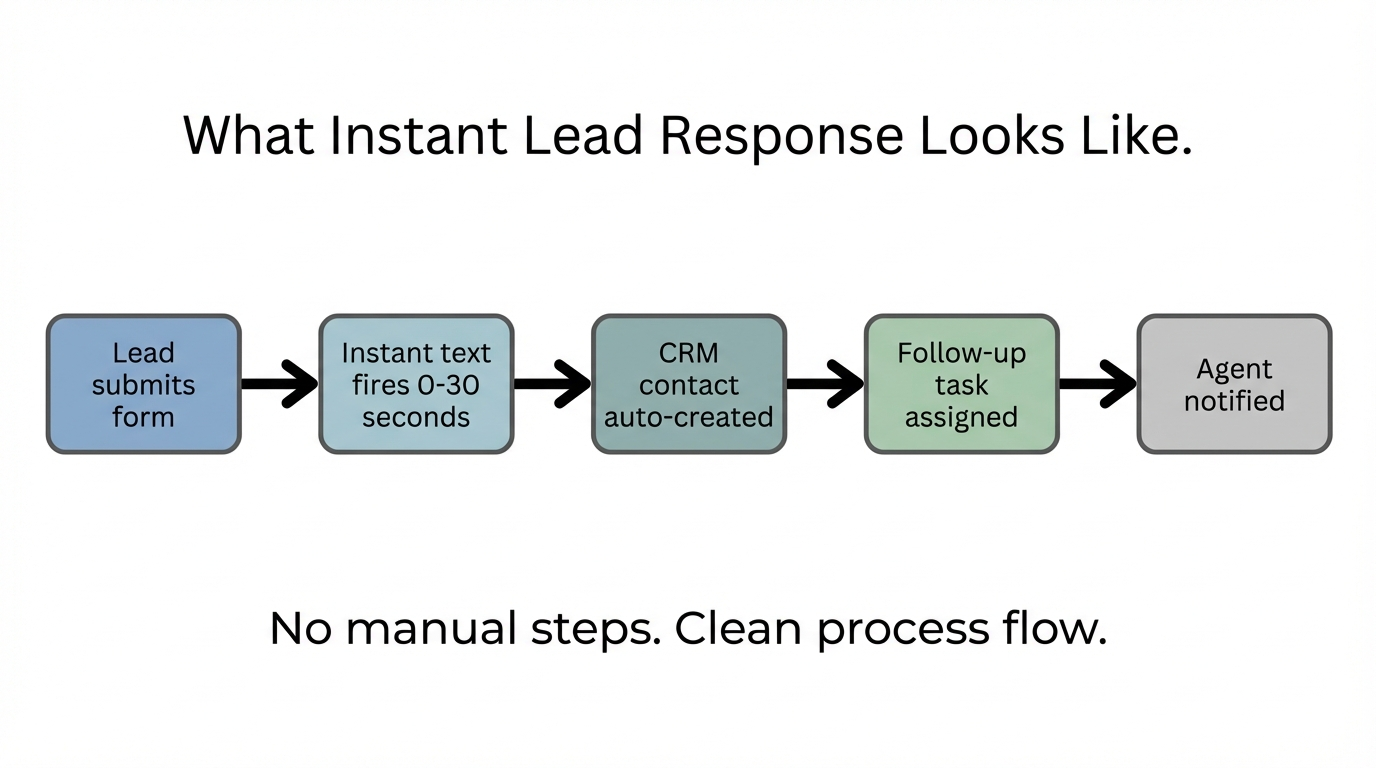
What an Instant Response System Looks Like

A proper speed-to-lead system has a few specific components.
Instant automated text. The moment a lead submits a form, they get a text from you within 60 seconds. Not an email – a text. Something direct and personal-sounding: “Hey [Name], this is [Agent] – just saw your message. Are you looking to buy or sell?” It doesn’t need to be elaborate. It needs to arrive fast and feel like a real person.
Instant automated email. Alongside the text, an email confirms you received their inquiry and sets expectations for the conversation. This email can include more – a link to listings, a home value estimate, useful content – but the text is what gets the first response.
Immediate CRM entry. The lead hits your database automatically with source, timestamp, and any data from the form. No manual entry. No leads falling through because a form result sat in an email inbox for two days.
Lead routing notification. You get an alert on your phone with everything you need to make a personal call: name, number, what they inquired about, when. The automation handled the first touch. Now you make a call as soon as you’re available – ideally within 15-30 minutes.
The goal is to take the human bottleneck out of the first response entirely, while keeping you in the loop to handle the actual conversation when it starts. This is exactly what automating real estate follow-up is designed to do.
The Human Follow-Up That Comes After Automation
Automation wins the first 5 minutes. But it doesn’t close the deal. That’s still your job – and the best thing about having instant automated response is that when you do call, you’re calling someone who already heard from you.
The sequence that works:
Day 0 (within minutes of form submit): Automated text + email fires instantly.
Day 0 (within 30-60 minutes): You call personally. If they respond to the text, you already have a conversation started. If they haven’t responded yet, you’re still calling within an hour – which is dramatically better than the industry average.
Day 1: If no response, a second automated text check-in goes out. Something low-pressure: “Totally understand if the timing isn’t right – just let me know if you have questions.”
Days 2 to 14: A drip sequence runs automatically with relevant value – neighborhood guides, market stats, similar listings. You’re staying visible without stalking.
Day 14+: The lead moves into your longer-term real estate drip campaign – monthly touches to stay present until they’re ready.
The point isn’t to manufacture urgency. It’s to be present when they are ready – and to make sure the first impression was a fast, helpful response rather than silence.
FAQ
Does speed to lead really matter if I’m in a relationship-based referral business?
Yes – because not every lead comes from referrals, and even warm referrals check you out online before they call. If someone submits a contact form after being referred, how fast you respond tells them exactly what working with you will feel like. Fast response is a first impression, even in a referral business.
What should the automated first text actually say?
Keep it short and direct. Something like: “Hi [Name], I’m [Agent] – saw your inquiry about [area/property type]. Quick question: are you working with a timeline or just starting to explore?” Conversational, not scripted. The goal is to get a reply, not deliver a pitch.
What if I get leads from multiple sources – Zillow, my website, open houses?
Your CRM should be aggregating all of them into a single inbox with a consistent automated response triggered on entry. If you’re managing lead sources manually across different tabs and apps, you’re setting yourself up to miss the window consistently. Centralize everything first.
Is instant automated response going to feel impersonal to leads?
Only if it sounds robotic. Write your automated messages the way you actually talk. Use your real name. Ask a genuine question. Most leads don’t know it’s automated – and even if they suspect it, what they register is that someone responded immediately. That speed itself builds trust.
What’s a realistic personal call response time if I’m in showings all day?
Set up your lead alerts so you can see who came in during the showing. As soon as you’re done – before driving to the next one – spend 10 minutes making calls. The goal isn’t to be available every second. The goal is to have automation buy you time while keeping the window as short as possible on the personal call.
The Bottom Line
Speed to lead is the easiest competitive advantage available to real estate agents – and most agents are giving it away by default. While you’re waiting to call back, the agent with an automated response system has already started a conversation with that lead.
The solution isn’t checking your phone more. It’s building a system that responds instantly regardless of what you’re doing, then routing warm conversations to you when you’re ready to take them.
Is Your Real Estate Business Leaking Revenue?
Most agents are losing deals they don’t even know they have. Find out exactly where your business is broken and get a custom plan to fix it.