⏱ 20 min read
Published March 30, 2026
8 Strategies to Prospect in Real Estate Without Cold Calling
Last Updated: March 30, 2026
Most agents think prospecting means dialing strangers until someone agrees to talk. That’s the hardest, least efficient version of prospecting – and it’s why most agents hate doing it. The agents with the fullest pipelines aren’t grinding through cold call lists. They’re working a system that starts with the people who already know and trust them, then expands outward in deliberate layers.
Here are 8 real estate prospecting strategies in priority order. Work the first ones before you touch the last ones.
Key Takeaways
- Your database and sphere of influence are your highest-ROI prospecting sources – work them first, every time
- Expired listings and FSBOs are motivated sellers who already want to transact; most agents skip them because the conversations feel awkward
- Geographic farming requires 12+ months of consistent effort before it pays off – most agents quit at month 3
- Referral partner relationships compound over time; one good mortgage broker can feed your pipeline for years
- A prospecting routine that runs 5 days a week beats a heroic 3-hour session once a month
Table of Contents
- Why Most Prospecting Fails
- The Prospecting Pyramid: Work Inside-Out
- Strategy 1 & 2: Your Database and SOI
- Strategy 3 & 4: Expired Listings and FSBOs
- Strategy 5 & 6: Geographic Farming and Open Houses
- Strategy 7 & 8: Referral Partners and Online Presence
- Building a Prospecting Routine That Sticks
- FAQ
Why Most Prospecting Fails
Agents fail at prospecting for two reasons: they start with strangers instead of relationships, and they’re inconsistent.
Cold outreach to people who have never heard of you has a conversion rate that’s somewhere between miserable and insulting. Meanwhile, the average agent has 200–500 people in their sphere who would refer business – if the agent stayed in touch. Most don’t. They disappear between transactions and wonder why the referrals dried up.
Real estate agents who prospect daily close 3x more transactions than those who prospect sporadically. (REAL Trends) The math is unforgiving – daily discipline compounds in ways that occasional heroic effort never does.
The second problem is consistency. Prospecting that happens three times a month when you feel motivated will not build a pipeline. Prospecting that happens every weekday – even for 45 minutes – compounds. The math is simple and unforgiving.
Before you build any prospecting system, read Real Estate Lead Generation: 12 Strategies That Don’t Require Zillow to understand the full landscape of where leads actually come from.
The Prospecting Pyramid: Work Inside-Out
Think of your prospecting universe as a pyramid. At the top – smallest group, highest conversion – are the people who already know and trust you. At the bottom are cold strangers. Most agents prospect from the bottom up. Flip the pyramid.
Work in this order:
1. Your existing database (past clients, current pipeline)
2. Your sphere of influence (people who know you personally)
3. Motivated strangers with a specific problem (expireds, FSBOs)
4. Geographic targets (farming, open houses)
5. Referral partner networks
6. Online presence (inbound leads, social, content)
Each layer is less warm than the one above it, which means more effort per conversation. Only move down the pyramid after you’ve fully worked the layers above.
Strategy 1 & 2: Your Database and SOI
Strategy 1: Database First
Your past clients and warm leads are the most underworked asset in your business. The average real estate lead requires 8–12 follow-up attempts before converting. The average agent follows up 1–2 times and stops. If you have 100 people in your pipeline who went cold, you have a gold mine disguised as a graveyard.
It takes an average of 8 follow-up attempts to reach a prospect, yet 44% of salespeople give up after just one. (RAIN Group) Your database is full of leads who got 1-2 follow-ups and were abandoned – they are the fastest deals available to you right now.
How to start: Pull every contact who hasn’t heard from you in 60+ days. Send a personal check-in – not a mass email blast, a real message. Something like: “Hey [name], just thinking about you – how did things shake out with [house/neighborhood/situation]?” You will be surprised how many conversations restart.
For the systematic version of this, see How to Reactivate a Dead Real Estate Database. Pair this with an AI database reactivation system to turn your cold list into booked appointments.
Strategy 2: Sphere of Influence
Your SOI – friends, family, former colleagues, neighbors, your kids’ soccer coach – is your most reliable referral source. These people root for you. They want to send you business. They just forget you exist if you don’t remind them.
How to start: Make a list of 50 people in your personal network. Schedule one personal touchpoint per week – a call, a handwritten note, a coffee meetup. The goal is not to pitch. The goal is to stay in their lives so they think of you when someone mentions real estate.
For a deeper approach to this, read Sphere of Influence Marketing for Real Estate Agents.
Strategy 3 & 4: Expired Listings and FSBOs
Strategy 3: Expired Listings
Expired listings are sellers who already want to sell – they just had a bad experience. That’s not a liability; that’s an opportunity. They’re motivated, they understand the process, and they’ve already self-selected as people who are ready to transact.
How to start: Set up a daily MLS alert for expired listings in your target market. Contact them within 24 hours of expiration. Don’t lead with “I can sell your home.” Lead with “I noticed your listing expired – do you mind if I ask what happened?” Diagnose first. Pitch second. The agents who win expireds solve problems; they don’t just show up with a listing presentation.
Strategy 4: FSBOs
For Sale By Owner sellers are trying to save a commission but usually don’t know what they don’t know. A significant percentage of FSBOs eventually list with an agent – often within 90 days.
How to start: Identify FSBOs in your market through Zillow, Craigslist, or FSBO-specific sites. Don’t call to list them immediately. Call to offer something useful – a free CMA, a showing from a buyer you’re working with, local market data. Build a relationship over 2–3 touchpoints before you bring up representation.
Strategy 5 & 6: Geographic Farming and Open Houses
Strategy 5: Geographic Farming
Geographic farming is planting seeds in a specific neighborhood through consistent, valuable outreach until you’re the agent everyone thinks of first. It works. But it takes time – plan for 12 months before you see consistent returns.
How to start: Choose a farm area of 300–500 homes with a turnover rate above 5% and limited agent competition. Send something valuable every 4–6 weeks: market updates, home value estimates, neighborhood stats. Be the information source. Don’t just send “I sold another one!” postcards. For the full playbook, see the post on real estate farming strategy (Strategy 5 gets a full post – Post 20 – in this series).
Strategy 6: Open Houses
Open houses are not just marketing tools for the seller. They’re prospecting machines for you. Every person who walks through the door is either a buyer, a future seller, or someone connected to both. The agents who waste open houses sit at the table and answer questions. The agents who work open houses build relationships with everyone who walks in and follow up every single one.
How to start: Host or co-host 1–2 open houses per week. Collect contact information from every visitor. Follow up within 24 hours with a personal message referencing something specific from your conversation. Most agents never follow up at all. You already have the advantage.
Strategy 7 & 8: Referral Partners and Online Presence
Strategy 7: Referral Partners
One strong referral partnership with a mortgage broker, financial planner, divorce attorney, or estate attorney can generate 5–15 qualified leads per year. These are warm introductions from people the client already trusts.
How to start: Identify 5–10 professionals in adjacent businesses whose clients regularly have real estate needs. Have coffee. Ask about their clients and challenges before you talk about yourself. Refer business to them first. Referral partnerships built on genuine reciprocity outlast every other lead source you’ll ever use.
For the full approach to building this, read How to Get More Referrals as a Real Estate Agent.
Strategy 8: Online Presence
Online presence is listed last for a reason: it takes the longest to build and has the coldest leads. But it compounds. A well-optimized Google Business Profile, consistent social content, and a few strong blog posts or video reviews will generate inbound leads that come to you already convinced.
How to start: Pick one platform and be consistent for 90 days before evaluating. Google is the highest leverage for local search. Instagram and Facebook work for brand building. Content that answers real estate questions gets found by buyers and sellers in your market who are actively searching.
Building a Prospecting Routine That Sticks
The best prospecting strategy is the one you actually do every day. Build a simple daily block – 45 to 60 minutes, five days a week – and protect it.
A basic routine:
- Monday–Wednesday: Database and sphere outreach (calls, texts, personal messages)
- Thursday: Expired and FSBO follow-ups
- Friday: Referral partner check-ins and open house scheduling
Only 2% of sales happen at the first point of contact. (Sales Insights Lab) This is why a daily routine that keeps you in front of prospects across multiple touchpoints is the only system that actually works at scale.
Track your numbers: contacts made, conversations had, appointments set. Prospecting is a numbers game with a relationship layer on top. The relationship layer is what separates the agents who close 50 deals a year from the ones who close 12.
When you have a CRM handling the follow-up sequences automatically, your prospecting time gets more efficient because you’re not tracking who needs to hear from you next – the system does it. See How to Automate Your Real Estate Follow-Up for how to set that up.
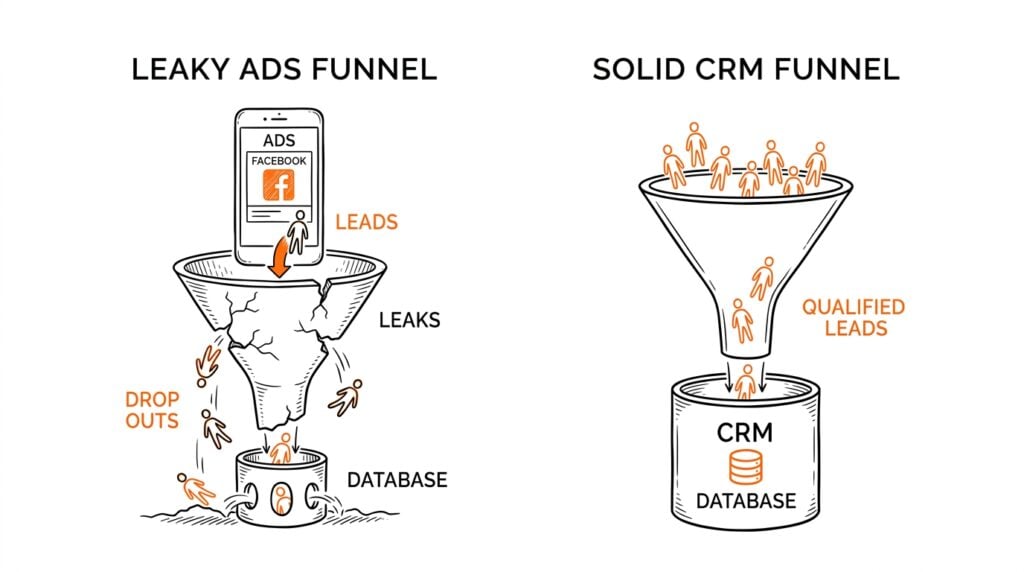
Is Your Real Estate Business Leaking Revenue?
Most agents are losing deals they don’t even know they have. Find out exactly where your business is broken and get a custom plan to fix it.
FAQ
How many prospecting contacts should I make per day?
Most successful agents aim for 10–20 meaningful contacts per day. “Meaningful” means a real conversation or personal message – not a mass email blast. Volume matters, but quality of connection matters more.
Is cold calling still worth it for real estate agents?
Cold calling works, but it’s the lowest-ROI use of your prospecting time. Exhaust your database, SOI, and warm lead sources before spending significant time on cold calls. If you do cold call, use a targeted list – expireds, FSBOs, or absentee owners – rather than general neighborhood cold calls.
How long does it take to see results from prospecting?
Database and SOI prospecting can produce conversations and appointments within days. Expired and FSBO outreach can produce listings within weeks. Geographic farming takes 6–18 months. Online presence takes even longer. Start with the fast-cycle strategies while building the long-cycle ones in the background.
What’s the biggest prospecting mistake agents make?
Giving up too soon. The average real estate transaction takes months to develop. Most agents stop following up after 1–2 touches. Build a system that keeps you in front of prospects for 12–18 months and you’ll close deals your competitors abandoned.
Do I need a CRM to prospect effectively?
You can prospect without a CRM, but you’ll be slower and you’ll let leads slip. Even a basic CRM with follow-up reminders will measurably improve your conversion rate. See Real Estate CRM: Do You Actually Need One? for an honest take on this.
The Bottom Line
Prospecting works when you work the right sources in the right order with relentless consistency. Start with the people who already know you. Expand outward systematically. Build a daily routine and protect it.
The agents who fill their pipelines aren’t magical closers – they’re consistent prospectors with a system that runs whether they feel like it or not.
Is Your Real Estate Business Leaking Revenue?
Most agents are losing deals they don’t even know they have. Find out exactly where your business is broken and get a custom plan to fix it.