⏱ 19 min read
Published March 31, 2026
10 Scripts That Top Agents Use to Handle Common Real Estate Objections
Last Updated: March 31, 2026
Every real estate conversation hits objections. Most agents respond to them the same way – with facts and logic – and wonder why it doesn’t work. Objections are rarely logical. They are emotional responses dressed in logical language. “I want to wait for rates to drop” usually means “I’m scared to make a wrong decision.” “I need to think about it” usually means “I’m not convinced yet.” The scripts in this guide are built around that reality: acknowledge first, then address the real concern, then ask a question that moves the conversation forward.
Key Takeaways
- Objections are buying signals – they mean the person is still engaged, just not yet convinced
- The formula: acknowledge – clarify – respond – advance
- Don’t argue with objections – redirect them with questions
- Most objections fall into four categories: timing, price, trust, and fear
- A follow-up system ensures objections that weren’t resolved in the conversation get another chance later
Want a printable PDF of this guide?
Keep this at your desk. Enter your email below and I’ll send the Cheat Sheet straight to your inbox.
Table of Contents
- The Objection Handling Formula
- Seller Objections
- Buyer Objections
- The Objection You Can’t Overcome
- Following Up After an Unresolved Objection
- FAQ
The Objection Handling Formula
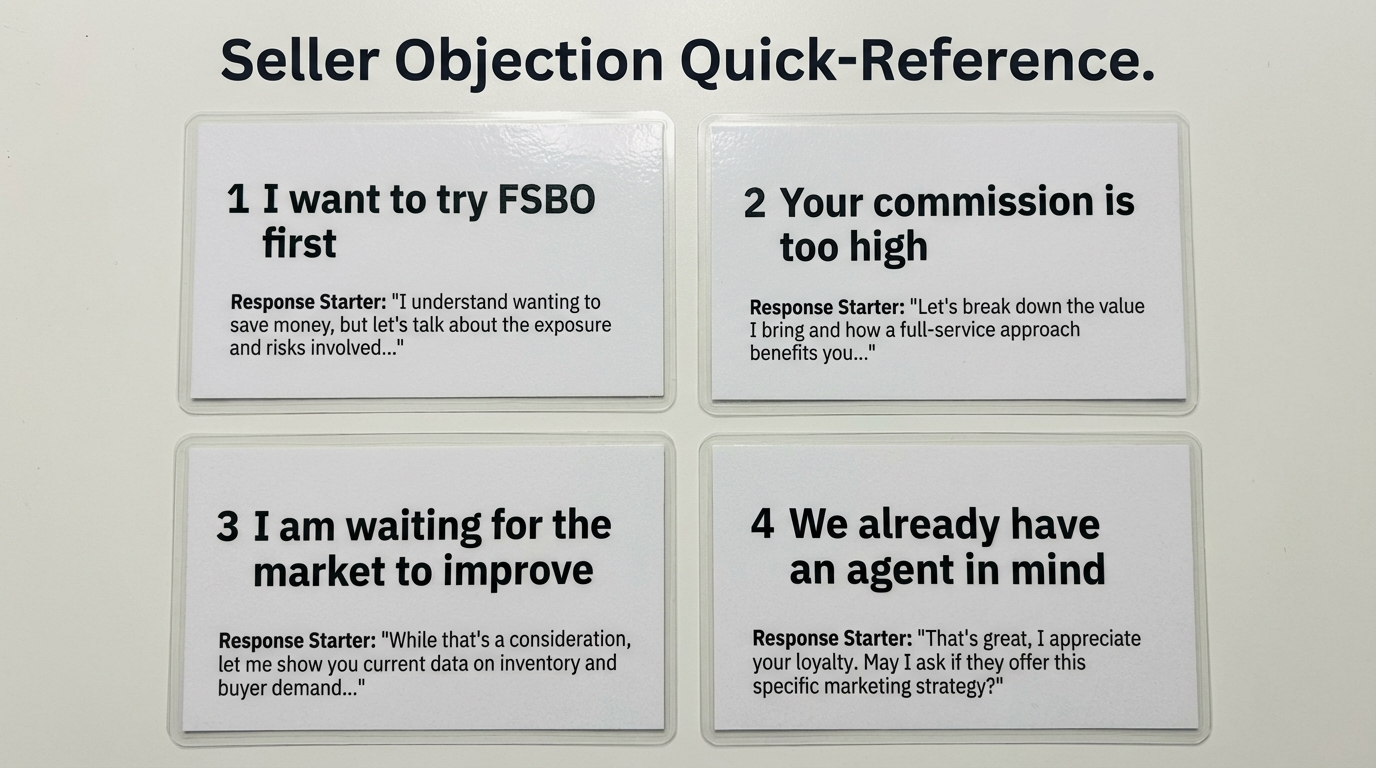
Before the scripts: a framework that works across every objection.
1. Acknowledge. Don’t immediately counter. “That makes sense.” “I hear that a lot.” “That’s a fair concern.” Acknowledgment reduces defensiveness and signals that you’re listening, not selling.
2. Clarify. Most objections are surface-level. Get to the real concern. “When you say you want to wait, what specifically are you waiting to see happen?” The answer usually reveals the real issue.
3. Respond. Address the actual concern with data, a reframe, or a question – not a rehearsed feature dump.
4. Advance. Every response should end with a question that moves forward. Not a close – a step. “Does that make sense?” “What would need to change for this to feel like the right time?” “Is there anything else that would help you feel more confident?”
Seller Objections
“I want to wait until spring.”
“That’s completely understandable – spring is traditionally active. Can I ask what’s driving that specifically? Is it the price you’re hoping to get, or is the timing of your move tied to spring?”
[Listen.] If it’s price: “The data in your area actually shows [current market conditions]. Waiting until spring means competing with more inventory and more sellers. I can show you what that’s looked like in your neighborhood over the last two years.”
If it’s move timing: “That makes total sense. If we listed now and got you under contract in 30 days, would that create a problem with your move timeline?” Often the timing concern dissolves when they realize they can control the closing date.
“I already have an agent in mind – my neighbor/friend/family member.”
“That’s great that you have someone you trust. Can I ask – are they active in this price range and neighborhood specifically? The reason I ask is that local market expertise makes a real difference in both pricing and negotiation.”
Don’t badmouth the other agent. Plant a question about relevant experience and let the seller think it through. If they’re committed to someone they know personally, respect it – a referred client who trusts someone else isn’t your listing.
“Another agent said they could get us more.”
“It’s worth asking them to show you the data behind that number. A higher listing price isn’t the same as a higher net at closing – homes priced above market tend to sit, and price reductions actually signal to buyers that something is wrong. Can I walk you through what the comps are showing?”
Redirect to data. Show your list-to-sale ratio. Let the market speak.
“We’re thinking of selling it ourselves (FSBO).”
“I respect that – it makes sense to explore it. Can I ask what’s drawing you to that route – is it primarily about saving the commission?”
[If yes:] “The data on FSBOs is pretty consistent – NAR research shows FSBO homes sell for a median of 13% less than agent-assisted sales. Even after commission, most sellers net more with an agent. Would it be worth running those numbers for your home specifically?”
See also: FSBO leads real estate for a full approach to converting FSBO sellers.
“Your commission is too high.”
“I appreciate you being direct about that. If both agents you’re considering were going to net you the exact same amount at closing, would the fee matter?”
[Most say no.] “Then the real question is whether I’m going to sell your home for enough more to cover the difference – and then some. Here’s my average list-to-sale ratio versus the market over the last 12 months…”
For the full commission objection playbook, see the listing presentation guide.
Buyer Objections

“I want to wait for rates to drop.”
“That’s something I hear a lot right now. Can I ask – what rate would make you feel comfortable moving forward?”
[They give a number.] “So if rates hit [X]%, you’d be ready to buy? Here’s what that would look like on your monthly payment versus today… The challenge with waiting is that when rates do drop, buyer demand surges and prices go up. A lot of buyers who waited in [year] found that the lower rate was offset by higher purchase prices.”
This isn’t an argument – it’s math. Show the actual numbers. Let them respond to data, not your opinion.
“I’m just looking / not ready yet.”
“Totally fine – most people I work with aren’t ready to make a move right away. Can I ask, what would need to happen for you to feel ready? Is it rates, finding the right property, selling your current home first?”
Get specific. A buyer who says “I just need to sell my house first” is not the same as a buyer who says “I don’t know, just browsing.” The first is a concrete next step. The second needs nurturing, not a close.
Move them into your buyer lead nurture sequence and stay present until they’re ready.
“The market is too crazy / I’ll wait for it to cool down.”
“What would ‘cooling down’ look like for you – lower prices, more inventory, or both?”
[Listen.] “Here’s what I’m seeing in [specific area]: [current inventory, days on market, price trends]. If prices soften, rates may not – and vice versa. The buyers who have done best in this market are the ones who got clear on their must-haves, moved fast when the right property appeared, and didn’t try to time the market perfectly.”
“I need to talk to my spouse/partner first.”
“Of course – this is a big decision and you should both be on the same page. What’s your partner’s biggest concern about moving forward?”
[They tell you.] Now you can address the actual objection, not the proxy. If you don’t know what the partner’s concern is, you can’t address it.
Follow up: “Would it make sense to set up a call or meeting with both of you so I can answer any questions together?” Getting in front of both decision-makers is almost always worth the effort.
“I want to see more houses before I commit to working with you.”
“Completely understand. How many more are you thinking – do you have a specific number in mind, or more of a ‘I’ll know it when I see it’ situation?”
[Listen.] “The reason I ask is that I want to make sure I’m finding you the right properties, not just more properties. If I know specifically what’s missing from what you’ve seen so far, I can narrow the search down so you’re not wasting time on homes that don’t fit.”
Reframe from volume to fit. A buyer who sees 30 mediocre houses is not better positioned than one who sees 8 well-matched ones.
The Objection You Can’t Overcome
Some objections are real. “I want to wait until my divorce is finalized.” “We’re not moving until our youngest graduates.” “My husband isn’t on board yet and I can’t move without him.”
Don’t fight these. Acknowledge them genuinely, put the person in a low-frequency long-term nurture sequence, and check in every 60-90 days. The worst outcome is burning the relationship by pushing too hard on something they genuinely cannot change right now.
Your real estate drip campaign handles this automatically – they stay in your database, they keep receiving value, and when their situation changes, you’re the agent they remember.
Following Up After an Unresolved Objection
An objection that wasn’t resolved in the conversation is not a dead lead. It is a lead with a specific concern that you didn’t fully address yet.
Log the objection in your CRM as a note. “Waiting for rates to drop – target rate 6%.” “Wants to see 5 more houses before committing.” “Husband not on board yet.”
Then your follow-up is specific. When rates move, you send a note: “Rates just hit 6.1% – wanted to make sure you saw this.” When a strong listing comes to market, you send it directly with a note: “This might be #5 of the 5 you wanted to see.”
Specific follow-up based on the actual objection converts far better than generic check-ins. This is exactly what real estate lead scoring and CRM notes are for.
FAQ
Should I memorize these scripts word for word?
No – internalize the structure and the intent, then use your own language. Scripts that sound memorized feel inauthentic. The goal is to understand what the objection really means and know the right questions to ask, not to recite a response.
What if the prospect gets defensive when I push back on an objection?
Back off and acknowledge more. “I hear you – I’m not trying to talk you into anything. I just want to make sure I understand your situation so I can actually help.” Defensiveness usually means the acknowledgment step was too brief.
How do I handle an objection I don’t have an answer for?
Be honest. “That’s a fair point – I don’t have a perfect answer for that right now. Can I look into it and follow up with you?” Honesty builds more trust than a forced response.
Is it ever okay to let a lead go without resolving their objection?
Yes – put them in a long-term nurture sequence and revisit in 60-90 days. Some objections are timing-based and will resolve themselves. Pushing too hard on a genuine constraint damages the relationship.
How many follow-ups are appropriate after an unresolved objection?
Until they tell you to stop or they buy/sell. Most agents give up after 1-2 follow-ups. Research from RAIN Group shows that 80% of sales require 5+ follow-up contacts. The persistence gap is where business is won.
The Bottom Line
Objections are not rejections. They are questions in disguise, and most of them are asking the same thing: “Can I trust you, and is this the right decision for me?” The agents who win more often are the ones who slow down when they hear an objection, ask the right clarifying question, and follow up specifically on what was left unresolved.
The follow-up is where most objections actually get resolved – not in the moment, but three conversations later when the prospect’s situation has shifted and you’re still present because your CRM has been keeping you in front of them.
Is Your Real Estate Business Leaking Revenue?
Most agents are losing deals they don’t even know they have. Find out exactly where your business is broken and get a custom plan to fix it.