⏱ 17 min read
Published March 31, 2026
Here Are the First 3 Hires When You Are Growing Your Real Estate Team
Last Updated: March 31, 2026
Most agents start thinking about building a team when they’re too busy – which is usually the wrong time to start and leads to reactive hires that don’t solve the real problem. The agents who build teams successfully start from a different place: they get their systems right first, hire to protect their highest-value time, and grow in a sequence that makes each hire force-multiply the last. This guide covers when you’re actually ready to hire, who to bring on first, and how to structure a team that produces consistent results.
Key Takeaways
- The right time to hire is when you have a consistent, documented system – not just when you’re busy
- Your first hire should protect your time for income-generating activities, not add more complexity
- A transaction coordinator (TC) is almost always the highest-ROI first hire
- Team structure depends on your business model – buyer-heavy, listing-heavy, or referral-based each have different optimal structures
- Your CRM is the operating system of your team – if it’s disorganized, every hire inherits the chaos
Table of Contents
- When Are You Actually Ready to Build a Team?
- The First Hire: Almost Always a TC
- The Second Hire: ISA or Buyer’s Agent
- Team Structures That Work
- Compensation Models
- The CRM as Team Infrastructure
- FAQ
When Are You Actually Ready to Build a Team?
The most common mistake in real estate team building is hiring to solve a capacity problem before solving the systems problem. If your database is disorganized, your follow-up is inconsistent, and your transaction process lives in your head – adding people adds chaos, not capacity.
Signs you’re ready:
- You’re consistently closing 24+ transactions per year as a solo agent
- You have a documented transaction process (even a simple checklist)
- Your CRM is organized and your pipeline is trackable
- You’re turning down leads or losing them due to bandwidth
- You can articulate exactly which parts of your week are not income-generating
Signs you’re not ready yet:
- You’re busy but not consistently producing
- You don’t have a defined lead follow-up system
- Your database is a mess of duplicates and dead contacts
- You’re thinking about hiring because other agents are building teams
Building a team on top of a broken system scales the dysfunction. Before you hire, clean your real estate database, document your transaction process, and get your follow-up system running automatically.
The First Hire: Almost Always a TC
A transaction coordinator handles everything after a contract is signed: inspections, title, lender coordination, contingency deadlines, closing prep. For most producing agents, this is 10-15 hours per transaction of work that does not require your license or your relationships.
Why a TC first:
- Immediate ROI: every transaction you close saves 10-15 hours of admin
- Frees you to prospect, go on appointments, and work your database
- Low risk: the role is defined, the work is process-driven, and mistakes are usually fixable
- You don’t need high volume to justify it – at 2+ transactions per month, a part-time TC pays for itself
A TC can be part-time, virtual, or on a per-transaction fee ($300-$500/transaction is common for virtual TCs). You don’t need a full-time salaried employee as your first hire.
What a TC does NOT do:
- Prospect or follow up with leads
- Go on appointments
- Manage your CRM
- Handle your marketing
If you need help with those, that’s a different hire.
The Second Hire: ISA or Buyer’s Agent
After a TC is in place and your transaction workload is managed, the next question is: where is your growth constrained?
If the constraint is lead follow-up: Hire an ISA (inside sales agent). The ISA works your database, calls new leads, reactivates cold contacts, and books appointments. You go on the appointments; the ISA fills your calendar. This model works best if you’re generating significant lead volume and losing leads due to slow follow-up. Automating the booking step with calendar automation removes the back-and-forth that kills conversion.
If the constraint is appointment capacity: Hire a buyer’s agent. You’re generating and closing leads but running out of hours to take buyers through the full process. A buyer’s agent takes your overflow buyer clients, freeing you to focus on listings and higher-value activities.
The sequencing matters: An ISA without a TC means you’re booking more appointments but still drowning in transaction admin. A buyer’s agent without a TC means your new hire is also drowning. The TC creates the space that makes the second hire effective.
Team Structures That Work

The 3-person model (most common starting point):
- Lead agent (you) – listings, high-value buyer clients, team management
- TC – all transactions post-contract
- ISA or buyer’s agent – lead follow-up or buyer client management
This model can handle 50-80 transactions per year efficiently.
The listing-focused model:
- Lead listing agent
- TC
- Showing assistant or buyer’s agent
- ISA
The lead agent focuses exclusively on listing appointments and seller relationships. All buyer business goes to the buyer’s agent. Good for agents in markets where listings are the higher-value transaction side.
The database model (nurtureBEAST-aligned):
- Lead agent
- TC
- ISA focused on database reactivation and referral cultivation
- Part-time admin
The ISA spends the majority of time working past clients and sphere, not chasing cold online leads. The business runs on referrals and repeat clients rather than paid lead generation. Lower cost per lead, higher conversion.
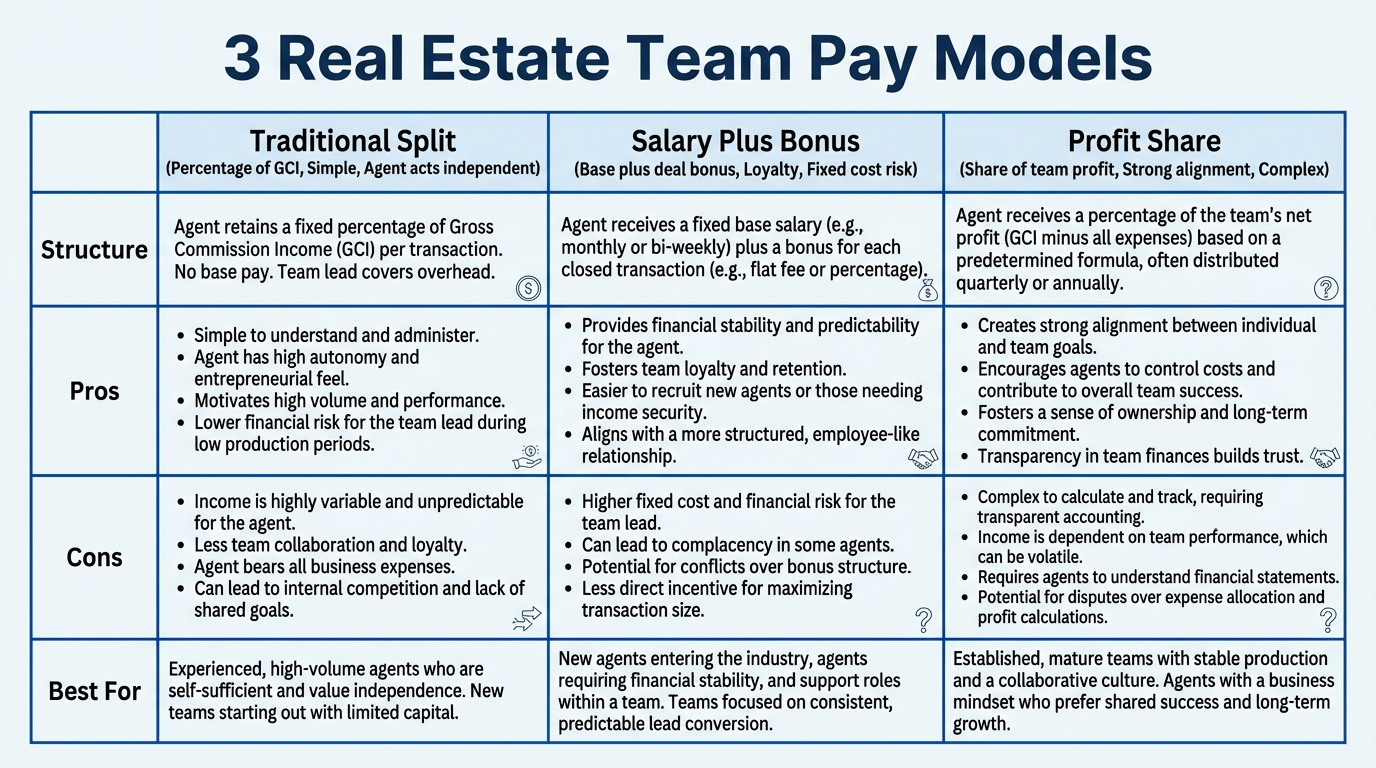
Compensation Models
Transaction Coordinator:
- Virtual/per-transaction: $300-$500 per transaction
- Part-time salaried: $25,000-$35,000/year
- Full-time salaried: $40,000-$55,000/year
ISA:
- Base + per-shown-appointment bonus: $35,000-$50,000 base + $25-$75 per shown appointment
- Never commission on closed deals – too delayed, wrong incentive
Buyer’s Agent:
- Commission split: 40-50% to buyer’s agent on deals they close
- If leads are provided by the team, split is lower; if the agent generates their own leads, split is higher
Admin:
- Part-time: $15-$20/hour
- Full-time: $35,000-$45,000/year
Keep compensation simple until you have enough volume that complexity is worth managing. A transaction-based TC fee is the lowest-risk way to start.
The CRM as Team Infrastructure
A solo agent can survive with a disorganized CRM. A team cannot. When multiple people are touching the same leads and contacts, the CRM is the single source of truth. Without it, calls get duplicated, leads fall through cracks, and clients get conflicting information.
What your CRM needs to do for a team:
- Assign leads to specific team members with clear ownership
- Show every interaction log so anyone can pick up a conversation where it was left off
- Run automated sequences so leads are being touched even when no one is actively calling
- Surface pipeline metrics so you know which team member is performing and where leads are stalling
Before you bring on your first hire, make sure your CRM is clean and organized, your lead routing is set up, and your drip sequences are running. The CRM trains your new hire as much as you do.
If your current CRM doesn’t support team features, look at the best CRM options for real estate agents before hiring.
FAQ
How many transactions do I need to justify my first hire?
For a virtual TC at $400/transaction, you break even at roughly 2 transactions/month if your time is worth $50/hour. Most agents at that volume find the time savings alone justifies it – the ROI comes from what you do with the freed hours.
Should my team members have real estate licenses?
Your TC does not need a license for most transaction coordination tasks (varies by state – check with your broker). An ISA does not need a license for lead follow-up. A buyer’s agent must be licensed. Admin does not need a license.
How do I find a good TC?
Ask your brokerage for recommendations – many brokerages have preferred TCs. Real estate Facebook groups in your market are also a reliable source. Start with a virtual TC on a per-transaction basis to test fit before committing to a salary.
What’s the biggest mistake team leaders make?
Hiring before their systems are documented. If your transaction process, lead follow-up cadence, and CRM structure exist only in your head, every new hire has to learn from scratch and you become the bottleneck. Document before you hire.
How do I manage a team without becoming a full-time manager?
Keep the team small. A 3-person team with clear roles and a functional CRM requires 2-3 hours of management per week. The moment you feel like you’re managing more than producing, something in the structure is off – usually a hire who wasn’t ready or a role that wasn’t clearly defined.
The Bottom Line
Building a real estate team is not about getting big – it’s about getting leverage. The right hires in the right sequence free your time for the activities that actually generate revenue, so you can produce more without working more hours.
The sequence is almost always: document your systems, hire a TC, then hire based on where your growth is specifically constrained. And through all of it, your CRM is the operating system – keep it organized, keep it current, and make sure every hire knows how to use it.
Is Your Real Estate Business Leaking Revenue?
Most agents are losing deals they don’t even know they have. Find out exactly where your business is broken and get a custom plan to fix it.