⏱ 19 min read
Published March 30, 2026
AI for Real Estate Agents: 3 Areas With Real ROI Today
Last Updated: March 30, 2026
Every software company selling to real estate agents has slapped “AI” on their product. Most of it is a chatbot sitting on top of an automation that existed five years ago. Before you buy another tool or rebuild your stack around a buzzword, here’s what AI in real estate actually does – and what it doesn’t.
Key Takeaways
- Most “AI” tools in real estate are just automations with a chat interface – not true machine learning
- Real AI delivers ROI in three specific areas: instant lead response, behavioral scoring, and personalized content
- Speed-to-lead is the single highest-leverage place to deploy AI – the first agent to respond wins the majority of deals
- Behavioral AI tells you who in your database is ready to move before they raise their hand
- AI cannot replace relationships, trust, or your judgment – it handles the tasks that pull you away from those things
Table of Contents
- What AI Actually Does for Agents
- The 3 Areas Where AI Delivers Real ROI
- AI Lead Response: Why Speed Is the Game
- Behavioral AI: Knowing Who to Call Before They Tell You
- AI-Powered Content Personalization
- What AI Cannot Replace
- How to Evaluate AI Tools Without Getting Burned
- FAQ
What AI Actually Does for Agents
Let’s be direct: the majority of what gets marketed as “AI” to real estate agents is rule-based automation. If someone fills out a form, send this email. If they don’t open after three days, send a text. That’s a workflow. That’s been available in tools like Follow Up Boss and LionDesk for years. It’s useful – but calling it AI is a stretch.
True AI involves machine learning: systems that improve over time by analyzing patterns in data. In real estate, that means things like predictive lead scoring, natural language processing for instant responses, and dynamic content that adapts based on a contact’s behavior. These capabilities do exist in some platforms now – but you have to look past the marketing copy to find them.
The practical question isn’t “does this tool use AI?” The question is: does this tool make me more money or save me meaningful time? That’s the filter. Apply it ruthlessly.
The 3 Areas Where AI Delivers Real ROI
After cutting through the noise, real AI in real estate delivers measurable return in exactly three areas:
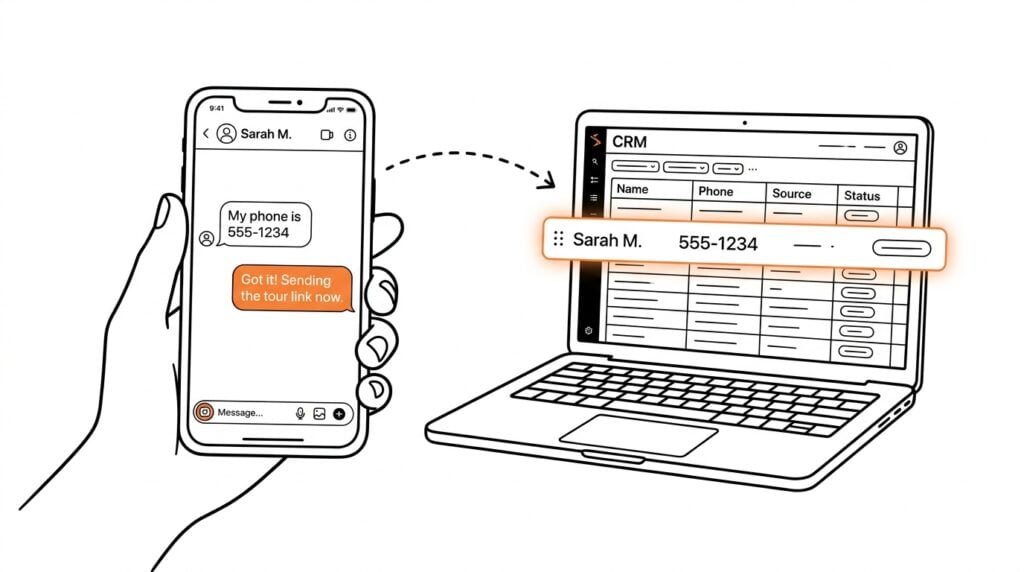
1. Instant lead response – AI that engages a new lead within 60 seconds, qualifies them through conversation, and routes the hot ones to your phone.
2. Behavioral signals – AI that monitors your database for activity patterns (website visits, email opens, link clicks, search behavior) and flags contacts who are showing buying or selling intent – before they tell you.
3. Content personalization – AI that tailors what you send to each contact based on what they’ve engaged with, where they are in their journey, and what’s relevant to their market.
Everything else is either a nice-to-have or repackaged automation. If an AI feature doesn’t fall into one of these three buckets, it’s probably not worth paying a premium for.
AI Lead Response: Why Speed Is the Game
The data on speed-to-lead is not subtle. Leads contacted within 5 minutes are 21x more likely to respond than those contacted after 30 minutes – and 100x more likely to connect than a lead reached after an hour (InsideSales.com / MIT Lead Response Management Study). Most agents respond in hours – or not at all.
AI changes this. A well-configured AI response system can engage a new lead within seconds, 24 hours a day. It can ask qualifying questions (“Are you looking to buy or sell? What’s your timeline? What neighborhoods interest you?”), capture the answers, and score the lead – all before you’ve looked at your phone.
This isn’t about replacing the agent-client relationship. It’s about making sure the relationship starts before your competitor calls. The agents who win on portal leads, paid social, and website inquiries are the ones who respond first. AI makes that structurally possible at scale.
If you’re building or evaluating a real estate follow-up system, instant AI lead response should be the first thing you configure – not the last.
Behavioral AI: Knowing Who to Call Before They Tell You
Your database is not a static list. It’s a living set of signals. Every email someone opens, every link they click, every page they revisit on your website – that’s data. Most agents ignore it completely. Behavioral AI doesn’t.
Predictive lead scoring takes all of that activity data and produces a signal: this person is warming up. Maybe they’ve opened your last four emails after not opening any for six months. Maybe they clicked the “what’s my home worth” link twice in three days. Maybe they visited your listings page and filtered by a specific price range.
Any one of those signals might be noise. Combined and weighted over time, they’re often a meaningful buying or selling signal. Behavioral AI surfaces those contacts and prioritizes them so you’re calling people who are ready to move – not just cycling through your database alphabetically.
This is the most powerful application of AI for agents with a mature database. If you haven’t reactivated your database in a while, start there first – read how to reactivate a dead real estate database before layering in behavioral tools. Pair this with an AI database reactivation system to turn your cold list into booked appointments.
Nurtured leads produce, on average, a 20% increase in sales opportunities (Demand Gen Report). Behavioral AI makes nurture intelligent – automatically identifying which contacts are warming up so your outreach lands at the right moment instead of on a fixed calendar.
AI-Powered Content Personalization
Generic mass emails get generic results. Most agents send the same market update to every contact in their database – the investor who owns six properties, the first-time buyer from three years ago who never closed, and the past client who sold and bought with you twice. Same email. Different people.
AI-powered personalization fixes this. It segments your database dynamically and adjusts what each contact receives based on their profile, their engagement history, and their likely intent. A contact who clicked on a “sell your home” article gets a different follow-up than one who clicked on a buyer’s guide.
This isn’t about making every email sound custom-written. It’s about relevance – sending the right message to the right person at the right time without manually managing a dozen different sequences. Done right, it lifts open rates, click rates, and most importantly, response rates.
For a deeper look at what makes email actually work in real estate, see real estate email marketing: what actually works for agents.
What AI Cannot Replace
Here’s the honest part of the article. AI cannot replace the conversation where a seller trusts you with the sale of the biggest asset they own. It cannot replace the judgment call about whether to recommend a price reduction. It cannot build the reputation that drives referrals from your sphere.
Relationships are built through consistent human contact. AI handles the volume problem – reaching hundreds of contacts consistently so the warm ones surface and the timing works. But the moment a lead says “I’m ready,” AI hands it back to you. What happens then is still entirely yours.
The agents who misuse AI are the ones who think it’s a substitute for showing up. It’s not. It’s infrastructure. It’s the system that makes sure nobody falls through the cracks so that when you do show up, you’re showing up with the right people at the right time. Agents using AI-powered CRM and automation tools see 29% higher sales productivity (Salesforce State of Sales Report) – not because AI closed deals, but because it kept the pipeline moving.
How to Evaluate AI Tools Without Getting Burned
Before you buy any tool marketed with “AI,” ask these four questions:
1. What specific outcome does this AI feature drive? If the vendor can’t answer in one sentence – skip it.
2. Is this machine learning or rule-based automation? There’s nothing wrong with automation. But you shouldn’t pay AI pricing for it.
3. Can I see it working on real data? Ask for a live demo on actual lead behavior, not a canned walkthrough.
4. What does setup look like? AI tools that require months of configuration before delivering value will collect dust. Look for platforms where the intelligence is pre-built, not something you construct yourself.
Most agents don’t need more tools. They need the right tool actually running. A real estate CRM with pre-built AI automations will outperform a powerful-but-empty platform every time.
Is Your Real Estate Business Leaking Revenue?
Most agents are losing deals they don’t even know they have. Find out exactly where your business is broken and get a custom plan to fix it.
FAQ
Is AI actually useful for real estate agents, or is it just marketing?
Both. There’s a lot of genuine marketing hype in this space – tools that call themselves AI when they’re just automated email sequences. But real AI (predictive scoring, instant conversational response, behavioral personalization) does deliver measurable ROI for agents willing to set it up correctly and actually use it.
Will AI eventually replace real estate agents?
No – at least not the parts that matter. AI can handle speed, scale, and data analysis. It cannot replace the trust, negotiation, and relationship management that make a great agent indispensable. What it will replace is agents who refuse to modernize their systems, because those agents will lose on speed and consistency to the ones who do.
What’s the best AI tool for real estate agents right now?
The best tool is the one you’ll actually use. Platforms built specifically for real estate – with pre-configured AI sequences, lead scoring, and follow-up built in – will outperform generic AI tools you have to configure from scratch. Look for tools that run on a foundation like GoHighLevel with real estate-specific logic already in place.
How much does AI for real estate cost?
It ranges from $100/month tools with basic automation labeled as AI to enterprise platforms at $500+/month. The cost isn’t the issue – the issue is whether the tool is actually running and doing what it’s supposed to do. An underused $400/month tool is more expensive than a well-configured $150/month platform.
Do I need to be tech-savvy to use AI in my real estate business?
Not anymore. The barrier has dropped significantly. Tools designed specifically for real estate agents – not for tech teams – are built to work out of the box. If you can use a smartphone, you can run AI-powered follow-up on your leads. The question is setup and onboarding, not technical skill.
The Bottom Line
AI for real estate agents is real, but most of what’s being sold isn’t. Focus on three things: instant lead response, behavioral signals from your database, and personalized content that speaks to where each contact actually is. Everything else is noise.
Is Your Real Estate Business Leaking Revenue?
Most agents are losing deals they don’t even know they have. Find out exactly where your business is broken and get a custom plan to fix it.