⏱ 17 min read
Published March 31, 2026
6 Steps to Write a Real Estate Business Plan That Actually Works
Last Updated: March 31, 2026
Most real estate agents write a business plan once – usually in January – and never look at it again. It ends up as a document full of revenue goals disconnected from any actual system for hitting them. A real estate business plan only works if it connects your income target to specific daily behaviors, and if those behaviors are trackable inside your CRM. This guide skips the fluff and builds the plan backward from your number.
Key Takeaways
- Start with your income goal and reverse-engineer the transactions, leads, and contacts required to hit it
- Most agents need 5-10x more leads in their database than they think
- Your CRM is not separate from your business plan – it is the system that executes it
- A plan without a follow-up cadence is just arithmetic; the cadence is what converts contacts into closings
- Review your plan quarterly, not annually – markets shift, so should your plan
Table of Contents
- Start With Your Number
- Reverse-Engineer the Pipeline
- Define Your Lead Sources
- Build the Follow-Up System That Executes the Plan
- Set Your Weekly Metrics
- Quarterly Review Cadence
- FAQ
Start With Your Number
Before strategy, there is math. Every business plan starts with a target gross commission income (GCI) for the year. From there, everything else is derivable.
Step 1: Set your GCI target.
Pick a specific number – not a range. $150,000 is a target. “$100K to $200K” is not.
Step 2: Calculate transactions needed.
Divide your GCI target by your average commission per transaction. If your average deal nets $8,000 and your target is $160,000, you need 20 closed transactions.
Step 3: Calculate conversion rate.
If you close roughly 1 in 10 leads you work, you need 200 active leads to produce 20 closes. If your database-to-close rate is lower, adjust accordingly.
This is not a plan yet. It is the foundation. The plan is what you do to fill and work those 200 leads.
Reverse-Engineer the Pipeline
The most common mistake in real estate business planning is setting a transaction goal without mapping the pipeline that feeds it.
Here is a basic pipeline math framework:
- GCI target: $160,000
- Average commission per closing: $8,000
- Closings needed: 20
- Appointments-to-close rate: 50% – so you need 40 listing/buyer appointments
- Lead-to-appointment rate: 20% – so you need 200 working leads
- Database-to-working-lead rate: 30% – so you need 650+ contacts in your database
Most agents are surprised by that last number. A 500-person database sounds big until you realize a significant percentage are uncontactable, cold, or already past the buying/selling window. This is why real estate database management is not an optional cleanup task – it is central to hitting your number.
Define Your Lead Sources
Once you know how many leads you need, the next question is where they come from. Every agent’s mix is different, but most sustainable businesses draw from at least three sources:
Sphere of influence. Past clients, personal network, referrals. These should be your highest-converting leads. If your sphere is healthy and you have a consistent touch system, plan on this producing 40-60% of your business.
Online leads. Zillow, Realtor.com, Facebook ads, Google ads. Higher volume, lower conversion. Expect a much longer nurture cycle and a stronger need for real estate speed to lead automation.
Geographic farming. A defined neighborhood or ZIP code where you target every homeowner systematically. Lower immediate ROI but builds equity in a market over 12-24 months. See our real estate farming strategy for specifics.
Expired listings and FSBOs. Higher-intent leads who are already in selling mode. Requires scripted outreach and fast follow-up. See FSBO leads real estate and expired listing strategy.
For each source, assign a volume target and a conversion estimate. This tells you if your mix is realistic or if you’re planning to close 20 deals on 80 online leads with a 1% close rate.
Build the Follow-Up System That Executes the Plan

A business plan is a set of intentions. A follow-up system is what converts those intentions into revenue. Without automation, your plan depends on your discipline every single day – and discipline is not scalable.
For new leads: Every lead source should trigger an automatic response within minutes. Not hours. Research from InsideSales.com and MIT shows leads contacted within 5 minutes are 21x more likely to respond than those called after 30 minutes.
For warm leads: A real estate drip campaign keeps you present without requiring daily manual effort. Value-first content – market updates, neighborhood stats, buying/selling guides – builds trust during the long nurture period.
For past clients: Your highest-ROI database segment. 87% of real estate sales come from referrals or repeat clients (NAR, 2023). This group needs a dedicated track focused on check-ins, market updates, and soft referral asks – not generic lead nurture content.
Your CRM is the infrastructure that runs all of this. If your CRM can not separate past clients from cold leads, or fire different automated sequences to each, it is holding your business plan back. Pair this with an AI database reactivation system to turn your cold list into booked appointments.
Set Your Weekly Metrics
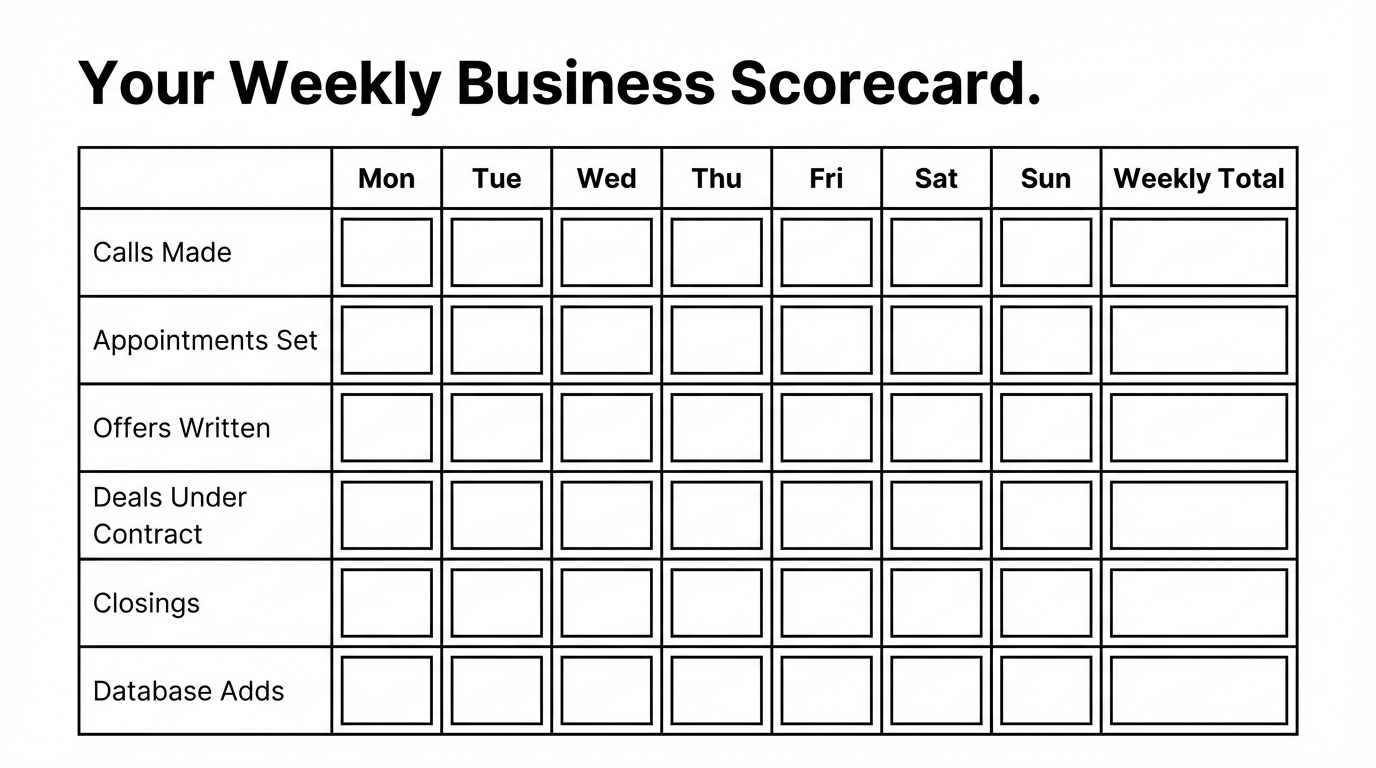
Annual goals create annual accountability – which means you find out in December that you missed. Weekly metrics create weekly feedback loops.
Core weekly metrics for most agents:
- New contacts added to database
- Lead follow-up attempts made (calls, texts, emails)
- Appointments set
- Active contracts in pipeline
If you do not know these numbers each week, you do not have a plan – you have a goal. Pull a weekly dashboard from your CRM every Monday morning. It takes five minutes and tells you whether your activities are on track to produce your number.
Real estate agent productivity research consistently shows that top producers are not necessarily working more hours – they are tracking the right metrics and adjusting based on data.
Quarterly Review Cadence
Review your plan every 90 days, not once at year-end. A quarterly review asks:
Are my transaction numbers on track? If you need 20 closings and have 3 in Q1, you need 17 in the remaining three quarters. Is your pipeline sized to deliver that?
Which lead sources are converting? Most agents discover mid-year that one channel is producing most of their business and others are underperforming. Reallocate time and budget accordingly.
Is my database growing? Track net new contacts added each quarter. A database that is not growing is a business that is not growing.
Is my follow-up system running? Check that drip sequences are active, that new leads are being entered promptly, and that past clients are receiving touches on schedule.
A business plan that does not get reviewed does not get executed. Block 90-minute calendar appointments at the start of each quarter labeled “Business Plan Review” and treat them like client appointments.
FAQ
How long should a real estate business plan be?
One page is enough for most agents. Your number, your pipeline math, your lead sources, your weekly activity targets, and your review schedule. The value is in the clarity and specificity, not the length.
Should I include marketing budget in my business plan?
Yes – allocate a percentage of your GCI target to lead generation expenses. Industry benchmarks typically put this at 10-15% of GCI. Know which sources you’re spending on and what return you expect.
What if I don’t have 12 months of data to calculate conversion rates?
Use industry averages as a starting point: online leads typically close at 1-3%, sphere/referral leads at 25-40%, farming leads at 2-5% over 12-24 months. Adjust as you build your own history.
How does a CRM factor into my business plan?
Your CRM is the execution layer of your business plan. It is where your lead sources feed in, where your drip campaigns run, and where your pipeline metrics live. A business plan without a CRM is a plan with no enforcement mechanism.
What’s the biggest mistake agents make in their business plan?
Setting a revenue goal without reverse-engineering the database size and daily activity required to hit it. The math usually shows you need significantly more contacts and more consistent follow-up than you currently have.
The Bottom Line
A real estate business plan is not a motivational document. It is a math problem: here is my income target, here is the pipeline required to produce it, here is the follow-up system that works the pipeline. Everything else is decoration.
Start with your number. Reverse-engineer the transactions, appointments, and database size required to hit it. Build a follow-up system that automates the repetitive touches so your manual effort goes to the conversations that close.
Is Your Real Estate Business Leaking Revenue?
Most agents are losing deals they don’t even know they have. Find out exactly where your business is broken and get a custom plan to fix it.