⏱ 20 min read
Published March 31, 2026
6 Proven Strategies to Turn Your Social Media Followers Into Leads
Last Updated: March 31, 2026
Social media followers are not leads. A 5,000-person Instagram following means nothing to your business until those people are in your CRM with a name, a phone number, and a follow-up sequence running. Most agents treat social media as a brand play and never build a system to convert the engagement into actual contacts. This post covers what content drives DMs and form fills, how to move social leads into your database, and how to automate the follow-up so no one falls through the cracks.
Key Takeaways
- Social media builds awareness; your CRM converts it to revenue – you need both
- The goal of every post is to drive one of three actions: DM, link click, or profile visit to bio link
- Lead magnets convert passive followers to database contacts faster than any other tactic
- Social leads go cold fast – speed of response matters as much as any other lead source
- Automated follow-up sequences for social leads are what separate agents who get ROI from social from agents who just get likes
Table of Contents
- The Gap Between Followers and Revenue
- What Content Drives DMs and Form Fills
- Lead Magnets That Work for Real Estate
- How to Move Social Leads Into Your CRM
- Setting Up Automated Follow-Up for Social Leads
- Which Platforms Are Worth Your Time
- FAQ
The Gap Between Followers and Revenue
Here’s the uncomfortable truth about social media for real estate agents: most of the agents with large followings make less money from social than agents with smaller followings who have a capture and follow-up system.
Followers are vanity. Contacts are business.
A follower can unfollow you, forget about you, or scroll past your content without ever taking action. A contact in your CRM – with their name, number, and a follow-up sequence running – is someone you can convert.
The shift in mindset is this: stop thinking about social media as a place to get exposure. Start thinking about it as a top-of-funnel that feeds your database. Every post, story, and reel has one job – move someone from passive viewer to active contact.
Only 2% of sales happen at first contact (Sales Insights Lab). The remaining 98% require follow-up. You can’t follow up with a follower. You can follow up with a contact in your CRM.
What Content Drives DMs and Form Fills
Not all content performs the same when it comes to generating leads. Aesthetic photos and motivational quotes get likes. These content types drive DMs and link clicks:
Market update posts. “Here’s what homes sold for in [Neighborhood] last month” with a simple data graphic. End with “Want the full report for your neighborhood? DM me ‘market’ and I’ll send it.” People who engage with this are interested in real estate data – they’re buyers, sellers, and investors.
Myth-busting content. “3 things buyers get wrong about interest rates right now” or “Why waiting for the market to crash is costing you money.” This content challenges beliefs and gets people commenting and DMing to ask questions or push back. Engagement = conversations = leads.
“Would you buy this?” posts. Share a listing with some quick numbers – price, rent estimate, neighborhood stats – and ask followers if they’d buy it. Investors and curious buyers respond. That’s your opening.
Before/after content. Renovation transformations, home staging results, or “what $400k looks like in [City] vs. [Other City].” High shareability, which brings in new followers who can then become contacts.
Question-based stories. Instagram and Facebook story polls and question boxes are underused. “Are you planning to buy in the next 12 months?” and “What’s your biggest concern about buying right now?” generate responses that are essentially pre-qualified lead conversations sitting in your DMs.
Local content with a hook. “The 3 blocks in [Neighborhood] where prices are up 12% this year” performs better than generic market commentary because it’s specific. Specific content attracts people who are actually connected to that area.
Lead Magnets That Work for Real Estate
A lead magnet is a free resource you offer in exchange for an email or phone number. It’s the fastest way to convert passive followers into database contacts because you’re giving them something they actually want.
Lead magnets that convert well for real estate agents:
Neighborhood home value report. “Get a free report on what homes are selling for in [Neighborhood].” Simple form, email delivered automatically. Works especially well on homeowners who are curious about their home’s value without being ready to list.
First-time buyer guide. “The 10 things nobody tells first-time buyers in [City].” PDF download in exchange for name and email. This attracts buyers in the early research stage who won’t be ready for months but are exactly who you want in your long-term nurture sequence.
Investment property calculator or guide. “How to analyze a rental property in 15 minutes” or “What cash flow looks like on a $350k home in [City].” Attracts investors who are high-intent and often move faster than traditional buyers.
Market snapshot for a specific neighborhood. Instead of a city-wide report, get specific. “Download the current market stats for [Neighborhood]” converts better because it’s relevant to a narrower, more interested audience.
“Is now a good time to sell?” quiz or assessment. Five questions, immediate result, email required. This converts homeowners who are in the consideration phase and gives you a warm lead who’s told you they’re thinking about selling.
The key with any lead magnet: deliver it automatically and immediately. If someone fills out your form and waits two days for the thing you promised, you’ve already lost them. Set up an automated email that fires instantly on form submission.
How to Move Social Leads Into Your CRM
There are three ways social leads enter your database, and you want all three working simultaneously.
1. Bio link to a landing page with a form. Your Instagram bio link should go to a landing page – not your website homepage, not a Linktree with seven options. One page, one offer, one form. Whatever your primary lead magnet is lives here. Every post that references “link in bio” is driving traffic to this page.
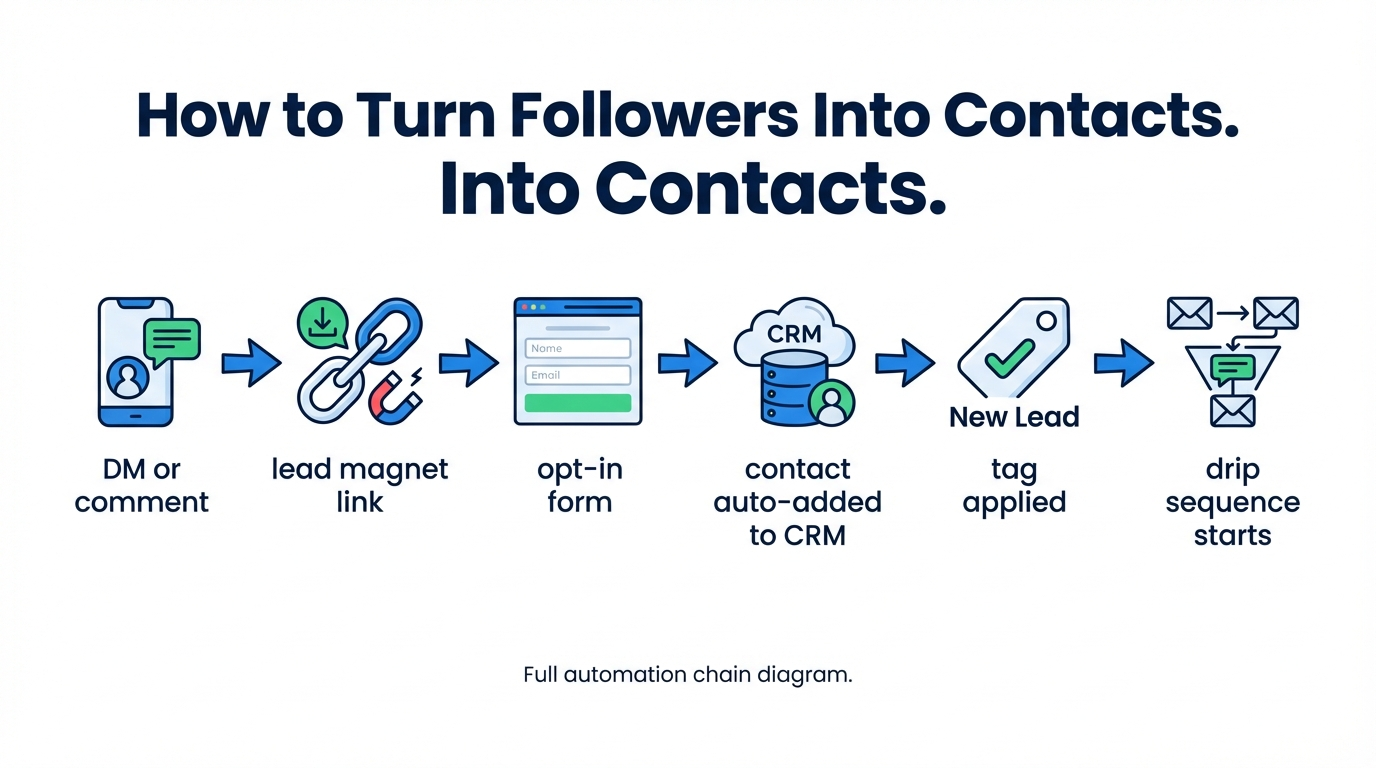
2. DM automation. Tools like ManyChat allow you to set up keyword triggers in Instagram and Facebook DMs. When someone comments “market” on a post or sends a DM with a specific word, an automated reply fires with the lead magnet and a form link. Their response captures their contact info. This is the fastest way to convert high-intent comments into database contacts without manual effort.
3. Manual DM conversations. When someone engages substantively – asks a real question, shares their situation, responds to a poll – that’s a warm conversation. Don’t send them a link. Have the conversation, then ask for their number or email to “send them something useful.” Most people will give it to you if the conversation was genuine.
Once you have their contact info, get them into your CRM immediately. Tag the source (Instagram, Facebook, etc.) and the lead magnet or post that drove them. This tells you which content is actually generating contacts vs. just generating engagement.
For details on building the follow-up structure those contacts flow into, see our real estate lead generation strategies guide and our post on real estate lead conversion.
Setting Up Automated Follow-Up for Social Leads
Social leads are different from paid leads in one key way: they already know who you are. They’ve seen your content. That means your follow-up can skip the cold introduction and get right to value delivery.
Leads contacted within 5 minutes are 21x more likely to respond (InsideSales.com). That stat applies to social leads too. When someone fills out a form from your social content, the automated follow-up should start immediately.
A basic social lead follow-up sequence:
- Immediately: Automated email delivers the lead magnet. Subject line confirms what they signed up for.
- Day 1: Automated text: “Hey [Name], this is [Agent] – I sent over the [lead magnet name] to your email. Let me know if you have any questions. Are you looking to [buy/sell] in the next 6 months or just keeping an eye on the market?” Simple, direct, asks a qualifying question.
- Day 3: Follow-up call or personalized video email if no response.
- Day 7: Value email – a market update or relevant content piece, not a pitch.
- Day 14: Check-in text or email. “Just wanted to make sure you got the report – any questions?”
- Day 30+: Move into your standard long-term nurture sequence.
Text messages have a 98% open rate vs. 20% for email (Gartner). For social leads – especially younger buyers who are on their phones constantly – text is often the faster path to a real conversation.
The entire sequence should be automated in your CRM. You add the contact, assign them to the “Social Lead” sequence, and the system handles the rest. Your only manual step is responding when someone actually replies.
For the specific text message scripts that work best at each stage, see our real estate text message scripts post.
Which Platforms Are Worth Your Time
You can’t be everywhere. Here’s where to focus:
Instagram – Best for agents in visual markets (major metros, luxury, resort markets). Stories and Reels get significant organic reach. DM automation works well here. If your ideal client is 28-45, Instagram is your primary platform.
Facebook – Still the highest-volume platform for real estate leads, especially in suburban and rural markets. Facebook Groups are particularly strong – joining or running a local neighborhood or community group puts you in front of highly local, homeowner-adjacent audiences.
YouTube – Highest long-term ROI but slowest to build. A video ranking on YouTube generates leads for years. “Moving to [City]” and “Living in [Neighborhood]” videos are consistent lead generators for agents who commit to it.
LinkedIn – Best for agents who work with corporate relocation or investor clients. Average user income skews higher. Less volume but higher quality leads for the right market.
TikTok – Fastest organic growth potential but younger demographic. Works well for buyer-focused education content. Not ideal as a primary lead gen platform for most agents but worth testing if you’re comfortable on video.
Pick two platforms and do them well. One for primary lead generation, one for secondary reach. Don’t spread yourself thin trying to be on all of them.
FAQ
How many followers do I need before social media generates real leads?
Fewer than you think. Agents with 500 highly engaged, locally relevant followers consistently outperform agents with 10,000 followers who built their audience with irrelevant content. Local specificity matters far more than follower count. Focus on attracting the right audience in your market, not the biggest audience overall.
Should I run paid ads on social media or focus on organic content first?
Get your organic content and capture system working first. Paid ads amplify what’s already working – if your lead magnet doesn’t convert organic traffic, it won’t convert paid traffic either. Once you have a landing page that converts and a follow-up sequence that works, paid ads are worth testing.
What should my bio link go to?
One focused landing page with your primary lead magnet and a simple form. Not your website homepage. Not a Linktree with ten options. One offer, one form, one conversion goal. You can always test different lead magnets by swapping the bio link.
How do I handle DMs from people who don’t want to give their contact info?
Have the conversation anyway. Some people aren’t ready to hand over their email but will talk in DMs for months. Keep showing up, answering their questions, and being helpful. When they’re ready to move, they’ll ask. The relationship is the asset, not the contact form submission.
How often should I post to generate consistent leads?
Consistency matters more than frequency. Posting three times a week every week outperforms posting seven times a week for two weeks and then going quiet for a month. Set a sustainable pace – even 3-4 posts per week with one story per day is enough to build and maintain an engaged audience.
The Bottom Line
Social media is a top-of-funnel tool, not a bottom-of-funnel tool. The agents who get real ROI from it are the ones who treat it as a database-building system, not a brand awareness exercise. Every post has a job to do. Every follower is a potential contact. Every DM is a potential lead conversation.
The mechanics are straightforward: create content that drives action, give people a reason to hand over their contact info, get them into your CRM immediately, and run an automated follow-up sequence that keeps you present until they’re ready to move.
Social media alone won’t build your business. Social media feeding a well-run CRM with automated follow-up will.
If you want to see how nurtureBEAST helps agents capture social leads and run automated follow-up sequences that convert, visit nurturebeast.com. Or take the quick quiz to find out where your lead generation is actually breaking down.