⏱ 18 min read
Published March 31, 2026
Real Estate ISA: 5 Steps to Hire and Set One Up Right
Last Updated: March 31, 2026
An ISA – inside sales agent – is one of the highest-leverage hires a real estate team can make. While agents are in showings, on listing appointments, and driving between properties, the ISA is on the phone working the database: following up with online leads, reactivating cold contacts, and booking appointments. The result is that agents spend more time in front of qualified prospects and less time chasing people who aren’t ready. This post covers what an ISA actually does, when you need one, and how to set them up to convert.
Key Takeaways
- An ISA focuses on lead follow-up and appointment setting so agents can focus on closings
- Most teams benefit from an ISA once they’re generating more leads than they can personally call within 5 minutes of submission
- The ISA lives inside your CRM – if your database is a mess, you’re setting them up to fail
- Compensation is typically base salary plus per-appointment bonus, not commission
- The ISA doesn’t close deals – they create the conversation. The agent closes.
Table of Contents
- What a Real Estate ISA Actually Does
- ISA vs. OSA: The Difference
- When You’re Ready to Hire an ISA
- How to Compensate an ISA
- Setting Up Your ISA for Success
- Scripts and Objections
- FAQ
What a Real Estate ISA Actually Does
The ISA role has one primary output: booked appointments. Everything else is in service of that.
Day-to-day responsibilities:
- Call new leads within minutes of form submission (the speed to lead window)
- Work the drip database: following up with leads who went quiet 30, 60, 90 days ago
- Re-engage past clients who haven’t been touched in over a year
- Qualify leads before passing them to an agent – confirming timeline, motivation, and financing readiness
- Log every interaction in the CRM with notes and next steps
- Manage the pipeline view so agents know exactly which appointments are booked and what’s in progress
The ISA is not doing social media, marketing, or transaction coordination. They are making calls and sending texts, all day.
A productive ISA typically makes 75-100 dials per day. That volume is impossible for a producing agent to maintain while also running showings and listing appointments. That’s the point.
ISA vs. OSA: The Difference
You may also hear the term OSA – outside sales agent. The distinction:
ISA (Inside Sales Agent): Works the phone and database. Calls leads, qualifies them, books appointments. Works from an office or remotely. Does not go to showings or listing appointments.
OSA (Outside Sales Agent): The producing agent who takes the appointments the ISA books. Goes to showings, runs listing consultations, negotiates contracts, closes deals.
Some large teams also use a buyer’s agent or listing specialist as the OSA, with the ISA feeding them a steady stream of booked appointments. On smaller teams, the lead agent acts as OSA while one ISA handles all inbound and follow-up.
When You’re Ready to Hire an ISA
The wrong time to hire an ISA is when you have no lead volume. ISAs need something to call.
Signs you’re ready:
- You’re generating 20+ new leads per month and can’t call all of them within 5 minutes of submission
- You have 300+ contacts in your database with no systematic follow-up
- Your conversion from lead to appointment is below 5% on online leads
- You’re losing track of leads in your pipeline because you don’t have time to log notes
- You’re in back-to-back appointments during the day and calls aren’t getting made until evening
Signs you’re not ready yet:
- You’re generating fewer than 10-15 leads per month
- Your CRM is disorganized – the ISA will just be calling a messy database
- You don’t have a defined lead qualification criteria for the ISA to use
Clean the CRM before you hire. An ISA working a database with 40% duplicates and no segmentation will spend half their time on dead contacts. See our guide on cleaning up your real estate CRM database first.
How to Compensate an ISA
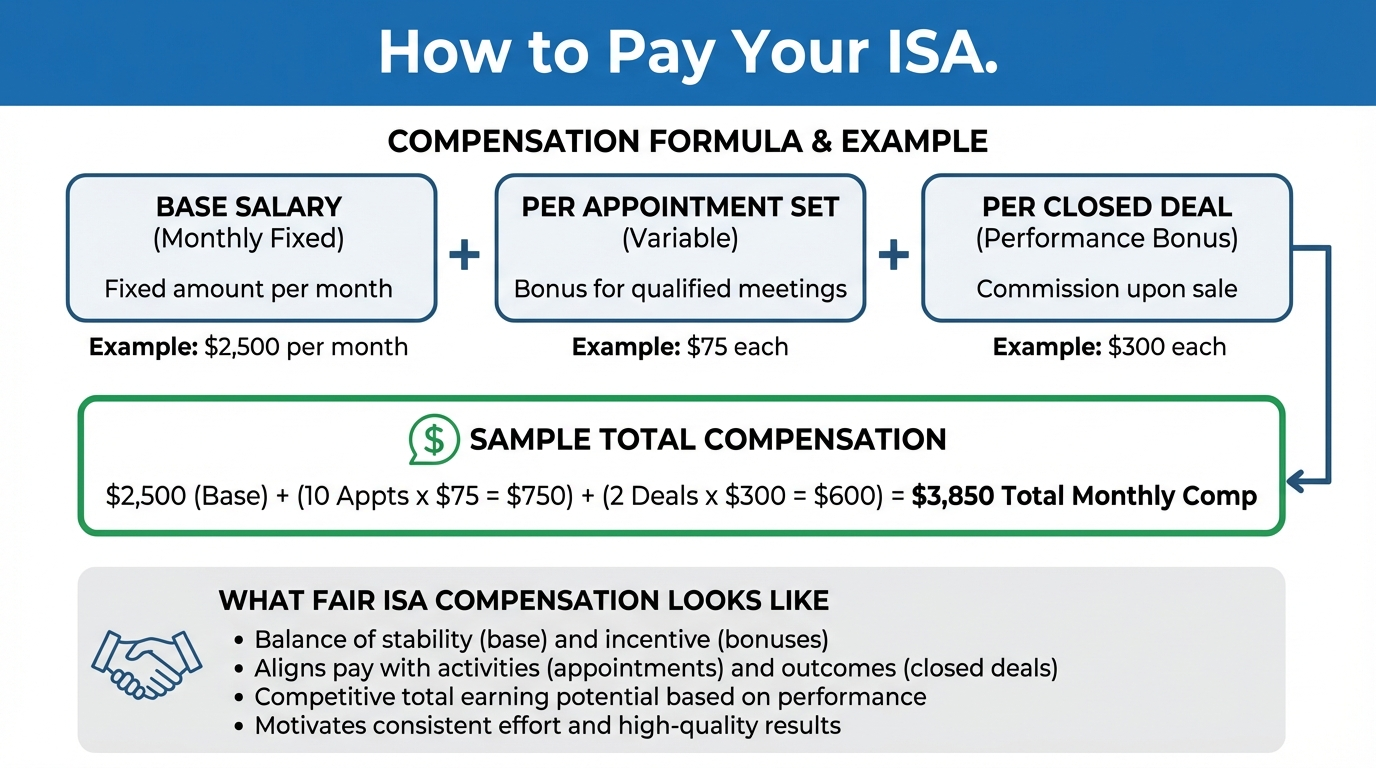
ISA compensation is typically a base salary plus a per-appointment bonus. Not commission on closed deals – that’s too delayed and creates misaligned incentives (booking any appointment to chase the commission vs. booking qualified appointments).
Typical structure:
- Base: $35,000 to $50,000 per year, depending on market and experience
- Bonus: $25 to $75 per appointment that shows (not just books – shows)
- Some teams add a smaller bonus for appointments that convert to contract
Paying per shown appointment keeps the ISA focused on quality over quantity. If they book unqualified appointments that agents waste time on, the bonus doesn’t pay out.
Avoid paying ISAs on closed GCI. The lag between appointment and close is too long, and they have no control over what happens in the transaction.
Setting Up Your ISA for Success

The biggest reason ISA hires fail is not the person – it’s the setup.
CRM access and training. The ISA needs full access to your CRM, including lead source tags, pipeline stages, and communication history. They should know at a glance where every lead came from, when they last received a touch, and what the next step is. If your CRM does not support this, the ISA’s effectiveness is capped.
A call script and objection guide. ISAs should not be winging it. Give them a core script for new leads, a script for reactivating cold contacts, and a guide for the five most common objections (“I’m just looking,” “I’m working with another agent,” “The market is too crazy right now”). Scripts are starting points – they adapt with experience.
Defined appointment criteria. The ISA needs to know exactly what qualifies a prospect for a booking. Is a buyer who’s 12 months out worth an agent’s time? What about a seller who wants to list but is underwater? Define the criteria so the ISA isn’t guessing.
Daily metrics review. Review dials, contacts reached, and appointments set each day. Not weekly – daily. ISA performance compounds fast in both directions: a bad habit caught on day three is easy to fix; the same habit after three weeks is a problem.
Building a real estate follow-up system that your ISA can plug into from day one is the fastest path to productivity.
Scripts and Objections
New lead – first call:
“Hey [Name], this is [ISA Name] calling from [Agent Name]’s team – you submitted a request about [property/area] on [source]. Did I catch you at an okay time? … Great. Quick question – are you thinking about buying in [area], or was this more exploratory? … Got it. And are you working with a specific timeline, or more open-ended?”
The goal is not to pitch. It is to ask questions and listen.
Cold lead – reactivation:
“Hi [Name], this is [ISA Name] – we connected a few months back when you were looking at buying/selling in [area]. I wanted to check in and see if your plans had changed at all. Totally understand if the timing wasn’t right – just wanted to make sure you had what you needed.”
Low-pressure, curiosity-driven. You’re not assuming they’re still looking – you’re checking.
Common objection – “I’m not ready yet”:
“That’s totally fine – most people I talk to aren’t ready right now. The goal isn’t to pressure you. Can I ask – is there a timeframe that makes more sense? Even a rough one?” Then book a follow-up call 30 or 60 days out. Get it in the calendar. Automating the booking step with calendar automation removes the back-and-forth that kills conversion.
FAQ
Is a real estate ISA the same as a virtual assistant?
No. A VA handles admin tasks: scheduling, paperwork, email management. An ISA is a sales role focused on making outbound calls, handling inbound leads, and booking appointments. The skill sets and compensation are different.
Can an ISA work part-time?
Yes, but call volume drops proportionally. A part-time ISA (20 hours/week) making 40-50 dials per day is still significantly more follow-up than most solo agents manage. Start part-time if lead volume doesn’t justify full-time yet.
How do I know if my ISA is performing well?
Track contact rate (% of dials that reach a person), appointment rate (% of contacts that book), and show rate (% of bookings that actually attend). Benchmarks vary by market, but 10-15% contact rate and 20-30% appointment rate from contacts are reasonable starting targets.
Should the ISA use their own phone number or the team’s?
Use a team number or a trackable VOIP line. This keeps all call records centralized, protects against the ISA leaving and taking call history with them, and allows the team to review recordings for coaching.
What CRM features does an ISA need?
Pipeline view with lead stage tracking, call/text logging, task reminders, and drip sequence management. If the ISA is manually entering every note into a spreadsheet, they’re losing time that should be on the phone.
The Bottom Line
An ISA is not a luxury for large teams. For any agent generating more leads than they can personally call in real time, an ISA is the unlock. They handle the volume, the follow-up, and the appointment-setting so agents can focus on what closes deals.
The setup matters as much as the hire. A clean CRM, defined qualification criteria, and a daily metrics review are what separate ISAs who book 20 appointments a month from ones who make a lot of calls with nothing to show for it.
Is Your Real Estate Business Leaking Revenue?
Most agents are losing deals they don’t even know they have. Find out exactly where your business is broken and get a custom plan to fix it.
Next step: Whether you hire an ISA or not, the follow-up still has to get sent. Give them a head start with these real estate follow-up email templates.